Bethlehem Historical Marker Photos


More like Bethlehem Historical Marker
Recommended Reviews - Bethlehem Historical Marker
Start your review...



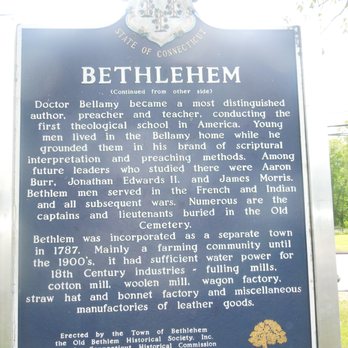
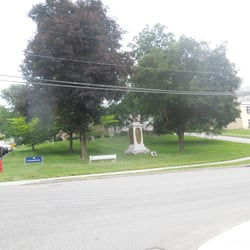
A fine sign! Clean, looks to be reasonably freshly painted, and adjacent to a parking lot. The town sign is in front of Bethlehem's town hall, perhaps familiar to those who go to the Christmas fair. There is parking (as noted) a small playground off to the left, a memorial bench for those who want to sit and... sign watch, perhaps? It's also connected via parking lot to the Bethlehem library. For those with dogs, mine felt this was a wonderful sniffing opportunity, as he is less impressed with reading about history then I am. read more

Ever wonder where wagons, straw hats, and bonnets were manufactured in the 1700's? How about Bethlehem, CT! I thought this two-sided marker was pretty interesting to read. Lots of information on the area's Indian history, colonial land sale to the European settlers, the military service of the early settlers (all the way back to the French and Indian War), and the area's industrial heritage. This is a two-sided marker from the CT Historical Commission in the familiar white lettering on a blue background. There are different inscriptions on both sides. The marker is in pretty good condition with extremely minor evidence of early peeling and chipping of the blue background paint. The white lettering is crisp and undamaged. The full inscription reads: The spring session of the 1703 General Assembly granted to the town of Woodbury the right to enlarge its bounds. Negotiations with the Indian inhabitants were successfully concluded and in 1710 a deed of sale, signed by Nunawague and five other chiefs, conveyed to Woodbury nearly eighteen thousand acres, known thereafter as the North Purchase. This included the present town of Bethlehem and parts of the later Judea, now Washington. Surveyed in 1723 and, after proprietors were granted their rights, divided into lots, it was opened for sale. Pioneers arrived in 1734, settling on the heights northeast of the present center. In 1738 young Joseph Bellamy was called to preach during "winter privileges". Separate "society privileges" were granted in October, 1739. Bellamy was requested to continue as pastor, and so remained until his death in 1790, as the settlers established their own Bethlem Church and school. Doctor Bellamy became a most distinguished author, preacher and teacher, conducting the first theological school in America. Young men lived in the Bellamy home while he grounded them in his brand of scriptural interpretation and preaching methods. Among future leaders who studied there were Aaron Burr, Jonathan Edwards II, and James Morris. Bethlem men served in the French and Indian and all subsequent wars. Numerous are the captains and lieutenants buried in the Old Cemetery. Bethlem was incorporated as a separate town in 1787. Mainly a farming community until the 1900s, it had sufficient water power for 18th Century industries - fulling mills, cotton mill, woolen mill, wagon factory, straw hat and bonnet factory and miscellaneous manufactories of leather goods. Erected 1976 by Town of Bethlehem, The Old Historical Bethlehem Society, Inc., Connecticut Historical Commission. read more

More info about Bethlehem Historical Marker
















Bethlehem Historical Marker - landmarks - Updated August 2026
Best of Bethlehem
People found Bethlehem Historical Marker by searching for…
Places to Take Pictures in Bethlehem, CT
Scenic Overlook in Bethlehem, CT
Religious Organizations in Bethlehem, CT
Public Services & Government in Bethlehem, CT
Historic Churches in Bethlehem, CT
Kids Field Trips in Bethlehem, CT
Places to Study in Bethlehem, CT
Historical Sites in Bethlehem, CT
Public Parking in Bethlehem, CT
Walking Trails in Bethlehem, CT
Browse Nearby
BEST of Bethlehem, Connecticut Restaurants near Bethlehem Historical Marker
BEST of Bethlehem, Connecticut Coffee near Bethlehem Historical Marker
BEST of Bethlehem, Connecticut Things to Do near Bethlehem Historical Marker
BEST of Bethlehem, Connecticut Parks near Bethlehem Historical Marker
BEST of Bethlehem, Connecticut Museums near Bethlehem Historical Marker
BEST of Bethlehem, Connecticut Breakfast near Bethlehem Historical Marker
BEST of Bethlehem, Connecticut Campgrounds near Bethlehem Historical Marker
BEST of Bethlehem, Connecticut Ski Resorts near Bethlehem Historical Marker
BEST of Bethlehem, Connecticut Hotels near Bethlehem Historical Marker


