Chipping Ongar Castle Photos
Recommended Reviews - Chipping Ongar Castle
Start your review...



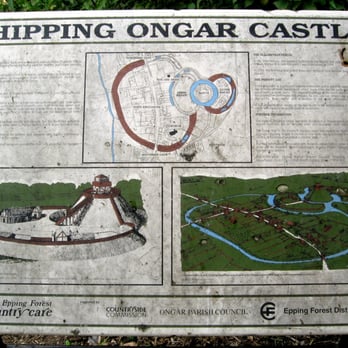
Anyone going to Ongar to see a traditional stone fortress is going to be sorely disappointed: not only are there no stone ramparts, but there may never have been any. However, from an historian's point of view, this is almost a textbook 'Motte and bailey' castle of the type erected in their hundreds by the Normans after the Conquest in 1066. The motte was a high earth mound on which a wooden fortress was built, often later replaced by stone, but it is not known if this happened here; the bailey was a defended outer enclosure, often with ramparts and a wooden fence, again often replaced in time with stone. At Chipping Ongar, the castle ramparts also extended to encircle the little Norman town. It was built at some point in the late 11th or early 12th centuries, supposedly by Richard de Lucy, a nobleman who held the manor in the mid 12th century. The keep was pulled down in 1539 and a brick building erected in its place by the owner William Morice, in which Elizabeth I was entertained in 1579. This building was itself pulled down in the 18th century. But both motte and the remains of the bailey survive here - including substantial parts of the moat - as well as a small part of the town enclosure. The motte in particular is still almost at its full height. The site is now heavily wooded, and the bailey contains modern houses and is in private ownership, but a footpath has been constructed around the whole area. (You'll get a better view in winter when the trees have shed their leaves). You can see the motte, ramparts, dithces and, at various points, the moats - these still have water and in some parts have been incorporated into gardens. The path skirts fields and is fairly uneven, with stiles and kissing gates, so is not suitable for wheelchairs or pushchairs, but otherwise makes for an undemanding historical walk of 10-15 minutes or so, with some good views over the surrounding countryside. read more

More info about Chipping Ongar Castle
off the High Street
Ongar CM5 9AB
United Kingdom
Directions
Hours
Other Amenities