Crowland Abbey Photos


Recommended Reviews - Crowland Abbey
Start your review...



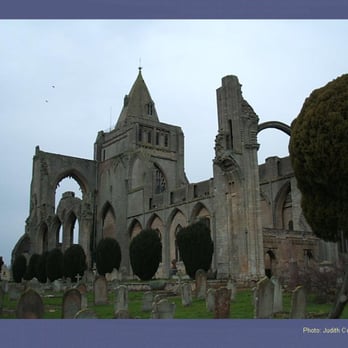
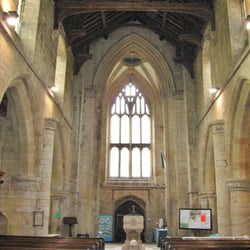
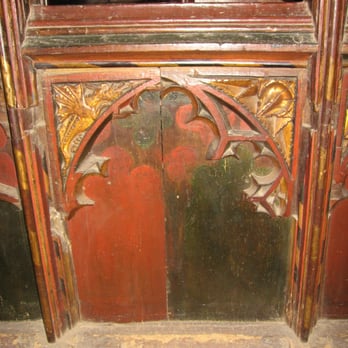
Crowland Abbey is a magnificent building now part church, part ruin, near Spalding in Lincolnshire, with an interesting but turbulent history. History The abbey was founded in memory of St Guthlac (673-714), a monk who founded a hermitage on the island. King Aethelbald of Mercia founded a monastery on the island in 716 in his honour, but it was destroyed in a Danish raid in 866. Refounded in the reign of King Edred (reigned 946-955), it was destroyed by fire in 1091, but rebuilt about twenty years later. Another fire burned the abbey again in 1170, after which it was rebuilt once more. Thereafter, it thrived until the dissoultion in 1539, by which time it had become one of the wealthiest abbeys in the country. The remains were fortified by the Royalists during the Civil War and damaged further by the Roundhead forces. The nave roof fell in 1720, the main south wall was taken down in 1744. The north aisle survived the troubles, however, as it had long functioned as the parish church, and still does today. The church The west front of the abbey is startling: the north aisle has a robust tower, built in the 12th-15th centuries, next to the remains of the great west front of the nave, all niches and statues. Above the former west door is a superb 14th century quatrefoil carving with images of the life of St Guthlac. Looking along the length of the former nave, the view is framed by the delicate remains of the Romanesque Crossing arch. To the south of the west front, fragmentary remains of the original west end of c. 1165, include some fine blind arcading. Inside, the former aisle is impressive. It was remodelled in the 15th century and has superb vaulting, as well as a magnificent panelled tower arch. Fittings and furnishings are of great interest. The early 15th century chancel screen has panels decorated with images of angels, dragons, flowers, fish and one with Guthlac in his boat. Above is a lovely ceiling boss of a Green Man. There is an octagonal 15th century font, and the tower arch has a large stoup incorprating a 12th century drum font under a cusped arch. Close by are two interesting tomb stones: one, very small, is ascribed to enclosing a crusader's heart, but is more likely to be Saxon; the other is to the mason William de Wermington, (d. 1427) depicting him holding his compasses and set square. Today, the church hosts regular services in the Anglo-Catholic tradition. read more




18 years ago
Crowland lies on the southern border of Lincolnshire and is famous for medieval Crowland Abbey and the curious triangular bridge. Crowland Abbey is believed to have been founded in 716 to commemorate the place on an island in the fen where St Guthlac lived. The present church is part of that built by Abbott Henry and partly remodelled by Abbot Radulphus in the thirteenth century. The name Croyland Abbey needs some explanation, for it refers, not to a monastery, but to the building that is the Parish Church in the town of Crowland, Lincolnshire. There was once an abbey here, but it ceased to exist in A.D. 1539, when Henry VIII's government had it closed down. Before 1539 Croyland was the largest monastery in Lincolnshire and one of the most important monasteries in England. It had a large and beautiful church. The nave of this church still stands as a picturesque ruin. What is today known as Croyland Abbey was only the north aisle of the old abbey church. This north aisle was saved from destruction because it was in use as the church of the townspeople well before 1539. As the town of Croyland grew up beside the abbey, the monks eventually allowed the north aisle to be walled off from the rest of the abbey church in order that the monks and the townspeople could each carry out their distinct patterns of prayer without the one group disturbing the other. Although popularly known as Croyland Abbey, the proper name for this church is the Church of the Blessed Virgin Mary, Saint Bartholomew, and Saint Guthlac. The first abbot (in Ethelbald's reign) is said to have been Kenulph, a monk of Evesham; and one of the most notable was Ingulphus, who ruled from 1075 to 1109, and whose pseudo-chronicle was long considered the chief authority for the history of the abbey, though it is now acknowledged to be a compilation of the fifteenth century. At the time of the Dissolution the abbot was John Welles, or Bridges, who with his twenty-seven monks subscribed to the Royal Supremacy in 1534, and five years later surrendered his house to the king. The revenue of the abbey at this time has been variously estimated at 1083 and 1217 pounds. The site and buildings were granted in Edward VI's reign to Edward Lord Clinton, and afterwards came into the possession of the Hunter family. The remains of the abbey were fortified by the Royalists in 1643, and besieged and taken by Cromwell in May of that year. The abbey church comprised a nave of nine bays with aisles, 183 feet long by 87 wide, an apsidal choir of five bays 90 feet long, a central tower and detached bell-tower at the east end. The existing remains consist of the north aisle, still used (as it was from the earliest times) as the parish church; the west front, the lower (twelfth century) and the upper part (fourteenth century) elaborately decorated with arcading and statues, it is thought in imitation of Wells cathedral; and a few piers and arches of the nave. Much careful restoration and repair has been carried out since 1860, under Sir Gilbert Scott, Mr. J.L. Pearson and others. The word Croyland, which tends to be used today only when speaking of the abbey or its church building, is the older spelling of the word Crowland. Apart from reminding us of this older spelling, the word Croyland does not make us think that the name for this place has something to do with crows, rooks, or jackdaws. Although there are a large number of these birds living in the trees of the churchyard that surrounds Croyland Abbey, the most likely meaning of Croyland or Crowland is not land of the crows, but marshland. The abbey at Crowland dates to the early 8th century, though its roots go back even further. Legend tells that the island of Crowland was chosen by St. Guthlac as the site for his hermit's cell. Guthlac was a young man who turned away from the world and sought a life of contemplation. He arrived at Crowland on St. Bartholomew's Day, 699 AD, and he dedicated his cell to that saint. At that time Crowland was literally an island, rising up out of the fens. It must have been a desolate spot in the 8th century - even the name suggests that; Crowland stems from Old English for wild land. (The marshes) Over time the hermit's reputation for holiness grew, and people began to seek him out. Among his supporters was Aethelbald, a claimant to the throne of the kingdom of Mercia. Guthlac prophesied that Aethelbald would one day gain the throne, and the nobleman swore that if the hermit were proved correct he would found a monastery in Guthlac's honour. Sure enough, Aethelbald became king of Mercia, and on St. Bartholomew's Day 716 AD, two years after Guthlac's death, Aethelbald founded Crowland Abbey. The abbey suffered under the Danish depredations of the following two centuries; in 870 a Danish attack surprised the monks at prayer, the abbot was killed and the buildings burned to the ground. Much of the abbey was restored by Turketyl, abbot in the mid read more