Two Joaquin Miler trails diverged in the woods. I chose the one less taken. That made all the…read moredifference.
The name Joaquin Miller, a one-time pony express rider, gold miner, judge, teacher, ex-lawyer, and critically praised poet of the American West, is closely connected to Oakland, California, where MIller lived for many years. As is the case with Jack London's former ranch near Glen Ellen, part of Miller's tree-filled estate ended up being preserved as a park. It grew over time to 500 acres of open space and trails, making it a popular destination for local residents and visitors, for whom the park is a welcome breath of fresh air: http://www.yelp.com/biz/joaquin-miller-park-oakland. It's an inspiring story of how local activists and boosters worked (and still work) to protect the land from private development. The result is a beautiful public space mere miles from one of America's most densely populated and culturally vibrant urban areas.
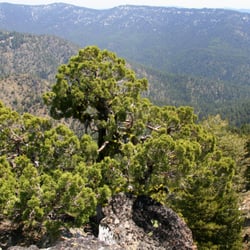
While it certainly has lots of trees in common, the Joaquin Miller trail in Eastern Oregon is a different kind of outdoor experience entirely. It's located in the rugged and (arguably) remote Strawberry Mountain Wilderness, about a 45 minute drive from Canyon City, where Miller worked as a lawyer and judge during the Oregon gold rush of the 1860s. Over the course of about 6 miles, the trail leads from a modest dirt and gravel parking area into a valley filled with rare old-growth Ponderosa pines. It then meanders, steeply at times, to the jagged crest of Strawberry Ridge, past cascading mountain streams, and offers hikers and equestrians spacious views of snow-covered peaks, rocky ridgelines, and dense forests.
That's about it.
This is not a Yosemite kind of place, filled with glamorous granite cliffs and photogenic falling water. It's quiet as hell, though, and extremely beautiful in a simple, unadorned, and unaffected way. Old growth ponderosas don't wow you like a coastal redwood, red cedar, or douglas fir, and Strawberry Ridge is barren, windswept, and patched with snow well into May and June. But there's something startling about the place that is hard to put into words or capture with digital pixels.
It's never easy to put a price on solitude. One shouldn't even try. The reason wilderness areas like Strawberry Mountain exist is to make sure that people don't start calculating its potential real estate value in dollar-denominated terms.
So what was it worth, then, to me?
Well ... for four long and sometimes arduous hours, I wandered in the footsteps of Joaquim Miller's namesake trail, past orange-covered trees and snowmelting streams, up stone-covered mountain switchbacks and through dense stands of trees. I was completely alone in a vast open space with only my thoughts and backpack to keep me company. Sun and clouds kept the temperature mild, even above 7000 ft on the snow-covered ridgeline. At the top, someone had hung a pair of binoculars and a half-empty bottle of whiskey from a low tree branch that was protected from the elements. A nice thought, but I wasn't in the mood for that sort of a drink.
Look, you don't just stumble upon a trail like this. You seek it out, like I did, because of an inarticulate but insistent inner need. A Forest Service map and compass sure help, but otherwise the trail is quite clear if unsigned most of the way. There's just not much foot or hoof traffic out here except maybe in peak summer months. It's very well maintained with minimal treefall that is cleared away in late spring. You feel "lost" without actually being lost. That's not always easy to pull off.
A single winding path in an ocean of pine, stone, and snow. Just you and lots of wilderness close enough to make it a short day trip.That's what this particular excursion is all about. Nothing more than that.
But somehow, for me at least, that was enough. Enough to make all the difference in the world. You don't need to be a famous poet like Joaquin Miller to figure that out. So just do it. Show up and see for yourself.
The trail will do the work for you.