Cancel

    Open app

    Search

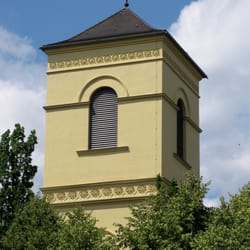
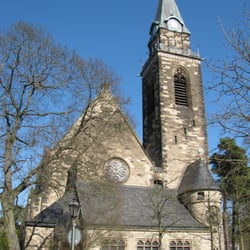
    Die Kapelle im Berliner Olympiastadion

    5.0 (1 review)

    Die Kapelle im Berliner Olympiastadion Photos

    Die Kapelle im Berliner Olympiastadion Reviews in Other Languages

    Verify this business for free

    Get access to customer & competitor insights.

    Verify this business

    American Church in Berlin - American Church in Berlin

    American Church in Berlin

    4.5(2 reviews)
    8.6 kmSchöneberg

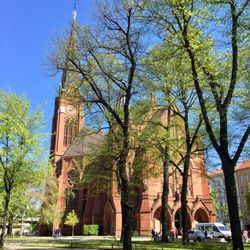
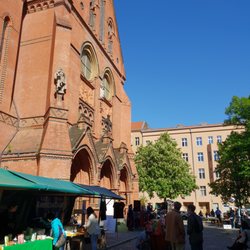
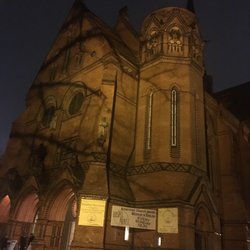
    The American Church in Berlin has its roots in the work of the German-American American Methodist…read moreEpiscopal (ME) missionary preacher Ludwig Nippert. He began worship in English in the large hall of his apartment in Klosterstrasse in January 1859. Worship moved to a purpose built chapel in Junkerstrasse in 1880, and in 1903 a permanent church was erected in Nollendorfplatz. This was closed (and the pastor asked to leave Germany) in 1941 and the building was destroyed during an air-raid in 1943. The post war history saw the church split into a more distinctly Lutheran church in 1955, which reassumed the ecumenical and non-denominational mantle of the American Church in 1987. Worship moved to current building in 2002 which was purchased as a permanent home in 2007. The Church engages in a wide range of community outreach. There is a more traditional Sunday morning service at 11am with a more informal Gospel service in the afternoon. I've been attending on my visits to Berlin for around 7 years and found it friendly and welcoming.

    American Church is one of the gorgeous buildings in the Bülowkiez, it hard to miss. The…read morecongregation can trace back to the 19th century, its original Church was built in Nollendorfplatz, later was destroyed by bombing in 1944. But the congregation continued their in others churches in South Berlin. Till 2002, it moved to the current location in Dennewitzplatz. Although the church is closed most of the time, its architecture style is still quite charming, it attracts many visitors. Next to the church is one of the most popular park - Park am Gleisdreieck, great to have a walk there.

    Photos
    American Church in Berlin - American Church in Berlin

    American Church in Berlin

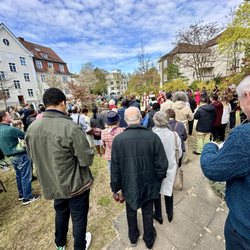
    American Church in Berlin - Promo event on Sunday

    Promo event on Sunday

    American Church in Berlin

    See all

    Kaiser-Wilhelm-Gedächtniskirche - Des Kaisers Kirche über dem Weihnachtsmarkt am Breitscheidplatz Heiligabend 2025

    Kaiser-Wilhelm-Gedächtniskirche

    4.2(81 reviews)
    6.3 kmWilmersdorf

    The Kaiser Wilhelm Memorial Church was heavily bombed towards the end of war. What's left, is a…read moreliving memorial to the violence and destruction that the allies wrought upon this city. This church was a casualty but also a focal point for Berliners to rebuild. Sadly, when it comes to churches, everyone has their own opinion... which is why today, the ruins stand as a testimony to the destruction of the Second World War. But! The citizens did build a beautiful Kirche next to the ruins. The discussions are ongoing, on the next phase of the rebuild. Some eighty-five years after the end of the fighting. See the many, many photos of both the New, and old Kaiser-Wilhelm-Gedächtniskirche. The new octagon sanctuary is magnificent! May I suggest you plan your visit around enjoying its beauty, splendor and peaceful solitude. You'll thank me later.

    This is a review of the buildings and their setting alone; I'm not reviewing the church as a…read moreworshiping, political, or theological body. If you visit Berlin, you must visit the Kaiser Wilhelm Memorial Church. The old church was built in the 1890s and largely destroyed by Allied bombing in 1943 during World War II. Like St. Nicholas Church in Hamburg, the ruins of the old church have been preserved as both a memorial and a statement against war and its devastating effects on society. Locally, it's referred to as The Hollow Tooth. The ruins are striking from a distance--especially the damaged spire--but they have removed the other parts of the church at very right angles so that when you're standing right next it, it doesn't feel like the result of bombing but, rather, construction. The new church's horrid bell tower and main building itself being right next to the old church (on either side) doesn't help either. Inside the old church, right beneath spire, there are informational panels about the history and destruction of the church. There are also three important artifacts: a damaged statue and two crosses. The statue is of Jesus, and it used to be on the main altar of the church before it was destroyed. The first cross is made of nails that came directly from the roof of Coventry Cathedral in England, which was damaged by German bombing in 1940; there's so much symbology, both secular and religious, in the fact that the German damage to an British church became a gift of peace to a German church damaged by British bombs. The second cross is an icon donated by the Russian Orthodox Church, also highly theologically charged, as Soviet forces obliterated large eastern portions of the city (and raped scores of German women) during the Battle of Berlin, which ended the war in Europe but also led to the partition of the city between east and west and further untold suffering of its civilian population; in my mind, this cross is less an expression of pure solidarity among nations and more solidarity among different sects of Christianity, as the Soviet Union was officially and atheist country that was virulently and violently anti-religious, and it actively repressed the Russian Orthodox Church and all other churches. (One of my great uncles [probably technically a cousin] was a Jesuit priest who survived being sent to the labor camps in Siberia.) From the outside, the new church is only interesting because of its scale. A totally random visitor might ask Why did they build such a huge boxy glass thing right next to this old ruin, and what's inside? When I first went inside, though, it was one of the most striking transitions I've ever experienced, and I've been to many churches. The stained-glass windows comprise these tiny square panes, which you can see from the outside but which look like plain glass blocks rather than beautiful liturgical art. And maybe that's the point; Jesus didn't come as a conquering king but as the child of poor family. What looks ugly and plain from the outside is breathtaking inside. It's a good reminder for all of us, especially those of educated in Jesuit institutions, to find God in all things, no matter how off-putting or insignificant-seeming. The floor tile is also beautiful and really well done. Almost everything about the interior of the new church is interesting at first and even better when you've spent some time looking at it. The old and new churches have a prominent location on the Kurfürstendamm, a huge street with lots of shops in Breitscheidplatz, south of the world-famous zoo. When the city was still divided, this was Berlin's city center, but within all of reunited Berlin, it's part of the Zoo Quarter, which is in the western part of the city. It still feels important, but I can imagine that especially at the height of the Cold War the damaged church spire was a constant reminder of what could happen again at any moment. As it's easy to imagine, damaged buildings require a great deal of maintenance so that they don't collapse completely. In another sign of former enemies reconciling, one of the champions of raising money to maintain the old church's structural integrity was Charles Jeffrey Gray, a former British bomber pilot who flew bombing raids over Berlin during World War II.

    Photos
    Kaiser-Wilhelm-Gedächtniskirche
    Kaiser-Wilhelm-Gedächtniskirche
    Kaiser-Wilhelm-Gedächtniskirche

    See all

    St. Nikolai-Kirche

    St. Nikolai-Kirche

    4.6(5 reviews)
    3.7 kmSpandau

    Oldest church in Berlin. Amazed by its impressive spires, stone walls, and cobblestone road.read more

    St Nickolai Kirche is the oldest surviving building in Spandau, prettily located close to the…read more"Aldstadt Spandau" U-bahn station. We visited Spandau on the recommendation of our guide book, which described the old town as having survived better than most in the area. This turned out to have been a little optimistic, as the old town has been heavily rebuilt and contains some large department stores, so - although pedestrianised - the atmosphere of most of it is definitely not historic. The area around the church, however, does contain a few half-timbered buildings and the square on which the church located is delightful. The church itself was founded in 1239, but the present building dates from a rebuilding in 1370, probably completed around the end of the 14th century. The tower was added in 1467-8, but renewed in 1744 (after a fire in 1740), and completely rebuilt again after another fire, caused by Allied bombing in 1944. The church was also attacked during the Napoleonic Wars (see the cannon-ball lodged in its wall), but restored in 1839, and again after World War II in 1949. A further restoration in 1989 restored the tower to its pre-War appearance. The church is constructed of brick, and consists of an aisled nave and apsed chancel with an ambulatory. The interior is largely whitewashed, better to display the brick structure, and particularly the attractive ribbed vaulting. Furnishings of note include the bronze font (1398), the magnificent Renaissance alter-piece (1582), and a crucifixion group dating from the early 16th century. The magnificent late-17th century baroque pulpit was originally in the chapel of the City Palace in Potsdam: it was transferred to St John's church in 1751, and moved to the St Nickolai Kirche in 1903. The walls are hung with life-sized portraits of several former ministers from the 16th century onwards, and there are some fine memorial slabs from the 16th to 18th centuries. The church holds regular services and is also a venue for concerts.

    Photos
    St. Nikolai-Kirche
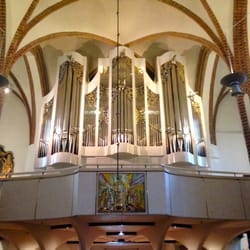
    St. Nikolai-Kirche - Organ, St Nikolai-Kirche, Spandau

    Organ, St Nikolai-Kirche, Spandau

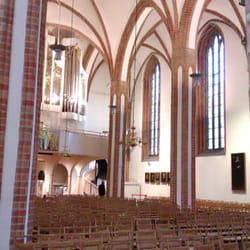
    St. Nikolai-Kirche - Nave looking towards the west end, St Nikolai-Kirche, Spandau

    See all

    Nave looking towards the west end, St Nikolai-Kirche, Spandau

    Die Kapelle im Berliner Olympiastadion - churches - Updated September 2026

    Loading...
    Loading...
    Loading...