The Ponte da Arrabida, or Arrabida Bridge,
is a classic…read morecase of "less is more." In Portugal's second city, this principal bridge is not at all about playing second fiddle to the Ponte 25 de Abril in Lisbon. It's a case of exactly what the situation called for.
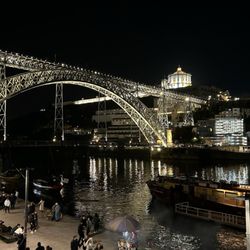
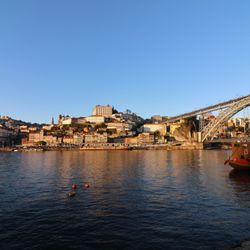
Porto, and its twin city of Vila Nova de Gaia, are separated by the Rio Douro coming in from the Atlantic. It does not make for a harbor, but it is dotted with boats carrying port wine and some personal craft. Even further upstream from the Atlantic is the city's most well-known bridge - the Ponte Dom Luis - which is located right in the historic center and was designed by Gustave Eiffel. They made a bold move whereby its principal task became to carry the newer Metro do Porto between the twin cities. Pedestrians are able to walk across on both sides of it. It is considered the city's iconic bridge.
As Porto became a larger and more modern city, more roads and bridges were needed. The main motorway from the north going south to reach Lisbon obviously goes through the Porto area, but it does not go through the center. Rather, it feeds its ring road. The ring road proceeds to cross the Douro River twice, both here, close to the Atlantic, and further east and upstream on the lesser known Ponte do Freixo.
The Ponte da Arrabida, which opened in 1963, was the solution to carry the western side of the bypass and facilitate traveling south to and from Lisbon. It also held a record, with it being the largest single span reinforced concrete arch bridge in the world at its inception. They kept this project local, and it was both designed and built by the Portuguese.
Lisbon's Ponte 25 de Abril figures prominently as a notable point of reference when anywhere near its waterfront. That is not the case with this bridge. That's because most of the touristic and civic activity in Porto is upstream near its historic waterfront called the Ribeira District. From there, you might notice the Ponte da Arrabida in the distance downstream and closer to the mouth of the Douro as it meets the Atlantic. That said, many tourists might never use it, nor even go near it.
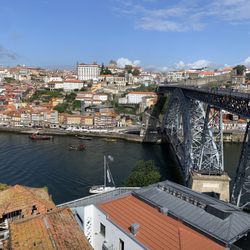
I prefer to stay on the south shore of this metro area, and have thus become both familiar with both the Arrabida and the historic Dom Luis bridges. The Ponte da Arrabida crosses the Douro at a fairly high elevation, springing from two promontories on both sides of the river, and with the river being about 230 feet down below. It carries 3 lanes of traffic in each direction and has sidewalks for foot traffic providing stunning views on both sides. While the Metro travels on Ponte Dom Luis, the local transit system - STCP - ties into the south shore via the Arrabida Bridge using buses. They practically careen down Porto's streets after leaving the Casa da Musica Metro station, cross this bridge, and first stop at Arrabida Shopping, from which about three bus lines then diverge to service different areas of a Vila Nova de Gaia. A new and much needed Metro line (Linha Rubi) is in the works, but will use a much more slender and similarly styled bridge parallel to the Arrabida to carry it over the river.
Lisbon's big harbor bridge might be a workhorse, but, it might function in a more isolated manner in relation to its context. On the other hand, the Ponte da Arrabida seems better integrated with its neighborhoods adjacent to the river. On the north shore in Porto, double-decker city bus 500, popular with tourists, follows the waterfront next to and under the bridge, giving many views of it as it heads out to affluent Foz do Douro and its working port at Matosinhos. Inboard from the bridge on the south shore is the Cais de Gaia, where people enjoy seafood restaurants and taste port wine from the many wine lodges. On the western side of the bridge toward the ocean is the increasingly popular small fishing village of Sao Pedro de Afurada, where people also go to eat fresh fish. One can also go to the beach in Sao Pedro da Afurada and always have this bridge a ways off in the distance as a backdrop.
One could easily become very fond of the Ponte da Arrabida. If staying on the south shore or needing to move between Porto and Vila Nova de Gaia by car frequently, it may become a part of your routine. Its look is simple and elegant and, despite being somewhat dated, it still continues to look imposing and dignified. There are 4 upward protuding but truncated Art Deco-like towers on each side of ends of its big arch which used to have elevators in them. The elevators have been decommissioned. The only reason I may not be giving the Ponte da Arrabida 5 stars is because it is not the well known engineering marvel that is Lisbon's harbor bridge. However, if you keep using it and studying it, you'll find that there's a lot to like about it.