Cancel

    Open app

    Search

    Ft Supply Historic Site Photos

    More like Ft Supply Historic Site

    Recommended Reviews - Ft Supply Historic Site

    Your trust is our priority, so businesses can't pay to alter or remove their reviews. Learn more about reviews.
    Yelp app icon
    Browse more easily on the app
    Review Feed Illustration

    2 years ago

    Helpful 1
    Thanks 1
    Love this 1
    Oh no 0
    Photo of Anna R.
    668
    327
    4068

    6 years ago

    Helpful 3
    Thanks 0
    Love this 2
    Oh no 0

    Verify this business for free

    Get access to customer & competitor insights.

    Verify this business

    Cast Away Intersection - Cast Away Intersection

    Cast Away Intersection

    5.0(1 review)
    81.6 mi

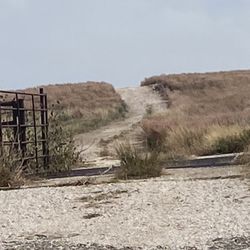
    Round number reviews should be something special. My round number 16000 was the Grand Saline Salt…read morePalace and 16100 was the Kimbell Art Museum in Fort Worth. So here we are at 16200 and it's... an intersection. What? Well, my friend. This is a special intersection. At the end of the Tom Hanks movie Cast Away, we see the protagonist at a literal and a philosophical intersection. Having been rescued from the island and finding out that his fiancée has moved on, he is stopped here and trying to work out what's next in his life. A pretty redhead pulls up and tells him, "Well, that's 83 South. And this road here will hook you up with I-40 East. Um... if you turn right, that'll take you to Amarillo, Flagstaff, California. And if you head back that direction, you'll find a whole lot of nothin' all the way to Canada." Watch it here: https://youtu.be/afiuJ2tsoVA. What do you think the character does after the credits roll? But back to here. I agree that there's not much between here and Canada and maybe she was referring to the next town north, Canadian. Regardless, it's desolate. I was here for 15 minutes, parking the car in the same spot that Tom Hanks did and setting out my tripod so that I could get my selfie properly. Not a single vehicle passed by from any direction in those 15 minutes. Very little has changed since then. The stop signs are the same. The fences are the same. I had arrived from the north, the same as Tom Hanks did. That road is now gravel and not packed dirt. Dozens of wind turbines are erected and spinning. Otherwise? It's a postcard for a literal crossroads that is near absolutely nothing and 35 miles from the I-40 that the young lady mentions. Sadly, the actress Lori White passed away in 2018. This detour was worth it for me. I doubt very much that I'll ever be back in this part of the world so this was a once-in-a-lifetime stop. What's next in my life? Oklahoma City, Tulsa, Nashville, and home in 1300 miles. [Review 16200 overall - 376 in Texas - 1706 of 2021.]

    Photos
    Cast Away Intersection - Cast Away Intersection

    Cast Away Intersection

    Cast Away Intersection - Cast Away Intersection

    See all

    Cast Away Intersection

    Sod House

    Sod House

    4.7(3 reviews)
    63.0 mi

    Sod House is a must see. Take your kids/grandkids…read more Good history lesson without seeming like it. Renea, the curator is awesome of all the knowledge on the Soddy. You'll want to take lots of pictures!

    You're driving how many hours to go see a what?…read more Telling people that you're going to a sod house will likely result in their bewilderment. I find it fascinating and first came upon the sod house museum a number of years ago as I was driving the smaller roads in this area. I saw a sign for the sod house museum and couldn't resist. A few weeks ago, I decided to return for another visit. So, what is a sod house? It's sort of a dirt igloo only bigger. A sod plow was used to split the grass in the fields into long rows. A shovel then sectioned the rows into 18" dirt blocks. These blocks were used to build the walls of the 'soddy' (which is the slang term for the house). Trees on the land were sourced to form the rafters that lay across the top of the structure. More sod blocks were laid on top of the rafters like shingles. The roof on this soddy may have been about a foot thick. Alkali clay found nearby was the ingredient in a pasty compound used to finish the interior walls. It was essentially a home-made plaster. A thin cloth was used as the finished ceiling. Newspaper was initially used as wallpaper. This soddy was unusual in that it had two rooms and, incredibly, it's over 120 years old. (It's only been safely protected in this museum shell since 1967.) Oklahoma gets some rough weather and a soddy house was lucky to last a few years. Homesteaders essentially relied on dirt as protection. That wasn't the only hardship. Unlike a real house, residents essentially shared their space with the animal kingdom. Rodents lived in the walls. Snakes slithered in the ceiling. They were good neighbors in the big picture, though, because bugs were an ever present problem. It puts modern-day hardships in perspective, doesn't it? Why didn't folks just build a real house? Poverty and lack of resources. Homesteaders barely had enough money for their farm tools. Proper lumber was not readily available and it was expensive so the few trees on a property were a luxury to obtain the rafters. Personally, I truly think this simple museum is one of the most historic places in the United States. This sod house is National Park Service or Smithsonian-worthy both culturally and architecturally. It's no less important than a Native American ruin or Thomas Jefferson's Monticello. Not only is this soddy over 120 years old, which is remarkable in itself, but it's the last one in Oklahoma built by a homesteader. It's also an original. It hasn't been rebuilt -- aside from some newer sod in the late 1960s -- and it's not a modern-day replica. Sod houses once numbered in the thousands across the plains and into Canada. Few stand now and this one is a window into a time that, frankly, probably very of us know existed. Oklahoma seems to take this humble museum for granted and it hangs on by a thread. Unless politicians, historians, and residents take this place up as an important cause, this crucial link the the past might fade away in time like the thousands of other sod houses. Are you planning next summer's trip to jet off to the architectural wonders of Europe or some other far-flung place? Instead, you might consider loading up the car and settle in for the long drive to Aline, Oklahoma.

    Photos
    Sod House
    Sod House
    Sod House

    See all

    Buffalo Wallow Battle Ground

    Buffalo Wallow Battle Ground

    5.0(1 review)
    79.5 mi

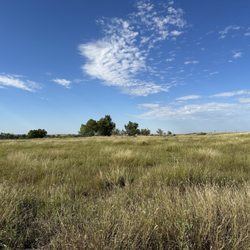
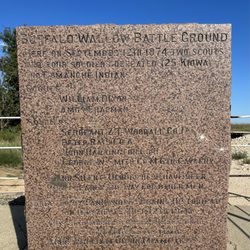
    Today, September 12, 2024 is the 150th Anniversary of the Battle of Buffalo Wallow…read more At this remote location way up in the Texas Panhandle, early on the morning of September 12, 1874, two US Army Scouts and four Enlisted Men were spotted and attacked by a group of about 125 Kiowa and Comanche Warriors. Caught out in the open, outnumbered 125 to 6, things looked grim for the Soldiers. In the first minutes of the battle all of the soldiers and both scouts had been wounded. The exchange of gunfire stampeded their horses. The loss of their horses left the men with no water and only the ammunition they had on their person. The lead Scout, Billy Dixon, spotted a buffalo wallow, a depression in the ground created by buffalos trying to cool themselves off by rolling around in the dirt. With the Warriors circling and shooting at them, Dixon eventually got all the badly wounded Soldiers to the wallow. With no water and running out of cartridges for their guns, the situation seemed hopeless for the soldiers. But late in the day the weather turned cold and it began to rain. The rain came down in torrents. It mixed with the Soldier's blood, gathering in pools in the wallow. It was enough to keep the Soldiers alive. The weather change prompted the Kiowa and Comanche Warriors to break off the attack and eventually withdraw. One of the soldiers, shot through the lungs, died during the night. The next day Billy Dixon decided to leave the others, setting out on foot to try to find help. Miraculously he spotted a Calvary column and signaled them. Ok, so at this point in the story you're thinking, here comes the Calvary to the rescue, right? But no. As it turned out, the Calvary officer in charge was a kind of a Dick. He sent a detail with his Surgeon to evaluate the situation. They concluded the men were too badly injured to ride horseback. They needed an ambulance, something the Calvary column didn't have. The Calvary left the wounded men some raw buffalo meat and resumed their original journey. The wounded men suffered, exposed to the elements until finally being rescued on September 18. For their bravery in battle the survivors were awarded the Congressional Medal of Honor, the highest honor our country bestows on military personnel. A couple years after Billy Dixon died, Congress decided to revoke his Medal of Honor because Dixon wasn't actually in the military; he was just a Scout. Fortunately Dixon's widow told the Congress to go pound sand. She refused to give the Medal back. Today Billy Dixon's Medal of Honor is on display at the Panhandle Plains Museum in Canyon, Texas. To their credit, the US Congress eventually saw the stupidity of taking away Dixon's Medal and officially restored it to him in the 1960's. Last year I visited the Buffalo Wallow Battle site for the first time. I'm visiting again this Fall. This site is extremely remote. Way off the beaten track. Not at all easy to visit. Mikey C says: I don't care. I've got to be there. To me this place is hugely significant.

    Photos
    Buffalo Wallow Battle Ground
    Buffalo Wallow Battle Ground
    Buffalo Wallow Battle Ground

    See all

    Plains Indians & Pioneers Museum - Sheriff

    Plains Indians & Pioneers Museum

    4.5(2 reviews)
    13.4 mi

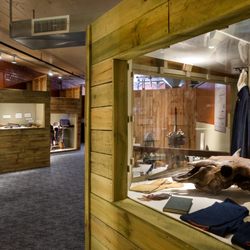
    Wonderful little museum in the heart of Western Oklahoma. Came to visit while staying with family…read morein the area and I have to say for a town of less than 15k people this is a pretty nice establishment! The museum is set into a pretty interesting building as well. I can't truly pin-point the architectural style of it, but I'd say it's mainly mid century modern with a dusting of art deco thrown in, just for good measure. The cupola as you first enter is quite impressive. It is lined with murals depicting life in western oklahoma thru the centuries. Vibrant colors and simple scenes make for a stunning entry. The installation begin with native Americans infographics and artifacts, moving into the Temple Houston's room, then by the depression era/dust bowl room, to showcase some old area relics (bank, post office, photography studio, sheriff) ending right at the gift shop. From here you can visit the outdoor annex buildings, via a beautiful courtyard, where agricultural implements as well as a reconstruction sod-dwelling are on display. A gem for anyone who is interested in the historical features of this region. Also FREE of charge, not sure how you could ever go wrong with free education! ^__^

    I've been coming here for quite a few years, as I travel to Woodward to visit family on holidays…read moreevery year. I've seen the museum grow and change over the years, and its developed into quite a resource for local history that I think would interest people from outside the area. While most of the exhibits are the same year after year, whoever has done the curating recently has really given them new life, making me actually see them in a new light, and appreciate the rich history of Woodward and the surrounding area. The only real critique I would have is that the Plains Indians exhibit isn't as large as it could be, but that may be due to available space. There is certainly a lot of Native American history to explore, and it seems there is an abrupt transition between the Plains Indians exhibit and the Pioneers exhibit. Granted, that transition was pretty abrupt historically, but I doubt that was taken into consideration. Because of their connection to each other in local history, I would have placed the Ft. Supply exhibit closer to the Plains Indians exhibit instead of across the museum, as the timeline jumps from room to room, and it would have put each exhibit into context if they had been physically closer. Even a slight adjustment to current exhibit layout and a creative use of floor space would provide the room necessary to join the two together. That's just a minor quibble that doesn't detract from what the museum is attempting to do, which is to show the rich and diverse history of the region. The other bigger issue I have is the use of one wing of the museum as an art gallery for an artist (is he even local?) to sell his paintings and wood carvings. I wouldn't even mention it if the art were Woodward or Oklahoma sourced or related, but as best as I can tell, there's no explanation made, no connection given (some of the photos are even captioned with out-of-state locations like Colorado) -- you just find yourself in a room with woodcraft and photos from some guy, with a price tag. Sure, support your local artist, but surely there are more local artists who could have used some of that space as well? A showcase of local artists instead of one huge room dedicated to one? I wouldn't mind it so much if I remembered a good chunk of the museum is out in the annex, which isn't marked well -- I always forget to check out the whole other half of the museum because it's in a whole other building, so I keep missing out. Better signage would at least insure people check out the other exhibits. Or, turn the annex into the art gallery and keep all the museum exhibits under one roof. I think this issue drops it from 5 to 4 stars for me. Otherwise, I think the current curator has done quite a good job with the exhibits, to the point I was really impressed during my recent visit there, despite my feelings about the artist gallery. I've visited a fair number of museums, and this still ranks as one of the best small town museums (I'd almost venture to say "hidden treasure") I've visited.

    Photos
    Plains Indians & Pioneers Museum - Annex - bathtub

    Annex - bathtub

    Plains Indians & Pioneers Museum - Display

    Display

    Plains Indians & Pioneers Museum - Interior courtyard

    See all

    Interior courtyard

    Ft Supply Historic Site - landmarks - Updated August 2026

    Loading...
    Loading...
    Loading...