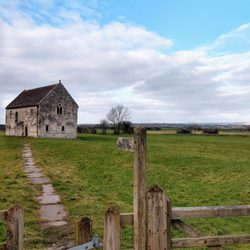
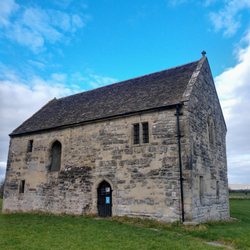
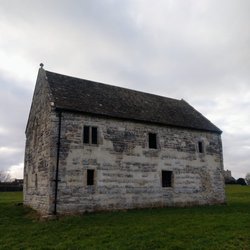
The only surviving monastic fishery building in England, Meare Fish House was the residence of…read moreGlastonbury Abbey's official in charge of the nearby lake and its fishery, and it provided facilities for fish-salting and drying.
Standing in a beautiful position by the site of a long-drained lake (the 'mere') on the Somerset Levels, the Fish House was built for Glastonbury Abbey in the 1330s. The building's design shows that it was not meant for processing or storing fish, but as a house. As such it is of interest for its excellent preservation, its quality despite its small size, and its peculiar and precocious internal planning. Its name derives from its use as an occasional residence for the abbey's official in charge of the lake and its fishery. After the Suppression of the abbey in 1539 it was largely put to agricultural use until it was gutted by fire in the 1880s.Glastonbury Abbey owned property at Meare, 3 1/2 miles north-west, from at least 680 and retained it, except for a brief period in the 13th century, until 1539. As with most monastic landed property, it provided income for the community. Meare's greatest asset, however, was not farming but the natural freshwater lake or mere which covered more than a square mile to the north of the village until it was drained, bit by bit, between the later 16th century and 1718.
Most large monasteries set aside one or more rural properties as a place of occasional recreation for the abbot, the community or both, and from at least the 1320s the manor house at Meare was one of several used as such by Glastonbury. Manor Farm, 220 metres west of the Fish House, incorporates its remains.As its name suggests,[ the Fish House owed its origin to the exploitation of the mere. Religious communities, officially forbidden to eat meat unless ill, consumed large quantities of fish, but mostly from the sea, usually salted and often transported over long distances.
Freshwater fish, almost always eaten fresh, was much more expensive and prestigious, hence the economic and social value of the Meare fishery to the abbey.[5] The fishery was highly productive, being admired in 1540 for its 'great abundance of pykes, tenches, roches, jeles and divers other kinds fysshes'.
Systematic exploitation was under way by the 12th century, and by 1235 the fishery was managed by a tenant answerable probably to the abbey's cellarer (a monk-official responsible for provisions). In 1252 this arrangement was regularised with the appointment of a custos or warden of the fishery, lodged in a house in the churchyard.
While no custos is recorded after 1275, the need for a resident official no doubt remained, and the Fish House, dateable on architectural grounds to the 1330s, was probably built for him. The impetus may have been the abbey's recent victory in a long wrangle over fishing rights with the Dean of Wells.
The high quality of the building reflects the culinary prestige of freshwater fish, the status of the official responsible and the abbey's sense of its own dignity, buildings being important signals of wealth and prestige. In practice, as is suggested by some impracticalities in its internal arrangement, the house was probably for occasional use only. Its original function probably continued until the Suppression.
AFTER THE SUPPRESSION
The end of Glastonbury Abbey came in September 1539 with its seizure by the king's officials and the arrest of the abbot, Richard Whiting, who was subsequently executed on trumped-up charges. In 1547 Meare was granted to Edward Seymour, Duke of Somerset and Lord Protector, and it was held by his descendants until the 18th century.
After changing hands only twice more, in 1931 Manor Farm and the Fish House were bought by the tenants, in whose family they remain. But with the end of institutional ownership the Fish House was relegated, apart from brief use as a cottage (about 1830), to various agricultural purposes.
The building's increasing disrepair in the mid-19th century coincided with the beginnings of antiquarian interest, which was eventually to secure its future. In 1850 the historian Alexander Nesbitt signalled its importance to members of the newly founded Somerset Archaeological and Natural History Society and soon published a related article. The illustrated description in JH Parker's Domestic Architecture of the Middle Ages followed in 1853 and repairs had been made by 1859.
In 1910, at the owner's invitation, the government's Inspector of Ancient Monuments, Charles Peers, viewed the site. Deemed to be of sufficient 'antiquarian interest and value', on 26 April 1911 it became only the fourth medieval monument to be taken into state guardianship following the Ancient Monuments Protection Act of 1900.
Major repairs were carried out in 1912, followed by others in 1955 and 2002.[17] Public access was provided through the good graces of a key holder, then as now resident at Manor Far