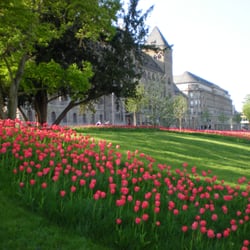
The Electoral Palace in Koblenz is part of the UNESCO World Heritage Site in Upper Middle Rhine…read moreValley. It was commissioned by the last Archbishop and Elector of Trier, Clemens Wenceslaus of Saxony and is currently undergoing extensive renovations until 2029.
By employing French architects in 1776 to design what was then considered an unornamented and austere residence and city palace, Wenceslaus broke with previous traditions of French and German Baroque in favor of more enlightened French neoclassicism. The exterior was completed in 1784 and he moved in in 1786 while work on the interior continued. He retained his Baroque palace in Ehrenbreitstein, which is within view on the other side of the Rhine River.
Initially a reformer, Clemens Wenceslaus greatly improved public education and encouraged music in the archdiocese. However, he grew alarmed as the Revolution gained momentum in nearby France. He ceased reforms and welcomed members of the French royal family - he was uncle to King Louis XVI - and nobility, turning Koblenz into a center of the French monarchy. After Louis XVI was executed in 1793, Clemens Wenceslaus fled in 1794. Koblenz was captured 2 weeks later by 25yo French General François Séverin Marceau-Desgraviers. The Electoral Palacw was turned into army barracks, then used as a military hospital until the Russians liberated Koblenz from the French. It was then passed to the Prussians who used it first as barracks, then government offices, before returning to use as a palace. The structure was reduced to a shell in 1944, but the exterior was faithfully restored in 1950/1 with an updated interior. It now houses various federal offices.
This building is already gorgeous. It's going to be absolutely stunning in 2029.
https://www.visit-koblenz.de/sehe.../kurfuerstliches-schloss