Haywards Heath Station Photos


Recommended Reviews - Haywards Heath Station
Start your review...



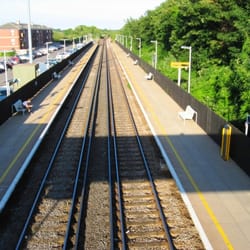
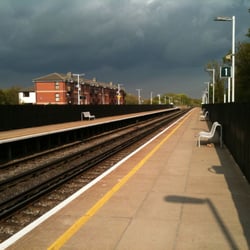
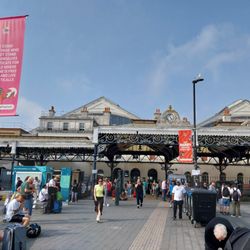
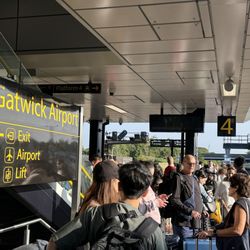
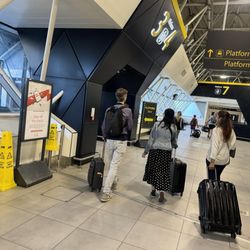
Haywards Heath is one of the principal stations on the main line between London and Brighton, serving the commuter town of the same name which has grown up around it. It's not an architectural gem, but it's functional and has a good range of train services. The station opened in July 1841 as the temporary southern terminus on the London to Brighton Railway, and became a through station when the line to Brighton opened in its entirety in September of that year. In 1847 a line was opened from Wivelsfield, just south of Haywards Heath, to Lewes, providing direct lines to Newhaven and Hastings, and 1864 another line opened, to the north, towards Horsted Keynes on the Lewes to East Grinstead line. The line to Horsted Keynes closed in 1963. The station was rebuilt with two long, spacious island platforms in 1933, when the Brighton line was electrified. The street-level buildings are in an unremarkable version of the Modernist style, of brick with concrete canopies. The platforms level buildings are similarly functional and have deep awnings. Since electrification the station has become an important station for dividing trains heading respectively on the lines east towards Lewes and west to Hove and the 'West Coastway' line (avoiding Brighton) and for the same trains joining when heading north. Indeed, it is now the busiest station for this practice in the UK. The station has a regular off-peak service each hour as follows: Northbound Bedford via London Bridge and St Pancras 4 per hour London Victoria 2 per hour Watford Junction - hourly Southbound Brighton 5 trains per hour Littlehampton via Hove and Worthing 2 per hour Eastbourne 2 per hour (one extended to Hastings and Ore) Note: the half-hourly fast Victoria-Brighton trains do not stop here in the off-peak. In the peak hours all Brighton trains call here, providing an intensive service. All northbound trains stop at Gatwick Airport. The station is staffed 24 hours a day, and has a ticket office, waiting rooms, toilets and a large buffet, and step free access is available across the whole of the station (via lifts). There is also storage for over 60 bicycles and a 630-space car park. A limited number of local buses call at the station: see http://www.compass-travel.co.uk . read more

16 years ago
Whilst I may be living in Haywards Heath, I spend much of my time in Brighton for study, socialising and shopping. Hence, I am a frequent user of the station. It's one of the main connectors of the south, so is a featured stop for fast services as well as the stop at every station trains. This makes it handy for getting to Gatwick, Brighton and London and you end up waiting less time for a train than at other stations in the area. I think that this is a reason why Haywards heath has become such a popular commuting town and the large station car park attests to this claim! Being a busier station, you also find coffee/snack bars and waiting rooms that are actually open. Now whilst not a fault of the station I do find that a higher percentage of trains get delayed than I would like, so these waiting features are really appreciated. The station staff are helpful for any traveling inquiries or suggestions of cheaper way to get from a to b (sadly, I never seem to qualify for such savings). There are also 3 self service ticket machines if you want to save some time or are cutting your arrival a bit fine before your train departs. There is also a covered area to store bicycles if you are feeling like a healthy commute. All in all, you could do far worse if you have to kill 15-20 minutes waiting for a train than Haywards Heath! read more

16 years ago