Cancel

    Open app

    Search

    Heilige Familie

    4.0 (1 review)

    Heilige Familie Photos

    Heilige Familie Reviews in Other Languages

    Verify this business for free

    Get access to customer & competitor insights.

    Verify this business

    St. Lorenz Kirche

    St. Lorenz Kirche

    4.4(18 reviews)
    8.2 kmInnenstadt

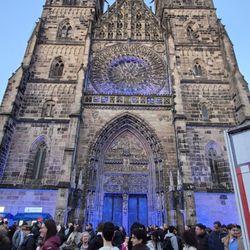
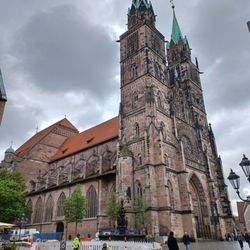
    One of my favorite churches in Nuernberg. I believe it is also the largest. I'm not going to state…read moreall the history and facts about this church, others have already done so. Just one little anecdote that always amuses me is that the builders could not agree on the style of the towers and this is why each tower is different. A feud that is permanently displayed on the towers of a church no less... Anyway, take a close look at this church both inside and out. There are so many details to see, that even after years coming here, I still seem to discover new details. A must see for sure.

    This is the largest church in Nuremberg. To my surprise, I thought I was entering in a Catholic…read moreGothic style church (built circa 1250) to find out it was a Lutheran one. In any case, amazing church with so much art to see in just an hour I spent there (I was with a colleague and did not want to spend the usual amount of time I would do in this type of sacred buildings with so many details and art in every corner). I can't believe it was bombarded during WWII, then rebuilt with great effort. The stained glass art is amazing and I was happy to see that during our visit it was an exhibit about the artist who created all of them originally. It was a very well paid 2 euros visit (I dont like to pay to enter in a church, I am more pro-donations, but still it was worth it). One suggestion is that I would prefer not to have a gift shop inside the church. That devalue both the religious experience and the artistic value, converting the whole thing in a theme park. That is the only part I disliked during my visit as well as the attitude of the young girl that was collecting the money...I got confused of door of our way out and she started yelling at me: no, not there, stop stop...which made me feel weird. Anecdotes apart, a must visit.

    Photos
    St. Lorenz Kirche
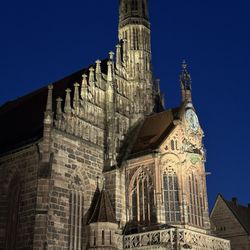
    St. Lorenz Kirche - ... Abendstimmung ...

    ... Abendstimmung ...

    St. Lorenz Kirche

    See all

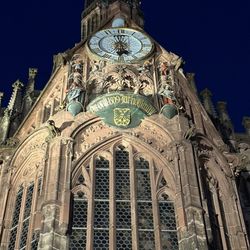
    Frauenkirche - ... Impressionen ...

    Frauenkirche

    4.1(19 reviews)
    8.5 kmInnenstadt

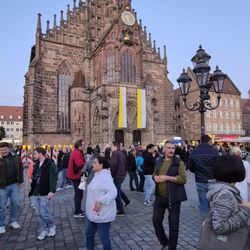
    I am not going to go through the history and facts of the church. Clearly another example of…read moreNuernberg's rich history as a medieval city. What makes this church stand out is the fact that it overlooks the main market place with it's many fruit and veggie stands, most with locally grown produce. Of course there are also food trucks and household wares to be had. The market place turns into a giant Christkindl Market and at its opening the Christkindl (which by the way is a Christmas angel - child of Christ) stands atop the church balcony and officially opens the Christkindl Market with a speech and blessings. Definitely worth attending, if you can squeeze in somehow, because be aware that it will be super crowded. Just before 12 noon you will see crowds gather looking up towards the top of the church. They are all waiting for the "Maennleinlaufen" were the figures start moving and the electors turn and face the Roman emperor. There are also musician figures that move as if playing their instruments.

    Frauenkirche or " The Church of Our Lady" is an example of brick Gothic architecture, and it was…read morebuilt on the initiative of Charles IV, Holy Roman Emperor (reign 1346-1378) between 1352 and 1362. The church contains many sculptures, some of them heavily restored. Numerous works of art from the Middle Ages are kept in the church, such as the so-called Tucher Altar (c. 1440, originally the high altar of the Augustinian church of St. Vitus also in Nürnberg). The church was built in the grand market, in place of the former Jewish synagogue, which was destroyed during the Nürnberg pogrom (Jewish persecutions of 1349) which followed an outbreak of Black Death. Charles IV wanted to use the Frauenkirche for imperial ceremonies, which is reflected in the porch with the balcony, and in the fact that the church is relatively unadorned except for the coats of arms of the Holy Roman Empire, the seven Electors, the town of Nuremberg, and the city of Rome, where the Holy Roman Emperors were crowned. Construction of the church continued until the 1360s. Charles IV's son Wenceslas was baptized in the church in 1361, on which occasion the Imperial Regalia, including the imperial reliquaries, were displayed to the people. References to Wenceslaus can be found throughout the sculptural program of the church. Beginning in 1423, the Imperial Regalia was kept permanently in Nürnberg and displayed to the people once a year on a special wooden platform constructed for that purpose. The current west gable of the church dates from 1506-8. Historic images show that this gable was once richly decorated with sculptures which were presumably destroyed in the Reformation. In 1525 the church became Lutheran and galleries were added in the aisles. In 1810, the church was acquired by a Catholic parish which removed the galleries and restored the church in 1816. This restoration involved replacing and repairing surviving sculptures and gathering Medieval art to adorn the church. One of the most notable features of the church is the Männleinlaufen, a mechanical clock that commemorates the Golden Bull of 1356. The clock was installed in the church between 1506 and 1509. The Holy Roman Emperor is shown seated with the prince-electors surrounding him. The clock mechanism is activated at noon when a bell is rung to start the sequence and is followed by the trumpeters and drummer. Then there is a procession of the electors around the figure of the Holy Roman Emperor.

    Photos
    Frauenkirche - ... Impressionen ...

    ... Impressionen ...

    Frauenkirche
    Frauenkirche

    See all

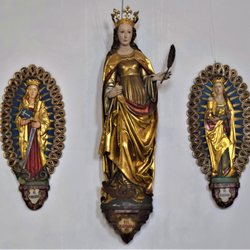
    St. Sebald - Three Saints

    St. Sebald

    4.5(2 reviews)
    6.0 km

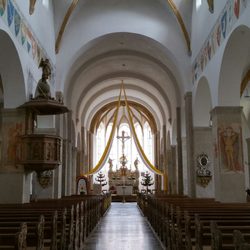
    Roman Catholic church in Schwabach. It's not particularly a large or old (only less than 200 years…read moreold) one, but what you can see inside is very remarkable--certainly worth your visit while you're in Schwabach. Here's the history of the church gathered from various websites: 1839: Sebastian Ablassmayer (1806 - 1882) became Schwabach's first Catholic pastor since the Reformation. Only around 140 Catholics lived in the city, about two percent of the population. With the construction of the railway, many Catholic workers moved to Schwabach. 1848-50: The Catholic Church is built next to the monks' gate in neo-Romanesque style. The interior of the church is decorated with paintings in the "Neubeuron style," which was shaped by the Archabbey of Beuron near Sigmaringen. The characters look like icons. It's a little reminiscent of Eastern Church paintings. 1885: The two stained glass windows were created. One is reminiscent of St. Sebald, the church's namesake. The motif with St. Sebastian was chosen as an honorable reminder of the city priest Sebastian Ablassmayer. 1925/26: The congregation grows, the plan is to build a new large church on the site of what later became the Ring pharmacy. But the economic crisis ruined the plans. In this way, the existing church will at least be expanded and given its current form. The apse was demolished and replaced by the extension. It is totally unfortunate that the old church painting was destroyed. The new plaster would not have held properly on the oil paints. Only in the chapel is plastering and painting done over the painting. 1948/50: After the World War, many Catholic refugees came to the city. The church is embellished by today's wall paintings.

    Photos
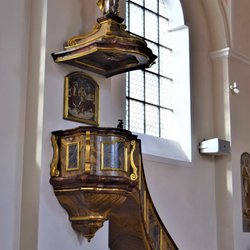
    St. Sebald - Pulpit

    Pulpit

    St. Sebald - St. Joseph Altar

    St. Joseph Altar

    St. Sebald - High Altar

    See all

    High Altar

    Regensburger Dom St. Peter

    Regensburger Dom St. Peter

    4.7(27 reviews)
    87.2 km

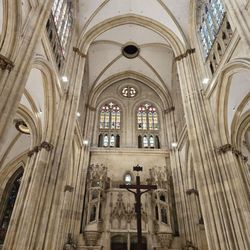
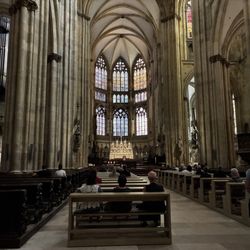
    St Peter's Cathedral is a Roman Catholic Church located in Regensburg, Germany. It was too…read moredifficult to take a photo ofnthe exterior, because of the vast size of the church. The church is 104 Feet high and 114 Feet wide. This historical church was completed in 1520. We toured the interior, which was free of charge. The most impressive thing of all were the gorgeous stain glass windows throughout. The colors were so vivid, my photos don't do them justice. I am always struck by the sheer feeling of peace and holiness inside churches. The church is magnificent and I wish I could hear the organ ( HUGE- see photo). With everything going on in our world right now, I appreciated the opportunity for some time for reflection and tranquillity

    Dom St Peter or Regensburger Dom (St. Peter's Cathedral, also known as Regensburg Cathedral) is…read morewell-known for her Gothic architecture in Bavaria. It is a landmark for the city of Regensburg, and the seat of the Catholic Diocese of Regensburg. The structure is considered the most significant Gothic work in southern Germany. This impressively preserved church is notable for its two 105-meter-high spires. Its spacious interior is of great beauty, and its most notable feature being its superb 13th- and 14th-century stained glass windows. Therefore, it's recommended as the top attraction to visit in Regensburg. You will not be disappointed for sure. The original church called Niedermünster, which was built west of where the current cathedral stands, was built around the year 700. That fact itself is amazing, but unfortunately it was burned down in 1273. The new one was built in 1280 with an incorporation of French Gothic architectural themes. By 1320, the three choirs of this cathedral were ready for use, and between 1385 and 1415 the main entrance to the West was completed. Most of edifice was finished around the year 1520, and this was also the opening year for the cathedral. It's amazing to be able to sit in this historical cathedral and imagine how the worship service was like with its great choir and organ vibrating through this massive structure. That's one of the reasons I like to visit these cathedrals.

    Photos
    Regensburger Dom St. Peter
    Regensburger Dom St. Peter
    Regensburger Dom St. Peter

    See all

    Schottenkirche St. Jakob - Säulen und Gewölbe

    Schottenkirche St. Jakob

    4.1(7 reviews)
    86.6 km

    This former Benedictine monastery--originally named Jakobskirche or St. James Abbey--was founded in…read morethe 11th century by Irish missionaries and for most of its history was in the hands of first Irish, then Scottish monks. In Middle Latin, Scotti meant Gaels, not differentiating Ireland from Scotland, so that the term Schottenstift dates from the Irish period. That's a bit confusing to me, but it was eventually renamed after the numerous Scottish monks and missionaries who called it home from 1560 to 1860. In 1577, shortly after the Scottish Reformation, a papal bull transferred the monastery from Irish to Scottish monks. The monastery was in decline by that time with only one monk and one novice. The first Scottish abbot was Ninian Winzet (1518-92), an opponent of the reformer John Knox. Mary Queen of Scots ordered Abbot Winzet to train priests for Catholic missionary work in Scotland; the first priests were sent long after his death in 1623. The monastery managed to avoid dissolution during the Napoleonic period, a rare accomplishment. It was demoted to a priory in 1820, but monks remained in residence until 1862, when the Bavarian government bought the property and turned it into a seminary for training Catholic priests. A highlight of a visit is the spectacularly ornate north doorway (photo). Known as the Scottish Doorway (Schottenportal) constructed in the 12th century. It is the most famous architectural element of the church which occupies a full third of the north wall and is richly decorated with both ornamental and figural sculptures. It has resulted in the church being named one of Germany's most important Romanesque ecclesiastical buildings.

    Easily overlooked by tourists (and slightly out of the old centre), the "Scots Church of St Jacob"…read moreis a stunning example of Romanesque architecture and a wonderfully quiet and spiritual counterpoint to the busy cathedral just 5 minutes' walk away. The name is, at first sight, rather odd: the church was founded as an Abbey by Irish monks. This reflects the fact that the word 'Scoti' was used by Roman authors to describe Gaelic tribes, whether from Ireland or what is now Scotland - the migrations of which in the Dark Ages were quite complex. But suffice to say that, in this case, the monks hailed from Ireland. An earlier Church to the South was established around 1070 but soon proved too small, and the present site was acquired around 1100 and a new Church dedicated in 1120. This was further enlarged around 1150-1185; only the east end (apse and towers) of the original church survives, the nave, Western transept and celebrated North portal dating from the later rebuilding. The monastery remained under Irish control until the Scottish reformation, when it was transferred by the Pope to Scottish monks: no less a figure than Mary, Queen of Scots sought monks from the Abbey for missionary work in Scotland. The church takes the form of a long, narrow nave with aisles, an apsed sanctuary flanked by aisle chapels, and a west transept. Unusually, the twin towers are at the eastern end. The north portal is a celebrated example of Romanesque architecture in Germany, but the meaning of its decoration has been long debated. As well as Christ and rows of seated apostles, it features a wonderful array of beasts (some real and some fantastical) including a crocodile, a mermaid entwined with a mer-man, and griffin-like winged animals, a dragon eating a lion and many more - all surrounded by classic Celtic interlaced decoration. The downside is that the portal is protected by the ugliest modern glazed canopy imaginable - and it needs a serious clean. Back inside however, the rhythmic pattern of rounded nave arcades of pale stone have exquisite Romanesque capitals and lead the eye effortlessly to the high altar. The effect is sublime.

    Photos
    Schottenkirche St. Jakob - Nebenaltar

    Nebenaltar

    Schottenkirche St. Jakob - Skulptur

    Skulptur

    Schottenkirche St. Jakob

    See all

    Heilige Familie - religiousorgs - Updated July 2026

    Loading...
    Loading...
    Loading...