Cancel

    Open app

    Search

    Littlecote Roman Villa Photos

    Recommended Reviews - Littlecote Roman Villa

    Your trust is our priority, so businesses can't pay to alter or remove their reviews. Learn more about reviews.
    Yelp app icon
    Browse more easily on the app
    Review Feed Illustration
    Photo of Brian G.
    624
    1180
    6322

    3 years ago

    Helpful 3
    Thanks 1
    Love this 1
    Oh no 0

    Highclere Castle - Downtown

    Highclere Castle

    4.2(42 reviews)
    12.5 mi

    Went on a day trip here from London This is the castle from…read more"Downtown Abbey" tv show It has beautiful Victorian architecture inside but I absolutely love the grounds - they host many events here I would love to attend a summer garden party- maybe one day! We enjoyed a tour, you can only see parts of the castle as it's still being used by an actual couple who live there day to day The highlight was afternoon tea in the patio with the castle in view

    This was a bucket list place for my wife and I was happy to help her realize this aspiration. While…read moreher motivation has to do with her love of the Downton Abbey franchise, I was interested in visiting both for the value of its status as a cultural icon and its historical significance as a magnificent castle. Built for and passed down through the succession of the Earls of Carnarvon, it was built in 1679 and renovated in the 1840s. It's a fascinating representation of upper class life in England. I was anticipating the fact that the castle would be memorable. What took me by surprise, however, were the grounds and how enjoyable they were to traverse. First of all, the vastness of the 1000-plus acre estate was almost overwhelming. There was so much area to explore that you could almost spend a full day hiking around. There were a few structural follies on the grounds such as the Temple of Diana and Heaven's Gate that were interesting. There were also tree groves and flower fields that were enjoyable. But the highlights of the grounds were the gardens. The Rose Garden was quite nice, but the main garden was magnificent. It features several types of beautiful flowers and the variety and quality were impressive. Upon walking through the castle, an appreciation of the architecture and decorative arts are a major part of the enjoyment. For Downton Abbey fans, how the physical set fits with beloved scenes from the show adds an extra dimension of meaning, of course. The castle features 200 rooms, many with breathtaking opulence. The self-guided tour takes you through several rooms including highlights such as the Saloon, the Library and the Music Room. There are descriptions for each room with staging indications in many of them for scenes depicted in Downton Abbey. The Egyptian Display is another noteworthy feature. Ancient Egyptian culture and history was a passion of the 5th Earl of Carnarvon. He ended up being a part of the effort that discovered the tomb of King Tutankhamun. The items displayed and the descriptions are interesting. It's an additional charge over and above the fee to visit the castle, but it's worth it. It's also worth noting that there is a food tent. The offerings there are decent quality and the prices are not unreasonable. The pleasant staff adds to the experience. There are sundry other refreshment opportunities as well, such as an ice cream stand. As far as practical considerations, you need to buy your tickets on-line before visiting. Entries are timed, so you need to choose the part of the day you want to visit. Visiting is perfectly doable on your own with little stress without a tour guide, but there certainly are guided tour packages available if you don't mind paying the extra cost. The location is remote, so driving is the most convenient way to get there. Parking is included with the fee and there are plenty of spaces. Public transportation is not a great option and a taxi or Uber would be relatively costly unless you are staying at one of the few hotels that are close by. But overall. I think both of my wife and I felt like this was a unique experience that was very enjoyable and it was particularly meaningful for my wife. We'd recommend it to anyone, especially those who are Downton Abbey fans. The fee is not cheap but also not exorbitant, especially compared to fees for places like the Vanderbilt Mansion. It's worth it for such something that will, for most people, be a once-in-a-lifetime opportunity.

    Photos
    Highclere Castle - Ice Cream on the Grounds at Highclere Castle

    Ice Cream on the Grounds at Highclere Castle

    Highclere Castle - On the Grounds at Highclere Castle

    On the Grounds at Highclere Castle

    Highclere Castle - In the Rose Garden on the Grounds at Highclere Castle

    See all

    In the Rose Garden on the Grounds at Highclere Castle

    Portchester Castle - View of the keep from the castle courtyard

    Portchester Castle

    4.6(7 reviews)
    46.7 mi

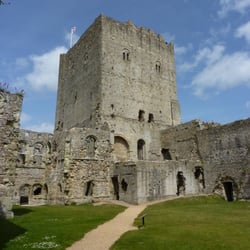
    Hidden away in the urban sprawl of Portsmouth is a gem of English history…read more The approach is about as unprepossessing as you can get: dreary suburbs and endless urban motorways. But then you come to a leafy Georgian village, and through the trees the gatehouse of an impressive castle. The site is ancient: built by the Romans in the 3rd century AD, it is the best preserved of the 'Saxon Shore' forts, and the highest and most complete Roman fortification north of the Alps. The Saxons adapted it to enclose a small town, but it was restored to its use as a castle when Henry I built an impressive Keep and inner-bailey inside. Further modifications were made by Richard I in 1396 to make it more luxurious, and it was the embarkation point for Henry V's iconic expedition to Agincourt in 1415. Thereafter, it was used mostly as a prison: an excellent exhibition recalls the appalling conditions in which French Napoleonic prisoners were kept. The grounds also enclose an impressive Norman romanesque church, built in the 1120's and given by Henry I to Augustinian Canons for use as a priory in 1133. After a generation they moved on, leaving the parish an outsized church. This remains largely 12th century romanesque, with early gothic and late perpendicular additions (and a fine Norman font). It still functions as the parish church to-day. And last, but not least, don't forget to wander through the gates down to the shoreline: the views of Portsmouth Harbour, from three sides, are spectacular.

    Portchester Castle is a waterfront castle dating back to Norman times. The outer wall, forming a…read morelarge square, was built on the ruins of an old Roman fort, and inside the wall, there's a large green space, with the castle in one corner and St. Mary's Church and yard in the opposite corner. The overall grounds (and the green inside the outer wall) appear to be open to the public for free by English Heritage, with the castle as a fee attraction. You enter and pay through the gift shop, and I would strongly recommend the audio guide. This was one of the best audio guides I've encountered for a historical landmark. Instead of just a dry narrator, the audio guide is a dialogue between two historical inhabitants of the castle: an English soldier and a French prisoner, and they provide a great history of the castle and surrounding area in a way that is both informative and entertaining. The audio tour will lead you first to the outer buildings of the castle, whose roofs have long since crumbled away. Finally you will enter the keep, and go up several floors in it, learning about various roles the castle has played in history - from Roman fort to Norman stronghold to military staging point in the Hundred Years' War to prison. The ground floor of the keep has some exhibits on some of the artifacts found on the grounds, and the role of archaeology, and some models of what the castle looked like at different times. If the day is not windy or wet, you can also go up on the roof of the keep and get a great view of Portsmouth across the way, using the spiral staircase in one corner of the keep. You can walk around the outer wall, along the tidelands of the bay. The castle seems to be popular with school groups and artists seeking ruins for landscapes. There's restrooms next to the parking lot, and the gift shop has some treats and ice cream. St. Mary's Church is an active church, on the site of an Augstinian Priory from the 1100s, but you can check out the main chapel and the cemetery around it. They also have a tearoom if you are looking for a spot for sitting and tea. Anyone going to the Portsmouth area - I'd recommend this castle!

    Photos
    Portchester Castle - The main entrance

    The main entrance

    Portchester Castle - The Keep

    The Keep

    Portchester Castle - Photograph of the Keep and Inner Bailey. Photo courtesy of Gaius Cornelius (2006).

    See all

    Photograph of the Keep and Inner Bailey. Photo courtesy of Gaius Cornelius (2006).

    Nunney Castle

    Nunney Castle

    4.4(10 reviews)
    38.5 mi

    What an amazing place, and it is free as well for a meander and to take in all the splendor. After…read morewalking around the castle, do wander around the delightful and history pretty Nunney village as well. They also have a nice pub located there - see my other review. Here is some information regarding the castle.A picturesque moated medieval castle, Nunney Castle in Somerset dates from the 1370s. Its builder was Sir John de la Mare, a local knight who was beginning to enjoy royal favour. Much modernised in the late 16th century, the castle was besieged and damaged by the Parliamentarians in 1645, during the English Civil War.

    Nunney is fun castle to visits if you are in the area. Its free to get into and free to park and if…read morethe weather is good it's a nice place to have a picnic or spend a few hours soaking up the sun with a decent book and a lovely view. It is pretty much a ruin but with four wall and no roof. It is however not possible to get to the upper floors, well there are no floors, or to the tops of the towersI took my three sons and we had fun running around the outside and sword fighting (wooden swords) on the draw bridge and playing hide and seek. The moat would be an issue if you have younger kids. as it is fairly deep with steep sides to it. I would think that for under 5's you would want to take extra care. There are ducks to feed in the moat and they were really cute. As it is free there is no shop or toilets but there is a pub and corner shop nearby for cold drinks and ice creams (it was spring when we went) and the old church and it's graveyard is worth a visits as well. It's only a two minute walk from the castle. Good fun way to spend an hour or so if the weather is good but as a castle its not as much fun as Old Waldorf.

    Photos
    Nunney Castle
    Nunney Castle
    Nunney Castle

    See all

    Titchfield Abbey

    Titchfield Abbey

    4.0(3 reviews)
    43.6 mi

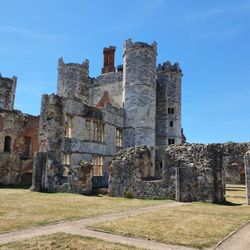
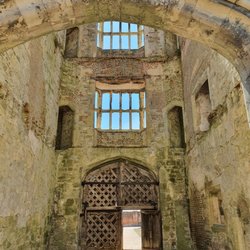
    On our Road Trip through England, Wales and Scotland we focused on Castles, Abbeys and walks…read more The Titchfield Abbey we've visited on our first full day here in England. It was a hot summer day. A monday. And only really a handful people on site. Which is surprising, because these are beautiful remains of a former abbey and mansion. It's almost still fully complete even. There's no entrance fee. And even parking is free if you're a member of the EH. If not it's 2£ only. The building is very impressive. Built in the 13th Century it was first in the hand of monks. Then it changed hands under Henry VIII. And was turned into a Tudor mansion. It's quite a sight to behold. And you can walk around the whole site. But as usual: Be respectful, don't climb around and pick up your litter and after your dog (which are allowed here on the site). A very good start for this year's Road Trip. A great place to visit. And there are even one or two lunch options around, if you feel hungry after your visit.

    Titchfield Abbey is a ruined former country home, which was itself adapted from an Abbey during the…read moreDissolution. The Abbey was founded in 1222 by the Premonstratensian Order of canons. It was founded as a daughter house of Halesowen Abbey, and endowed both by its founder Bishop Peter of Winchester and Henry III. Never especially wealthy, the Abbey was nevertheless noted for its scholarship and held a substantial library. The Abbey buildings followed a standard plan, albeit on a relatively modest scale. The Abbey seems to have had a quiet and ordered existence, although it's location near the south coast on one of the main routes to France meant it hosted both Richard II and Henry V, and was the location of Henry VI to Margaret of Anjou in 1445. The Abbey was dissolved in 1537, at the behest of Thomas Wriothesely, Chancellor to Henry VIII. Unlike many dissolutions, the Abbott John Salisbury secured a peaceful handover, with pensions provided for the canons and the position of Dean of Norwich for himself in 1539. Wriothesely adapted the buildings to form a n impressive country home for himself, called Place House. The Abbey church itself was converted to a grand gatehouse and accommodation wing, with a long gallery and hall formed around the former cloister. This involved taking down the church tower and chancel. The house hosted Elizabeth I, Edward VI, Charles I and Charles II. It continued in use as a home until the 1780s, when the decision was taken to abandon and deliberately demolish much of the complex to form a romantic ruin. Today it is in the care of English Heritage. The impressive turreted gatehouse forms the larger part of what is visible today, the bare structure enabling much of the former church to be traced. There are also remains of the cloister walls, with the foundations of the demolished buildings traced out on the ground. The site is also known for its collection of decorative mediaeval floor tiles. The adjacent fish ponds have survived but are no longer part of the site. Practicalities: the gravel drive is quite narrow and leads to a gravel car park. Although there is level access the rough surfaces make for challenging wheelchair access. There are no toilets on site.

    Photos
    Titchfield Abbey
    Titchfield Abbey
    Titchfield Abbey

    See all

    White Horse Hill - Summer Solstice 2014

    White Horse Hill

    4.8(6 reviews)
    8.8 mi

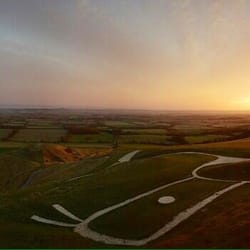
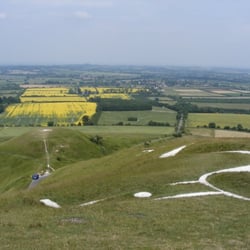
    NO IDEA if the map is right here so directions given Wantage (12km ENE)…read more A place of legend and a good day out if you combine it with the other places in the area..see my Wayland's Smithy. Picnic here..spend the day..the views are beautiful. We have to speculate here. It is called a horse but is it really a dragon? Only you can decide. The area would be quite difficult for the disabled. The Uffington white horse can be seen from up to twenty miles away in good conditions. It can be seen close up from the top of nearby Dragon Hill, but is perhaps best viewed from three or four miles away The steep combe below the horse is known as the 'manger'. The ice-cut terraces to west are the 'Giant's Stair'. 'Dragon Hill' a natural outcrop with an artificially flattened top is just to the North. While the great expanse of 'Uffington Castle,' a hillfort dating from 700 bc, guards the southern approaches. Further a-field are the 'Blowing Stone' and 'Wayland's Smithy'. It is the largest of the horses being some 374 feet in length and 110 feet in height, constructed of trenches which are 5 to 10 feet in width and 2 to 3 feet deep and filled with chalk, this is a few feet above the natural chalk of the hill. The horse is in excellent condition being maintained by the National Trust. The edges are well defined partially consolidated with concrete (although well hidden) and the top edge reinforced with polypropylene netting. The Uffington white horse, one of only four that face to the right, is high on an escarpment of the Berkshire Downs below Whitehorse Hill ten feet or less wide, and its length of around 365 feet makes it over twice as long as the longest of the Wiltshire horses The horse can be found 1.5 miles due south of Uffington village on the Berkshire downs ( now in Oxfordshire). It is situated facing NW near the top (at approx. 800 ft) of a very impressive steep escarpment below the Ridgeway long distance footpath, Whitehorse hill and the Saxon hillfort of Uffington castle and above Dragon hill. There is convenient parking nearby at Woolstone hill and at Whitehorse hill. This high locale makes the horse difficult to view from close quarters it is seen rather better from most areas of the Vale of the White Horse. The White Horse is a highly stylised prehistoric hill figure, 374 feet (110 m) long, cut into the turf of the upper slopes of White Horse Hill The figure has been shown to date back some 3,000 years, to the Bronze Age. The horse is thought to represent a tribal symbol perhaps connected with the builders of Uffington Castle. The Uffington Horse is the symbol of Wessex Hall at the University of Reading, adopted in 1920 and still in use. Dragons Hill A bare patch of chalk upon which no grass will grow is purported to be where the dragon's blood spilled. Dragon Hill and is said to be the site where St. George, England's patron saint, slew the dragon. The blood from the dying dragon so poisoned the ground beneath that grass never grows there leaving the chalk scar we see today. Pillow Mound.Between the castle and the Horse lie a number of burial mounds, the most obvious being the Pillow Mound. These date from the Neolithic and Bronze Ages and are unusual in that they were reused for Romano-British and Anglo-Saxon burials. The Giants Stairs are a reminder of how the valley was created by scouring melt-water during the retreat of the last Ice Age. A terrace along the lower edge of the western slopes is thought to be the remains of medieval farming practice.

    Went to Uffington's National trust white horse hill, 6 miles fro faringdon yesterday! and the views…read morefrom this English land mark are fantastic on a clear day! you can see Swindon city, Faringdon and all the oxfordshire village's, and oxford. and on the way up you see the chalk horse embedded into the hill side, and you also see dragon mound were it is thought that st George slayed the dragon! and on top of the hill are the remains of Uffington Castle, and a short walk from there an ancient burial ground. Car park £1 for two hours £2 for 4 hour's A great place to take a picnic.

    Photos
    White Horse Hill - The Manger

    The Manger

    White Horse Hill
    White Horse Hill - White horse hill

    See all

    White horse hill

    The Oxford Castle - Mug Shot at Oxford Castle & Prison

    The Oxford Castle

    4.5(14 reviews)
    24.8 mi

    A great tour of the Oxford Castle & Prison…read more The tour was a fantastic experience. Packed with history, storytelling with a fun tour guide that all ages could appreciate. Well worth the time and money. The demonstration of a real pillory was icing on the cake.

    This is a must-see if you visit Oxford. The guided tour takes you through the vestiges of the…read morecastle to view its architecture and give you an idea of its original use as a fortress. The moderate climb to the tower is worthwhile as you get a nice panoramic view of the city. As the tour transitions to the use of the castle in more recent times as a prison, there is an interesting display concerning that era highlighting criminal justice practices over the past couple of centuries. The "mug shots" of prisoners held there were fascinating and often poignant. This was particularly true for those stories of the children incarcerated for things like petty theft, acts they committed just to survive. The instruments of "correction" such as stocks were also described in detail. Notorious prisoners held at the castle prison were highlighted and their tales were intriguing. The stories of Mary Blandy and the Black Panther were especially memorable. Our guide did a fabulous job of informing us about the history and significance of the structure in a very engaging manner. The Castle Mound at the front of the grounds is also worth climbing as the views are terrific. This is definitely worth the time and price of admission if you are in Oxford.

    Photos
    The Oxford Castle - Cell Block at Oxford Castle & Prison

    Cell Block at Oxford Castle & Prison

    The Oxford Castle - At Oxford Castle & Prison

    At Oxford Castle & Prison

    The Oxford Castle - At Oxford Castle & Prison

    See all

    At Oxford Castle & Prison

    Farleigh Hungerford Castle

    Farleigh Hungerford Castle

    3.8(6 reviews)
    32.2 mi

    Farleigh Hungerford castle is a ruined castle located near Frome. It played an important role…read moreduring the English Civil War.

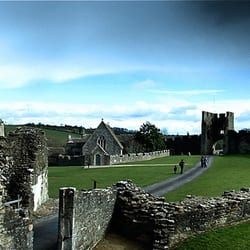
    Farleigh Hungerford castle is an attractive but largely ruined castle set in the very picturesque…read morevalley of the River Frome, about 10 miles south east of Bath. It played an important role during the English Civil War. History The castle started life as a Manor House, the home of the Montfort family since the Norman invasion. In 1369 it was sold to Sir Thomas Hungerford, the first speaker of the House of Commons, who began work on the present castle. This comprised a square-plan bailey, nearly 200ft across, enclosed by walls with a round tower at each corner, and a big gatehouse with projecting towers on the southern side. It contained a series of domestic buildings within, including a hall. The River Frome provided a natural protection to the east, and a moat surrounded the other three sides. The castle was substantially enlarged with the addition of an outer bailey around 1425 by his son, Sir Walter Hungerford (also the first Lord Hungerford), and provided with a fine square gatehouse. The new fortifications also enclosed the parish church, which henceforth became the castle chapel: confusingly, both the chapel, and the parish church built by Sir Walter in 1443 to replace it, are dedicated to St Leonard. The one in the castle is known as the Chapel of St Leonard. The Hungerford family was split between the opposing forces in the Civil War; the garrison of the castle was given to Colonel John Hungerford in 1644 but, a year later, he surrendered the castle without a fight to his half brother, Sir Edward Hungerford (1596-1648), who commanded the Parliamentary forces of Wiltshire. Charles II was entertained at the castle in 1675 by the last of the Hungerfords, Sir Edward (1632-1711), who sold it in 1686. It became ruinous shortly thereafter. It is now in the care of English Heritage. The site The site is entered through the impressive gatehouse of the later fortifications; the walls either side are largely intact and include a semi-circular tower in the south side. Within, the remains are more scattered: of the original inner bailey, the south west tower is well preserved, and the south east tower stands to about half its original height: most of the rest consists of low walls and the outline of foundations, together with some of the original paved internal roadways. Nevertheless, it is possible to get a good picture of the size and scale of the original castle. The Chapel of St Leonard, enclosed within its own walls in the outer bailey, is very well preserved. This consists of a mid 14th Century nave and chancel, to which the North or Hungerford Chapel was added around 1380, and a west porch in the 16th Century. Underneath the chapel is a vaulted crypt. The chapel has a large painting of a knight dating from around 1440, and features German and Dutch stained glass from the 16th to 18th centuries. The family monuments are very impressive, and include those of Sir Thomas Hungerford (d. 1398) and his wife; Sir Walter Hungerford (d. 1596); Sir Edward Hungerford (d. 1607); Mrs Mary Shaw (d. 1613); and Sir Edward Hungerford (d. 1648) and his wife, executed with fine effigies, in black and white marble. Finally, the chapel crypt contains the best collection of human-shaped lead coffins in the country. The site is well interpreted, with displays illustrating its history of the castle and its inhabitants, and an audio tour is available. It would make an excellent day out for families, walkers and those interested in history. The castle is also an excellent starting point for relatively undemanding walks along the valley of the River Frome. Practicalities The castle is on the busy A366 just over 3 miles west of Trowbridge. The site includes a shop and provides limited refreshments, as well as toilets (including one with wheelchair access). Disabled parking on tarmac is 20m from the entrance. Much of the site is level, albeit with a mixture of rough cobbles, paving, gravel and lawns. Wheelchair access is limited to the lawns of the outer bailey, although there is a chair lift to the Chapel. The upper level of the museum has a steep spiral staircase. Entry (April 2010) is £3.80 (adults), £1.90 (children) and £3.20 (concessions). Free to English Heritage members. The castle is open every day from 10am from April to the end of October, and Saturdays and Sundays only during the winter. Closing time varies from 4pm to 6pm depending on the time of the year.

    Photos
    Farleigh Hungerford Castle
    Farleigh Hungerford Castle
    Farleigh Hungerford Castle

    See all

    Littlecote Roman Villa - landmarks - Updated June 2026

    Loading...
    Loading...
    Loading...