Cancel

    Open app

    Search

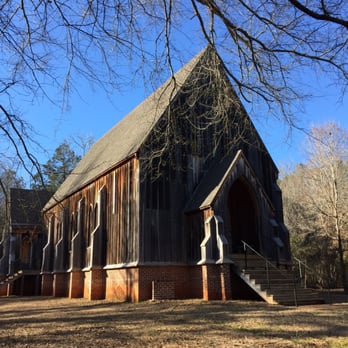
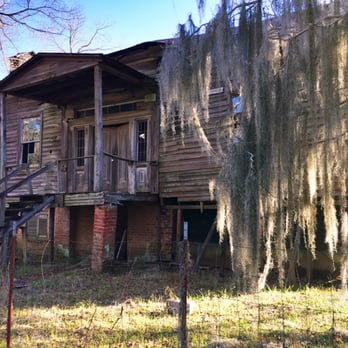
    Old Cahawba Archaeological Park

    3.4 (5 reviews)
    Closed 10:00 am - 5:00 pm

    Old Cahawba Archaeological Park Photos
    More like Old Cahawba Archaeological Park

    Recommended Reviews - Old Cahawba Archaeological Park

    Your trust is our priority, so businesses can't pay to alter or remove their reviews. Learn more about reviews.
    Yelp app icon
    Browse more easily on the app
    Review Feed Illustration

    Reviews With Photos

    April F.

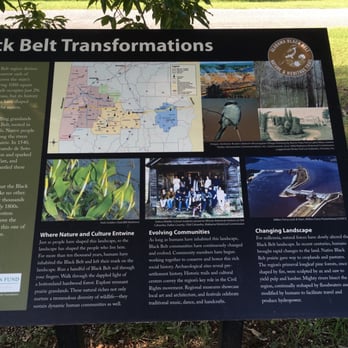
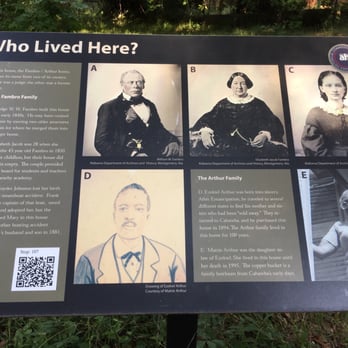
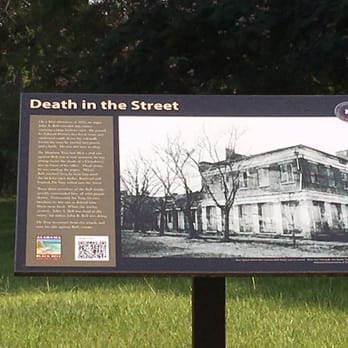
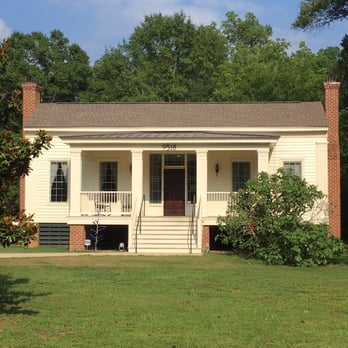
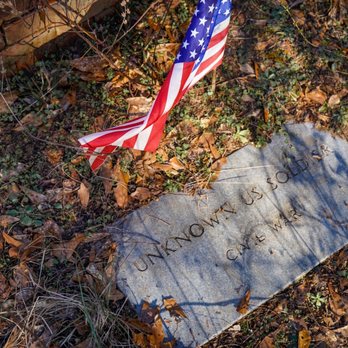
    My GGGG Grandfather was a Union POW at Castle Morgan in Old Cahawba in 1865. I visited the park as part of a reunion of descendants. It's a wonderful little park full of so much history and really beautiful areas. I would love to come back and tour it on a bike, our giant bus couldn't turn down the teeny dirt roads. Nice little gift shop at the end. I recommend booking a tour with one of the guides, they are super knowledgeable and obviously passionate about the history.

    See all

    Photo of Paisley T.
    932
    1168
    14983

    10 years ago

    Helpful 4
    Thanks 0
    Love this 3
    Oh no 1

    6 years ago

    Helpful 2
    Thanks 0
    Love this 1
    Oh no 0
    Photo of Carmen S.
    41
    117
    147

    11 years ago

    Helpful 2
    Thanks 0
    Love this 0
    Oh no 1
    Photo of April F.
    8
    169
    205

    8 years ago

    Helpful 1
    Thanks 0
    Love this 0
    Oh no 0

    9 years ago

    Helpful 0
    Thanks 0
    Love this 0
    Oh no 0

    Ask the Community - Old Cahawba Archaeological Park

    Verify this business for free

    Get access to customer & competitor insights.

    Verify this business

    Live Oak Cemetery

    Live Oak Cemetery

    4.3(4 reviews)
    7.3 mi

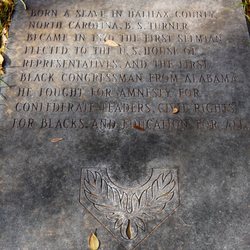
    We have been to Old Live Oak several times. This was the first cemetery that I photographed in…read more2000. While on that day I shot with a 35mm film camera and those photos are in a photo album, these photos are from our visits over the years, shot with a 35mm to a memory card, as well as different types of Samsung phones. This is by far my favorite cemetery to photograph. I have several family members on my father's side buried here. -Kevin Old Live Oak Cemetery is a historic cemetery in Selma, Alabama, founded in 1829 and expanded in 1877. The newer portion is sometimes called New Live Oak Cemetery, and the cemetery is collectively known as Live Oak Cemetery. It contains burials of Confederate States of America leaders, as well as Benjamin Sterling Turner, a formerly enslaved African-American who served as U.S. Representative for Alabama during the Reconstruction era. The cemetery is at 110 Dallas Avenue, approximately 0.7 miles west of downtown Selma. Famous Burials: Robert Woodward Barnwell (1849-1902), Episcopal Bishop of Alabama Katharine Hopkins Chapman (1870-1930), author and historian William Joseph Hardee (1815-1873), Confederate Lt. General from Camden County, Georgia, whose published military battlefield tactics were used by military commanders from both the North and the South. Catesby ap Roger Jones (1821-1877), Confederate Naval Captain who commanded the famous ironclad warship the USS Merrimack (1855) during its first battle versus the Union vessel the USS Monitor. William R. King (1786-1853), 13th Vice-president of the United States. Historians have speculated that King was likely the first gay U.S. vice president and possibly one of the first gay members of the U.S. House of Representatives and the U.S. Senate. A lifelong bachelor, King lived for 15 years in the home of future U.S. president James Buchanan while the two served in the Senate. Buchanan, also a lifelong bachelor, is believed by some historians to be the nation's first gay president. John Tyler Morgan (1824-1907), CSA General, then six-term U.S. senator after the war. An ex-slave holder, he was an ardent racist and an advocate for Jim Crow laws and racial segregation. Benjamin Sterling Turner (1825-1894), the first African American U.S. Congressman from Alabama. Turner was born into slavery in North Carolina and taken to Selma by his owner as a child. He remained enslaved until the end of the Civil War. Turner spent much of his congressional career seeking financial aid for his broken southern state. He advocated racially mixed schools and financial reparation for former slaves.

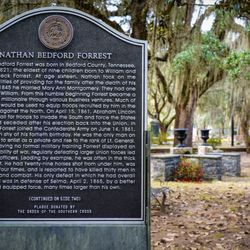
    Live Oak Cemetery is a potent example of the complex history of Selma…read more The final resting place of Benjamin Turner, he was Alabama's first African American representative in 1870. The plaque that honors him was installed by the Society of the Order of the Southern Cross so, of course, it implies that Turner was a Confederate sympathizer. The cemetery also features the mausoleum of William Rufus King, a vice-president who was pro-slavery (and may have had a long-standing homosexual relationship with President Buchanan). This long slim cemetery is filled with tall twisting trees from which faded green Spanish Moss hangs like garland. I meandered through the site until I came upon Confederate Circle. Atop a tall monument stands a soldier looking down ominously. Confederate flags are unwelcoming and chilling yet here were a number of freshly-planted ones sprouting like sprigs next to individual graves. Eight newly-installed metal plaques on a stone platform tell a story that clearly frames Selma as the victim during the Civil War. Referring to Abraham Lincoln as being 'avowedly hostile to the domestic institutions and to the peace and security of the people of the State of Alabama,' reference to yankees abound. Just a few minutes away is the Pettus Bridge. It's hard to reconcile that momentous civil rights history with the narrow romanticized southern vision of the Civil War that, obviously, still remains fresh in the minds of at least some here even after 150 years.

    Photos
    Live Oak Cemetery
    Live Oak Cemetery
    Live Oak Cemetery

    See all

    Memorial to Lynching Victims, 1865-1876

    Memorial to Lynching Victims, 1865-1876

    5.0(5 reviews)
    46.7 mi

    This memorial is located on the outside of the Legacy Museum in a small plaza. It is located behind…read morewhere the shuttle picks up to take visitors to the memorial park. This is a very nice memorial that is intended to honor the thousands of Black people lynched in the years immediately following emancipation, whose names may never be known. The memorial has bench seating on its permitter and features a fountain that lists 560 names of lynching victims, a small representation of the thousands killed between 1865 and 1876. You will find sculptures of 3 African heads of different ages coming out from the center of the water fountain. They are very detailed and almost look real. I can feel their pain. At the end of the fountain you will see a wall that reads a follow: "May we never forget all those who suffered and died because they asserted their basic human right to be free". It is very somber memorial and is respectfully done. It educated me as well. I really did not think about the mass lynchings that were conducted post emancipation by white mobs. The fact that everyone was not happy and did not approve of emancipation is commonly overlooked. Many of those people resorted to violence to express their disapproval and maintain supremacy. I like this mural. It is a one of a kind and honors a somewhat forgotten group. The fountain/water table, sculptures and wall and masterfully done and look awesome. You just have to see it for yourself. Anyway, as with most memorials that I have visited and reviewed, this is not a very long stop. I was there less than 10 minutes. More than likely you will stop here while visiting the Legacy Museum, but if not, you should at least make this part of a larger itinerary.

    As an artist and art educator I appreciate a well designed and curated museum and this one is…read moreperhaps one of the best I've ever been in. Really powerful stuff here, I think every adult in America needs to experience it. I would caution that I think it would take a well prepared and mature child to visit here, it really drives home America's ugly racial past.

    Photos
    Memorial to Lynching Victims, 1865-1876 - Beautiful metal art  and history of the African American Lynching.

    Beautiful metal art and history of the African American Lynching.

    Memorial to Lynching Victims, 1865-1876 - Memorial piece

    Memorial piece

    Memorial to Lynching Victims, 1865-1876

    See all

    National Memorial for Peace and Justice

    National Memorial for Peace and Justice

    4.9(130 reviews)
    46.3 mi

    There are some places you visit, and then there are places that stay with you. The National…read moreMemorial for Peace and Justice is one of those places. Opened in 2018 by the Equal Justice Initiative, this memorial honors more than 4,400 African American men, women, and children who were victims of racial terror lynchings between 1877 and 1950. It tells a story that is painful, sobering, and absolutely essential to confront. As you enter, the experience is quiet and intentional. Steel rectangular monuments are arranged by state and county, each engraved with the names of victims and the dates they were killed. At first, the columns stand at eye level. You can look directly at the names. But as you continue walking, the ground gradually slopes downward and the columns begin to rise above you. It is impossible not to understand the symbolism. The markers are roughly human-sized. As you descend and look upward, they resemble bodies suspended overhead. That realization hit me deeply. The weight of it -- the scale of it -- settles into your chest. It is heavy. It should be. Along the walls, detailed plaques explain the circumstances behind many of the lynchings. Some victims were murdered by mobs of hundreds or even thousands. Some were killed for reasons so trivial and unjust -- accusations, perceived slights, even something as simple as having a photograph of a white woman. You quickly realize how little it took, and how terrifying daily life must have been for Black Americans living under that constant threat of violence. Near the exit, there is a waterfall installation representing the countless undocumented lynchings -- lives lost that may never be fully known. It is a quiet but powerful reminder that even this memorial cannot capture the entire scope of the tragedy. Outside, each hanging monument is duplicated and laid flat across the grounds. This allows visitors to read each name more closely. I deeply appreciated this thoughtful design choice. Every name is treated with dignity and equality. As you walk among them, you may notice multiple names from the same county on the same date -- entire acts of mob violence frozen in steel. Further along, sculptures and signage from various states and counties acknowledge the history and efforts toward reconciliation. The Equal Justice Initiative encourages each county represented to claim its monument and publicly confront its history. Many have begun to do so. Many still have not. The memorial asks visitors to be respectful and to stay off the grass. There are restrooms available on site. Everything about the space is orderly, intentional, and reverent. This is not an easy place to visit. It is not meant to be. But it is profoundly important. If you are in Montgomery, this is a must-visit. It provides critical context for understanding why the end of slavery, Reconstruction, and the Civil Rights Movement were not just historical milestones -- but moral necessities born from immense suffering. I would give this memorial 10 out of 5 stars if I could. Go. Walk slowly. Read the names. Remember.

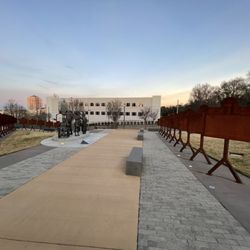
    We visited the National Memorial for Peace and Justice (NMPJ) on Jan 8, 2026 as part of Road…read moreScholar's "The Civil Rights Movement - Atlanta, Montgomery, Selma, Birmingham" program. It is one of the three Equal Justice Initiative (EJI) Legacy sites in Montgomery, AL, and the only one where photography is allowed. Like with the other two sites, security checkpoint is present and I surrendered my foldable (smartphone) tripod. While the Freedom Monument Sculpture Park has a collection of artwork in a park setting, the entire area of the NMPJ can be seen as a single artwork of many sections, like the long wall mural in Dexter Ave Baptist Church (also in Montgomery; within walking distance from the Legacy Museum). The first section of NMPJ is a large grassy area bordered by walkways, wall-mounted written content on the subject of "from slavery to lynching". and the Nkyinkyim Installation sculpture. I don't know if picnics or napping on the grassy area is allowed. I didn't ask. Walking from this area to the next section took time. The next section, being the memorial temple, is the highlight of NMPJ. An open structure that houses numerous tall tablets resembling coffins. Each tablet bears the names of county and state, followed by the names of lynching victims and their respective dates of death. Initially, the tablets look like they are resting on the floor. At the center of the temple is a grassy square accessible from multiple points. Standing at the center of the square, the visitor can see the sheer masses of deaths memorialized within the temple. (Photos and footages are found on my YouTube channel @1Somber. Look for video title "Day 5: National Memorial for Peace and Justice, Freedom Monument Sculpture Park" in playlist "2026-1: The Civil Rights Movement - Atlanta, Montgomery, Selma, Birmingham".) At one end of the structure, the path turns right to a corridor that slopes down. I then realized that the tablets are hanging from the ceiling. When the corridor reaches the bottom level, the tables are hanging over my head. Mounted on opposite walls are panels, each mentions the known "justification" for the victim's death. Why only the bottommost area of the panel is used is a mystery. I hope in time more names will be added to these panels. The final wall has an inscription draped by a waterfall states that the "victims of racial terror lynchings... whose deaths cannot be documented... whose names will never be known... are all honored here." Leaving memorial temple, I came to Monument Park. In this area, the tablets take on the shape and size of coffins, and lay on the ground rows after rows on the left and the right of the walkway. Like the tablets at the memorial temple, each bears the names of county and state, followed by the names of lynching victims and their respective dates of death. After Monument Park comes the "Guided By Justice" sculpture, and then Community Park. Tablets shaped like signposts line up in a single file to one side, and act as shoulders for the visitor walkway. Each has written details of specific lynchings. I followed these "signposts" and arrived at the "Arise" sculpture. The path then leads back to starting point. Visitors can either go for another round or leave. Our tour guide said that a visit at the NMPJ can be done in 45 minutes. I say, "Take all the time you want." The patrolling staff is sparse and there's no hurry. The $5 admission price covers all three EJI sites. Although I appreciated the NMPJ, particularly capturing a considerable amount of photos and footages, I do not give this place 5 stars because of the unnecessary security checkpoint to do the boat ride from Boat Launch at 101 Morris Street to Freedom Monument Sculpture Park, and vice versa. See attached image for further details. At 12:56pm, after visiting the National Memorial for Peace and Justice (NMPJ), I showed up at Boat Launch. There was a security checkpoint. I was told to turn over my tripod before getting on the boat. The big, burly bespectacled guy in the suit claimed that tripods could be used to vandalize the sculptures, and I could take the boat back and to this pier to get it back. He gave no explanation as to how a tripod would be a hazardous or dangerous object on a boat ride itself. The Sculpture Park has its own security checkpoint where I would turn over the tripod, and I wasn't planning on coming back to this pier just to pick up my tripod. It would be a waste of time. So I waited for the shuttle to take me back to the Legacy Museum after stopping over at NMPJ. When I finally arrived at Sculpture Park, 45 minutes of my time was wasted. This limited the time spent there. There was no necessity to have security checkpoint at Boat Launch when Sculpture Park has its own security checkpoint. Until EJI Legacy updates their policy to one that makes sense, this EJI site gets no more than three stars.

    Photos
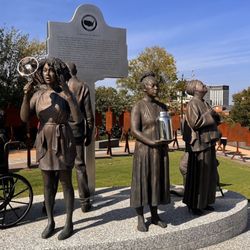
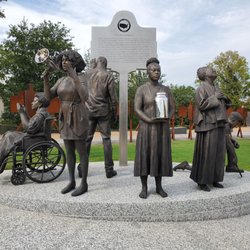
    National Memorial for Peace and Justice - Arise by Branly Cadet memorializing local community leaders and descendants of victims

    Arise by Branly Cadet memorializing local community leaders and descendants of victims

    National Memorial for Peace and Justice
    National Memorial for Peace and Justice

    See all

    Old Cahawba Archaeological Park - landmarks - Updated July 2026

    Loading...
    Loading...
    Loading...