Cancel

    Open app

    Search

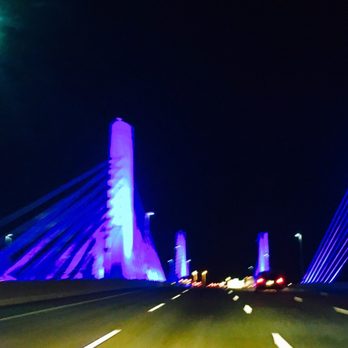
    Pearl Harbor Memorial Bridge

    3.6 (8 reviews)

    Pearl Harbor Memorial Bridge Photos

    More like Pearl Harbor Memorial Bridge

    Recommended Reviews - Pearl Harbor Memorial Bridge

    Your trust is our priority, so businesses can't pay to alter or remove their reviews. Learn more about reviews.
    Yelp app icon
    Browse more easily on the app
    Review Feed Illustration
    Photo of Marie R.
    2036
    428
    2336

    4 years ago

    Helpful 17
    Thanks 1
    Love this 20
    Oh no 0
    Photo of Bruce K.
    2415
    25961
    76247

    4 years ago

    Helpful 10
    Thanks 1
    Love this 9
    Oh no 0
    Photo of William G.
    3757
    2422
    6727

    10 years ago

    Helpful 12
    Thanks 0
    Love this 15
    Oh no 0

    9 years ago

    Helpful 43
    Thanks 0
    Love this 44
    Oh no 0

    13 years ago

    Helpful 2
    Thanks 0
    Love this 1
    Oh no 0
    Photo of Tiff M.
    61
    33
    0

    13 years ago

    Helpful 1
    Thanks 0
    Love this 0
    Oh no 0

    12 years ago

    Helpful 1
    Thanks 0
    Love this 0
    Oh no 0

    12 years ago

    No matter what they do to this bridge it's going to be a clusterfuck. Now it's a nicer looking clusterfuck, but a clusterfuck none the less.

    Helpful 0
    Thanks 0
    Love this 6
    Oh no 0

    Ask the Community - Pearl Harbor Memorial Bridge

    Verify this business for free

    People searched for Landmarks & Historical Buildings 174 times last month within 5 miles of this business.

    Verify this business

    Chetstone - Chetstone dining room.

    Chetstone

    5.0(2 reviews)
    1.3 mi

    What a beautiful 19th century home--the architectural detail inside and out is rare and…read morefascinating. I attended a benefit brunch on the first floor, so cannot speak about the rest of the home, but I was enchanted the entire two hours I was there by the intricate design in the molding as well as the decor. The nice young owners are personable.

    Chetstone is a Gothic Victorian mansion built on the highest ridge of Fairhaven Heights in the mid…read more19th century. After an almost 2 decades long effort to restore this historic home, it is now in fantastic condition. My family rented this beauty for a 4 day stay in New Haven on Air BnB. The Chetstone is also currently listed on the CT Film Commission, and is used for photography and videography, as well as a workshop and performance space. As a bed and breakfast, it would be hard to imagine a more amazing home to stay in. The Chetstone has 4 stories: the kitchen and living rooms on the first floor are warm (ambient heat in the kitchen and bathroom floors is awesome) and cozy. Three of the four bedrooms on the second floor come with working sinks! I felt like I was sleeping in a restored, totally livable adjunct to the Mark Twain house (didn't hurt that I had just recently watched Ken Burns' fantastic documentary on Twain.) The magic comes in from all angles with ancient glass refracting the sunlight in beautiful directions. The third floor is unfinished with whimsical rabbit art dating to 1919 exposed on the walls. The fourth floor is a beautiful lookout over Fairhaven Heights. This neighborhood used to be called "Dragon" because the harbor seals that hung out at the mouth of the Quinnipiac River resembled dragons: on a clear day, you can almost still seem them from the fourth floor. Thank you to all involved in the restoration of this Connecticut architectural gem!

    Photos
    Chetstone - Chetstone parlour.

    Chetstone parlour.

    Chetstone - Chetstone bedroom.

    Chetstone bedroom.

    Chetstone - Chetstone living room.

    See all

    Chetstone living room.

    Fort Wooster Park Historical Marker - Fort Wooster Park Historical Marker, New Haven

    Fort Wooster Park Historical Marker

    3.0(1 review)
    1.4 mi

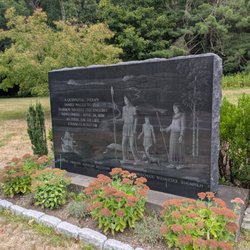
    This marker is along Townsend next to the historic Fort Wooster Park…read more On the front, "Sacred grounds of the Quinnipiac Indians and one of the earliest reservations in the New World Battle site of the American patriots against the British forces during the invasion of New Haven on July 5, 1779. Location of a hilltop beacon to warn of approaching enemy ships during the War of 1812, site of earthen ramparts and a black powder cellar." And it continues, "This coastal Algonquian tribe numbered about 250 members when the English colonists arrived in 1638. They practiced a variety of activities: fishing, clamming, farming of beans, squash & corn, gathering of nuts, berries & roots and hunting game animals & birds. They lived in wigwams covered with rush mats, skins or bark. Travel was by foot or dugouts. Clothing consisted of tanned hides decorated with feathers, porcupine quills & shell beads." On the reverse, "On November 24, 1638, the Quinnipiac leaders: Montowese, Sawseunek, Momaugin, Sugcogisin, Carroughood, Weesaucuck and Shaumpishuh signed a treaty with the Rev. John Davenport and Theophilus Eaton, which designated the east side of the harbor as a reservation of 1200 acres for the Native Americans. The Indian population gradually dwindled, some of the men serving in Great Britain's colonial wars. East Haven farmers pressured the Quinnipiacs to sell their reservation land. Many of the tribe migrated to Farmington to join the Tunxis Indians. In 1773 the last of the reservation land was sold. The Quinnipiacs as a tribe were gone forever from the area; however, as late as the mid-1800s, some members returned in the summer to fish, clam, sell baskets and help farmers with haying." The marker was erected in 2001. [Review 1061 of 2025 - 114 in Connecticut - 24615 overall]

    Photos
    Fort Wooster Park Historical Marker - Fort Wooster Park Historical Marker, New Haven

    Fort Wooster Park Historical Marker, New Haven

    Fort Wooster Park Historical Marker - Fort Wooster Park Historical Marker, New Haven

    Fort Wooster Park Historical Marker, New Haven

    Fort Wooster Park Historical Marker - Fort Wooster Park Historical Marker, New Haven

    See all

    Fort Wooster Park Historical Marker, New Haven

    Amistad Memorial

    Amistad Memorial

    5.0(3 reviews)
    1.2 mi

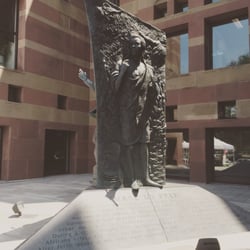
    "Make Us Free" I…read morelearned about the Amistad story from Steven Spielberg's 1997 movie. In 1839, a Spanish slave ship called La Amistad was carrying African slaves to Cuba. Under the leadership of Joseph Cinque (the central figure of the Amistad story), there was a prison break on the ship and two of the Spanish crew were killed. The ship ended up in New Haven, CT where a Supreme Court trial took place to decide the destiny of the slaves. Were they Spanish property? Were they free men? Were they criminals? What exactly were they? You will find this powerful memorial in front of the New Haven City Hall. It's a striking three sided sculpture with a trio of sculpted panels depicting Sengbe Pieh, also known as Joseph Cinque. Each panel shows him at different stages in his life -as a free African, as a defendant in the Supreme Court trial, and as a free man ready to return to Africa. The gorgeous sculptures of Cinque are 9 feet tall, resting on a 2 foot granite base. The three-sided base contains a large inscription that tells the story. The full inscription reads: Make Us Free This monument is a memorial to the 1839 Amistad Revolt and its leader, Sengbe Pieh, also known as Joseph Cinque. Sengbe Pieh was one of the millions of Africans kidnapped from their homes and transported in bondage to the Americas. Sold into slavery in Cuba, he and forty-eight other men, and four children were bound aboard the schooner La Amistad. During a storm, Sengbe Pieh successfully freed himself and his fellows. The Africans seized the ship, but their offers to steer La Amistad homeward were thwarted. After futile weeks at sea, they were captured off Long Island by the U.S.S. Washington. On this site, the Amistad Africans were jailed awaiting trial for piracy and murder. To aid their struggle for freedom, the Amistad Committee formed, counting in its number ministers Simeon Jocelyn, Joshua Leavitt, and James Pennington; merchant Lewis Tappan; professor Josiah Gibbs; and lawyer Roger Baldwin. The Africans were tried twice prior to their ultimate triumph before the United States Supreme Court, where former President John Quincy Adams courageously defended them. Sengbe Pieh and his fellows were declared Free Persons. The Africans sought to return home. To raise funds for their voyage and to further the anti-slavery cause, they engaged in a series of speaking tours. In 1841, after a sojourn that profoundly influenced the abolitionist movement, they set sail, free at last. To commemorate the heroism of the Amistad Africans and those who shared in their quest for freedom, the 1989 Amistad Committee commissioned his sculpture by Ed Hamilton and dedicated it on September 26, 1992. Erected 1992 by the 1989 Amistad Committee One of the best movie courtroom scenes I have ever seen has the great Anthony Hopkins as an elderly John Quincy Adams arguing for the freedom of the slaves before the US Supreme Court. If this doesn't give you goose bumps, go check to see if you are breathing. Check this out.. https://www.youtube.com/watch?v=EZFr4VLPW9Q

    The Amistad memorial has been on my list for some time. It commemorates the fight to establish the…read morefreedom of those slaves who took control of the slave ship The Amistad. After two trials, it was announced that they were in fact Freemen and allowed to return to their homes in Africa. It is a cornerstone in the abolitionist movement, and crucial case to abolishment of slavery in the USA.

    Photos
    Amistad Memorial
    Amistad Memorial
    Amistad Memorial

    See all

    New Haven Historical Marker

    New Haven Historical Marker

    5.0(2 reviews)
    1.2 mi

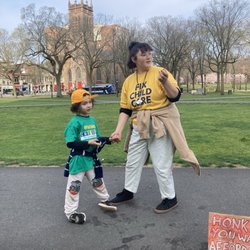
    I went to the New Haven Green to advocate for childcare. Childcare is in a crisis and there needs…read moreto be an increase in federally funded money to support childcare. Early childhood educators are not even paid minimum wage and struggling to pay their bills. Additionally, many families are not able to afford high-quality childcare. The Connecticut Childcare Organization is advocating for families for equitable, affordable access to high-quality care, and for early childhood educators to have a stable workforce. Moreover, they raise awareness of the importance of early childhood education, change of policies for early childhood education, partnering with business and private companies to fund early childhood, and persuading the public about the awareness of childhood education. Early childhood is in a national crisis that is affecting parents, especially mothers, struggling to find suitable and affordable childcare options. Also, a lack of federally funded investment is failing to relieve parents and families from childcare's high and inaccessible cost. The federal government must act quickly to preserve and increase funding for child care for children to experience a high-quality education. Policy makers must provide longterm investments to ensure that families can afford care, children receive the critical developmental support, and workers receive a living wage. As child care becomes more expensive and insufficiently funded, caregivers are struggling to pay for child care because child care is more expensive than ever. It is becoming increasingly difficult for parents to pay for childcare and to be able to work. Some caregivers are working two jobs just to pay for daycare and must sacrifice their bills to pay for childcare. Families spend an average of over $8,000 per year per child for full-time child care, a cost that has increased by 26 percent in the last decade which is more than 200 percent over the past 30 years, and is not nearly in line with minimum wages.,Childcare is $10,600 annually, which is more than public college tuition in 34 states and families are unable to pay for high quality childcare because of high cost.

    This is a two-sided marker from the CT Historical Commission in the familiar white lettering on a…read moreblue background. It highlights the history of New Haven and is located on the Church Street side of the New Haven Green, near City Hall. This marker needs both sides to describe the rich history and importance of New Haven. It traces its history way back to settlers from England and Boston in 1638. It was the first planned community in the US. It was invaded and looted by the British during the Revolutionary War. It was the site of the famous trial that cleared the slaves aboard the Amistad, and it became an American icon for higher education with the founding of Yale University in 1701. The plaque is located very close to Church Street on the beautiful Village Green. It's a worthy setting for a plaque honoring one of America's oldest cities. The plaque's full text reads: Settlement of Quinnipiac, afterward named New Haven, began on April 25, 1638 with the arrival of a large group from London by way of Boston, under the leadership of merchant Theophilus Eaton and the Reverend John Davenport. Later that year, the present downtown area was laid out and mapped in nine squares with a central common, now called the New Haven Green. This is the first example of a planned community in the United States. The town was invaded by the British in 1779 during the Revolutionary War, but escaped serious damage, despite extensive plundering. The City of New Haven was incorporated in 1784 and its first mayor was Roger Sherman, the only person who signed all four of the Nation's founding documents: the Articles of Association, the Declaration of Independence, the Articles of Confederation, and the Constitution of the United States. (Continued on other side) New Haven Harbor, the largest port on Long Island Sound, was the scene of an active fishing and sailing trade in the 19th century New Haven in 1840 was the setting for the AMISTAD trial, in which fifty-two black slaves, who had mutinied aboard a Spanish slave ship of that name after being kidnapped in Africa in defiance of law, were cleared of all civil charges brought against them. The city later became noted for manufacturing. New Haven is the site of a number of schools of higher learning, including Yale University, founded in 1701, South Central Community, Southern Connecticut State, and Albertus Magnus colleges, and Berkeley Divinity School. The homes and many institutional buildings of New Haven reflect the work of noted architects from the 18th century to the present. Since the 1950's, New Haven has received national acclaim for its efforts to renew and preserve the downtown and distinctive neighborhoods. Erected by the City of New Haven the New Haven Colony Historical Society and the Connecticut Historical Commission 1979

    Photos
    New Haven Historical Marker
    New Haven Historical Marker
    New Haven Historical Marker

    See all

    East Haven Historical Marker

    East Haven Historical Marker

    3.0(1 review)
    2.3 mi

    Impressions of the East Haven marker?…read more First of all, East Haven is really old, with a history tracing back to 1638. But paradoxically, it didn't become a "city" until the 1970s. Secondly, check out some of the awesome names on the marker. Theophilus Momaugin Lonotononket Jacob Heminway. Who's he? In 1701, he became the first student at Yale. This is a two-sided marker from the CT Historical Commission in the familiar white lettering on a blue background. It's located near town hall at the intersection of Main Street and Chidsey Avenue. Dedicated in 1976, the marker is in a deteriorating condition with many signs of peeling and chipping. The full inscription reads: This area, purchased by the Reverend John Davenport and Theophilus Eaton in 1638, was later known as East Farms. It was obtained from Indian sachems Momaugin and Mantowese. In 1639 Thomas Gregson, the first landowner, purchased Solitary Cove, later called Morris Cove. The first Connecticut ironworks was located in 1655 by Lake Saltonstall, formerly named Lonotononket, then Furnace Pond. East Farms became known as Iron Works Village, the third iron industry in the New England colonies. Jacob Heminway, the original Yale student, served as the first pastor (1704-1754) of the Congregational Church. In 1774 the Old Stone Church was erected; its first minister was Nicholas Street. This area was invaded in 1779 by British General William Tryon. During the Revolutionary War, Lafayette encamped on the green, revisiting it in 1824. In 1881 Fair Haven, Granniss Corners, and Morris Cove were ceded to New Haven. The Roosevelt Turkey Oak, a gift from President Theodore Roosevelt, was planted on the green in 1908. The initial town meeting (1785) named Isaac Chidsey First Selectman. The town became a city during the 1970's under Mayor Francis W. Messina Erected by the East Haven Historical Society and the Connecticut Historical Commission 1976

    Photos
    East Haven Historical Marker
    East Haven Historical Marker

    See all

    Pearl Harbor Memorial Bridge - landmarks - Updated July 2026

    Loading...
    Loading...
    Loading...