Cancel

    Open app

    Search

    Piazzale di Ponte Milvio

    3.0 (1 review)

    Piazzale di Ponte Milvio Photos

    Piazzale di Ponte Milvio Reviews in Other Languages

    Verify this business for free

    Get access to customer & competitor insights.

    Verify this business

    Piazza San Pietro - Fountain

    Piazza San Pietro

    4.8(158 reviews)
    3.9 km•Città del Vaticano, Prati

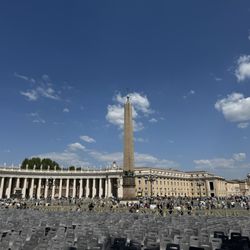
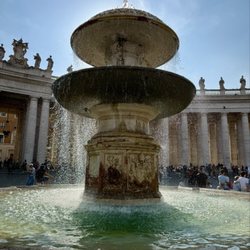
    Being located in front of Saint Peter's Basilica and the Vatican Museums, the cobble stone square…read morein front of this massive structure matches its grandeur of scale. 140 saints from the Catholic tradition, sculpted from travertine ranging from 10 to 11 feet in height, encircle the piazza as part of Bernini's Colonnade. The red granite obelisk jutting out in the center is much older than all the structures surrounding it, originating around 1900 BCE in Egypt, traveling to Italy and then to Rome in 37 CE, finally moving most recently to its present position in 1586. This massive feat to move the 330-ton tower of stone 260 meters to the center of the square required 900 men, 75 horses and complex, engineered crane systems. Two granite fountains--one north of the obelisk, one south--were signatures left by the master architects of St Peter's. The north one by Carlo Maderno, who designed the monumental facade and nave and the other by Gian Lorenzo Bernini who designed the Piazza San Pietro with its colonnade of saints. On any given day prior or during a mass, there are 20,000 chairs set up in a space that holds 60,000 people comfortably standing though history has known crowds of up to 100-130K. Tickets are free for papal audiences though need to be booked in advance for seated sections. There's not much "to do" per se, though walking here (and in many places in Rome), once you look past the hoards of visitors it's awe-inspiring to contemplate the history that's taken place here, and take a break from your Vatican exploration. From the piazza, a pleasant, less crowded stroll east down Via della Conciliazione (which has obelisk-shaped street lampposts) brings you to Castel Sant'Angelo, a 2nd century fortress with a museum inside and beautiful panoramic views of the city.

    When we were in Vatican City in the afternoon, we skipped the plaza. We came back in the early…read moreevening and it was much less crowded. The square is directly in front of St. Peter's Basilica. Both are named after Saint Peter, an apostle of Jesus whom Catholics consider the first Pope. There is an obelisk in the center and 284 columns that create the elliptical shape of the square.

    Photos
    Piazza San Pietro - Piazza San Pietro

    Piazza San Pietro

    Piazza San Pietro - Seats set up the day prior for mass on Sunday

    Seats set up the day prior for mass on Sunday

    Piazza San Pietro - Fountain

    See all

    Fountain

    Ghetto Ebraico - Dinner in the Jewish Quarter

    Ghetto Ebraico

    4.4(9 reviews)
    5.0 km•Centro Storico

    Should have posted previously…read more.. A darling neighborhood to stroll and should be added to any Tiberina itinerary since it's so close. Wonderful history to explore.

    Jews have lived in Rome for over two thousand years. Their presence in Rome predates Christianity…read more It is probably the oldest continuous Jewish community outside of the Israel and the Middle East. Written records trace the Jewish community as early as 161 BC when Judah Maccabee sent envoys to Rome. For hundreds of years, Jewish families coexisted with their neighbors. They worked as bakers, butchers, physicians, money lenders and craftsmen. As the friction between the papacy and the Jewish community in the 1500s escalated, walled off Jewish ghettos were created following the model in Venice. The Roman Ghetto was established as a result of Papal bull Cum nimis absurdum mandated by Pope Paul IV on 14 July 1555. The bull required that the 2,000 Jews who lived in Rome at the time to live in the ghetto, which was not only walled off, but the gates were also locked from the outside at night to keep them in. The Jewish community was also forced to pay 300 Roman scudi for the construction of the wall and gate. The location was prone to flooding and quite undesirable. By the late 1580s, roughly 3,500 inhabitants were living in inhuman conditions. During the plague of 1656, 800 of the ghetto's 4,000 inhabitants died. The bull revoked almost all the rights of the Jewish community. It placed many restrictions on Jews including prohibition on property ownership (even within the ghetto), not being allowed to provide medical care to Christians and compulsory Catholic sermons on the Jewish Shabbat. Life in the ghetto was harsh filled with poverty, epidemics, such as plague, cholera and malaria, diseases due to lack of fresh water and overcrowding. Roman Jews were limited to unskilled jobs such as pawn brokers, fish mongers or ragmen. Many Christians hated the Jews because they were allowed to "lend" money throughout Rome and Europe. Jews had to wear a yellow cloth if they left the ghetto. The yellow veil worn by Jewish women matched the color worn by Roman prostitutes. During Christian feasts they were forced to run naked or be ridden by the Romans as a way to entertain the Romans. They had to petition for the privilege annually to live in their homes and swear loyalty to the Pope at the Arch of Titus which celebrated the Roman sack of Jerusalem in 70 AD. As in most of Rome, there was no fresh water in the ghetto. When the Pope decided to use the old aqueduct system to provide fresh water via a series of fountains designed by Giacomo della Porta, a fountain was due to be placed at Piazza Giudea, the site of a market, inside the ghetto. However, Muzio Mattei used his influence to have the fountain, the Fontana delle Tartarughe (Turtle Fountain), located in the Piazza Mattei instead in front of his residence. Outraged, della Porta changed the design of the fountain so that it provided a small trickle of water to the Mattei family. In 1888, the ghetto walls were torn down. In 1904, the Great Synagogue of Rome and a number of apartment buildings were erected on the site. The Roman Ghetto was the last remaining ghetto in Western Europe until ghettos were reintroduced by Nazi Germany in the 1930s. Today, the Jewish Quarter is a thriving community filled with delicious Kosher restaurants, street musicians and shops. The Great Synagogue in Rome has a very visible square dome and a Jewish Museum. Look for the stumbling stones scattered along the cobblestone streets that remember Roman Jews who were murdered during the Holocaust and a tribute to Stefano Tache Gay who was murdered at the age of two as the synagogue was attacked on Shabbat in 1982. Sit at a sidewalk cafe for lunch or dinner. Try the Jerusalem artichokes and pistachio crusted sea bass at Renato al Ghetto and the pizza and pasta at Ba'Ghetto Milky. Delicious! Thank you to Mircea from GURU Tours who shared the rich history and secret sites of the Jewish Quarter during an amazing, and free, night tour. Highly recommended if you like history and cultural insights.

    Photos
    Ghetto Ebraico - Note the square dome on the synagogue

    Note the square dome on the synagogue

    Ghetto Ebraico - The particular eatery we ate at- very good! Best falafel ever!

    The particular eatery we ate at- very good! Best falafel ever!

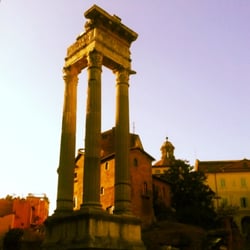
    Ghetto Ebraico - Tempio di apollo sosiano

    See all

    Tempio di apollo sosiano

    Foro Romano - Replica of the former buildings

    Foro Romano

    4.5(269 reviews)
    5.5 km•Aventino, Centro Storico

    Any student of history will appreciate the Roman forum which was the center for the majority of all…read morethe official and major activities that incurred in ancient Rome to include speeches, debate, gladiator fights in some instances, and even the return of victorious armies and new Caesars that you see in so many movies. When I saw the ruins and what was left of the forum I had assumed that this magnificent epicenter of old Rome had been ransacked and destroyed when the Roman empire fell. In fact and unfortunately, it's slowly fell into disrepair and ruins the direct result of lack of maintenance and care by the Roman people and government over time. In addition to the remaining structural ruins and statues that currently reside here you will find placards scattered about these ruins that explain the history of the forum and what each significant ruin stood for and was used for. Very educational and not to be missed as this clearly was one of the most significant ancient centers of the old world.

    After coming back to Roma, it was nice to again take a walk around this area & just take in the…read moresites. This location was consider to be the center of ancient rome, it's nice to be able to walk around & take in the sites it's wild when u think that once upon a time this area was a busy area & life was probably just as crazy if not more than it is today, nice to see how the area is kept well after all this time, worth taking the time to check it out.

    Photos
    Foro Romano - The Roman Forum at dusk

    The Roman Forum at dusk

    Foro Romano
    Foro Romano

    See all

    Pantheon - Basilica di Santa Maria ad Martyres - stunning

    Pantheon - Basilica di Santa Maria ad Martyres

    4.7(481 reviews)
    4.4 km•Centro Storico

    Realizing I may have left my review for the Pantheon in the wrong spot, and now I feel a bit more…read moreconfident I have found the right Yelp business... I am re-posting it here while we figure it out! Would take a lot for me to not give one of the oldest standing structures (still in use by the way) in the entire world a 5 star review right? Quite frankly, walking in and looking up is just enough to bring you to a state of awe at the massive freestanding dome, still completely open in the middle, where the sun moves about the room throughout the day. Over the years it has taken on both a secular and religious bent. There are several people buried there with large monuments, the most recent was the man who brought Italy out of monarchial rule. It appears Catholic services are still held here on occasion, and there are pews for prayer and places to light a candle for blessings. It's no longer free to get in, you can wait in a first come first serve line, or try your luck at buying tickets online... though we tried several times and the online payment system would not work for us. All in all, it's a 30 minutes stop to see one of the oldest intact structures in the world, and that is always worth it to me.

    While visiting Roma , this was one of our stops. No time to…read morevisit inside since our time was limited as our stop in Roma was during our Mediterranean cruise. Beautiful structure on the outside so grand, it's nice to see one of these days maybe next time we will be able to go inside.

    Photos
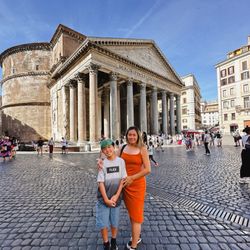
    Pantheon - Basilica di Santa Maria ad Martyres - In front of the Pantheon

    In front of the Pantheon

    Pantheon - Basilica di Santa Maria ad Martyres - Pantheon Rome, Italy on Friday, 09/26/2025 at 09:32pm

    Pantheon Rome, Italy on Friday, 09/26/2025 at 09:32pm

    Pantheon - Basilica di Santa Maria ad Martyres - Front far away

    See all

    Front far away

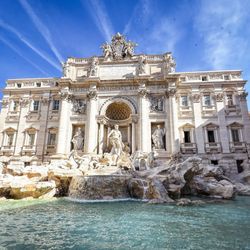
    Fontana di Trevi - Fontana di Trevi

    Fontana di Trevi

    4.5(995 reviews)
    4.3 km•Centro Storico

    There's no shortage of beautiful ornate water works and fountains in Rome, even the small fixtures…read morethat are just meant as water spots for people and pets are works of art. As I learned, the fountains of Rome are not just for show, they're an important part of the area water network. Rome is fed by one of the most potent mountain spring aquifer sources in the world, pumping 525 MILLION GALLONS a day. The pressure on piping for that kind of quantity is immense, and reliable outflows are needed in addition to the water use privately. Hence the many fountains and watering points around Rome, all fit for drinking straight from the tap or filling your most handy water bottle. Trevi fountain is easily one of the most ornate however, giving you that feeling of it being an exquisite pool for the gods. It has a almost a grotto-like feel, with the original stonemasons opting to use large unworked boulders as part of the landscape where they affixed their finely sculpted masterpieces. The square that surrounds it is just jam packed full of people, so unless you are tall like me, be prepared to work your way in for a good shot. If you are looking for refreshment, you'll be waiting a long time here. There are smaller water sources nearby to splash your face and fill your bottle. While you could spend months trying to explore all the fountains of Rome, if you just have a couple days, this one if the must see. It lives up to its reputation in every way.

    The "Trevi Fountain ", an iconic landmark in Rome. Several famous movies have scenes here dating…read moreback decade, we came a little later in the evening thinking maybe a smaller crowd, but we were wrong. The area was packed. One fact, you can't get right up to the fountain edge without paying and if you do it's a cattle drive in and out. The lighting is spectacular. One big issue, Beware of Pick Pockets. We were warned but I came very close to getting my pocket picked. I was quick enough to feel a hand go into my pocket and grabbed it in time. It was a cute young lady but I'm pretty sure she was in training. Nevertheless you should be aware of the possibility. Also there are plenty of restaurants in the immediate area, of which we took advantage of. Review to follow. Anyway, when visiting Tome the Trevi Fountain is a must see.
    Photos
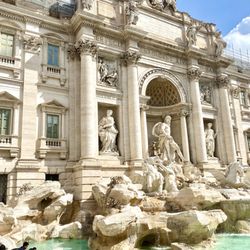
    Fontana di Trevi - Trevi !! So many memories

    Trevi !! So many memories

    Fontana di Trevi - Fontana di Trevi. Just amazing.

    Fontana di Trevi. Just amazing.

    Fontana di Trevi - @6:15am Tuesday morning crowds were already forming!

    See all

    @6:15am Tuesday morning crowds were already forming!

    Piazzale di Ponte Milvio - landmarks - Updated September 2026

    Loading...
    Loading...
    Loading...