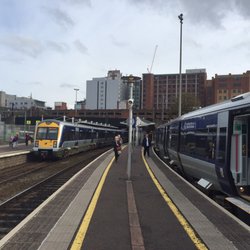
Just a snapshot from me. A life in the day.
It's an edge of town train station with tall chimney remnants of Ulster's flax mill past still visible on the Portadown skyline - flax (or linseed) is the naturally growing fibre that makes everything from bedsheets to table linen and underclothes. Linseed gives oil and other healthy derivatives.
Most recently, Portadown was the site of the long-running Drumcree dispute, but that dispute is a damp squid now but it was different in the 1980's and 1990's over yearly marches by the Orange Order through the Catholic part of the town, which often sparked violence and protests.
In the 1990s, the long running dispute escalated and prompted a massive security operation, drawing worldwide attention to Portadown for all the wrong reasons.
Historically Portadown can trace its origins to the early 17th century Plantation of Ulster, and in the Victorian era, with the arrival of the railway I'm travelling on today, it became a major town. It had the nickname "hub of the North" due to it being a major railway junction; where the Great Northern Railway's line diverged for Belfast, Dublin, Armagh and Derry.
In the 19th and 20th centuries Portadown was also a major centre for the production of textiles, mainly linen. Linen wasn't just an industry it was a way of life all over the Northern Ireland statelet that gave us model villages like Bessbrook which couldn't have a pub built in the village and while Quaker's like the Cadbury family were becoming multi millionaires from chocolate the Quaker linen barons were becoming the super rich of the day in Ulster. Meanwhile Harland & Woolf were becoming super rich from heavy engineering in Belfast.
Cadbury like other Quaker chocolate magnates (Rowntree and Fry) saw drinking chocolate as a drink for men who abstained from alcohol (women weren't mentioned back then) with a now deceased quasi religious cult leader here naming booze the Devil's buttermilk. Personally I've never met the devil.
Quakers here built houses for their workers with electricity and a water supply way back when it was unheard of - all taken for granted now for many years.
They gave workers a sense of pride in work - and work is still intrinsic to human nature in the west - again the Germans had a sign above the entrance of Auschwitz and other Nazi concentration camps: Arbeit macht frei; the German phrase means "Work sets you free" or "Work makes one free". Those who entered these places certainly met the Devil.
Such was the power of the Quakers throughout the UK they dictated when the families that worked for them went to bed and woke - they controlled the electricity supply in their model villages. It's as well these good folks were decent and honest in themselves - again honesty and decency were taken for granted back then too - moral fibre. If you look into 10 Downing St today or 1600 Pennsylvania Avenue DC in 2020 you couldn't find it with a sieve.
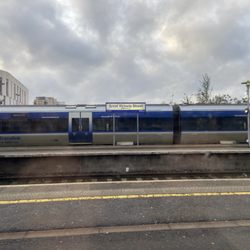
So I sit musing on a train with a cafe Krem flat white on the outskirts of Portadown. We all sit apart and away. We are on hopefully the tail end of Wu flu but it's as unclear and fragile as most things now, just like democracy. read more