Cancel

    Open app

    Search

    Puentes de Chimalistac Photos

    Puentes de Chimalistac Reviews in Other Languages

    Verify this business for free

    Get access to customer & competitor insights.

    Verify this business

    Zócalo Capitalino - Nopales en el Corazón de México

    Zócalo Capitalino

    4.6(84 reviews)
    11.4 kmCentro Sur

    As I'm watching the World Cup from my cozy confines back in Sacramento-I see the FIFA Fanfest in…read moreMexico City happening at the Zocalo with over 50k fans packed in the Zocalo watching on big screens their beloved home team Mexico open the World Cup 2026. During my visit to Mexico City earlier this year,I really enjoyed visiting the Zocalo.Its kind of Mexico City's version of Times Square in that it's used as a central location for many events that happen in the city-While also housing the Capital Building where the Mexican President works at on a daily basis. It also houses one of the most historic cathedrals in all of Mexico City.This church is a true must visit for anyone who spends any time in Mexico City. There are also many restaurants and bars surrounding the Zocalo-though be warned,it's pretty much a tourist trap and you will be price gouged at most of those restaurants in the Zocalo area. I remember during my trip we visited the Zocalo almost every day and the trippy part was how much it changed day to day.That trait also reminded me of Time Square-You go to bed with it looking one way and wake up and it's something else-that happens a lot at the Zocalo. Two really good memories standout about the Zocalo during my visit,The first was I got to witness firsthand the ceremony of the military taking the huge Mexican Flag down that is located in the center of the Zocalo-It's like a whole ceremony that is used to take it down each evening and felt very lucky to have been there at the right time to witness it.The ceremony starts at 6pm local time each evening-it's pretty awesome.Its free to attend and I highly recommend it. The second memory I had was I was at the Zocalo the morning that Shakira was giving her free concert at the Zocalo in Mexico City-so I got to witness for a few days watching them setup for the concert and it was a massive project-the concert later that evening set an attendance record for the Zocalo as an estimated 400k people were in attendance for the free concert. That's the kid of things that randomly happen at the Zocalo-it's a very special place and a must-visit for anyone visiting the beautiful Mexico City.

    The square itself is amazing, and the history is even more so. And while the square is a great…read moreplace to walk around and there is always something happing, it's great to go to the walking street and check out all the shops. But the people watching is the best. There are many souvenir shops around and it's worth going into the churches. One could easily spend a couple of hours here, more if you find a bar and have a nice, cool drink.

    Photos
    Zócalo Capitalino - Nopales en el Corazón de México

    Nopales en el Corazón de México

    Zócalo Capitalino - Nopales en el Corazón de México

    Nopales en el Corazón de México

    Zócalo Capitalino - Navidad 2025

    See all

    Navidad 2025

    Templo Mayor - Busto de Cuauhtémoc

    Templo Mayor

    4.6(78 reviews)
    11.8 kmCentro Norte

    The history in this part of Mexico City is incredible. If you're visiting, you should absolutely…read moremake time to stop at Templo Mayor--it gives you a completely different understanding of the region. Templo Mayor was the central temple of the Aztec capital, Tenochtitlán, which once stood in the middle of Lake Texcoco. After the Spanish conquest led by Hernán Cortés, the city was destroyed, and much of its stone was reused to build what is now the Metropolitan Cathedral and surrounding colonial structures. What's fascinating is that the ruins remained hidden for centuries. The first parts of the ruins were discovered during construction work in the 1970s and earthquakes in the 1980s revealed more of the remains. Standing here, you really feel the layers of history. Within a short walk, you can see modern Mexico City, Spanish colonial architecture like the cathedral, and the exposed Aztec ruins--all in one place. It's a powerful visual of how this city has evolved over time. If you made the trip to Mexico City, don't skip this stop. Even just walking through the area gives you a sense of history spanning from the Aztec empire, through Spanish colonization, to the present day. It's an experience that really stays with you.

    Built initially in the early 14th century, Templo Mayor aka the "Main Temple" sits in the middle of…read morewhat was originally the geographic and religious center of the capital city of Tenōchtitlan, when it was still an island city in the middle of Lake Texcoco. As a sacred site for the Mexica peoples, the structures erected here were dedicated to two deities--Huitzilopochtli, god of war, and Tlaloc, god of rain and agriculture. A shrine was built for each at the top of the temple on the main pyramid. From archaeological analysis, the temple was rebuilt six times, with the largest expansion under Mocteczuma I in 1454, though in 1521 the majority of the building was destroyed by Spanish colonizers when the whole city was razed and rebuilt following Spanish occupation. Notably the Metropolitan Cathedral which stands today adjacent to this site was one of the buildings which were built over it. By the 19th century the exact location and history of this sacred precinct had been lost but toward the end of the 1800s part of the temple corner was uncovered. However there wasn't an official organized effort to excavate and preserve the site until 1978-82. In 1987 the site became listed as an UNESCO world heritage site and a museum was built to house its artifacts and findings. When I was there in January I didn't go into the museum though walked around the edges--they've done an excellent job framing it with walkways along the west side, so it's somewhat of a public park. There are a few small scale models of what the precinct would've looked like in different eras, and a dedicated viewing platform. With entry to the museum you get closer access into the site with some walkways within the site itself. The entrance to the museum is free for Mexican citizens and 95 pesos for foreigners. Three floors with eight main exhibition halls focused on the deities, rituals (including human sacrifice), the role of the temple in economics and trade of the time, and flora and fauna of past Mesoamerica. In excavations more than 7000 objects were found and work continues on the site today.

    Photos
    Templo Mayor - Busto de Cuauhtémoc

    Busto de Cuauhtémoc

    Templo Mayor - Busto de Cuauhtémoc

    Busto de Cuauhtémoc

    Templo Mayor - Tenochtitlan

    See all

    Tenochtitlan

    Espacio Escultórico - escalando

    Espacio Escultórico

    4.3(11 reviews)
    2.9 kmCiudad Universitaria

    Breathtaking, beautiful, historic, positive energy, nature loving and Free every single day even…read morefor foreign tourist!!! it's an untouched lava garden encircled by giant prisms.

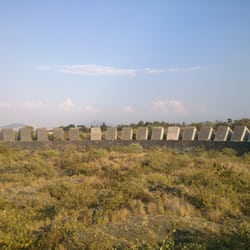
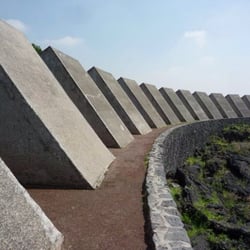
    On a recent trip to Mexico City I visited the Sculptural Space at UNAM (National Autonomous…read moreUniversity of Mexico). Proposed by sculptor Federico Silva in 1979, it is one of a series of 7 public sculpture's dedicated to ecology and art, and built on campus by artists from the University. Referencing pre-Hispanic culture and the aesthetics of nearby ceremonial sites such as the pyramids at Teotihuacan, this site specific work exists in harmony with its surrounding landscape and calls to a time in history when place was honored. The walk to the site requires traversing a long path surrounded by a muted palette of desert flora -- fields of tall dry grass sprinkled with bundles of cacti, pink desert flowers, and jagged rocky outcrops. At one point the concrete path became a grid of symbols resembling an ancient, or even extraterrestrial, form of communication. Upon arrival at the sculpture, I was confronted with a wall of 64 massive slabs of rock in a circular formation, 120 ft in diameter. I noticed people, mostly pairs, perched on the tips of some of these structures. The grand presence of these outcrops had a dwarfing effect while simultaneously offering an invitation to slip inbetween the slabs revealing an open field of jagged, black, petrified lava on the other side. There is a circular walking path lining the inset (slightly lunar) landscape but I chose to climb down into it and head to the center. From inside, the geometric ring of rocks frame the sculptural space and act as protectors, while also producing a kind of amphitheater effect. Unlike many public monuments which often feel indifferent to their degree of engagement with the viewer, Sculpture Space felt like a democratic and inviting public space, ripe for meditation, public interaction, and activation. It felt sacred. Like a celebration of place, history and ecological diversity that spoke to the institutions dedication to art...or so I initially thought. The view from the center offers a 360º horizon of sky and surrounding mountains with one jarring exception -- a disruptive, stark white building towering in the east and ultimately poisoning the entire experience. Upon further research it's revealed that this is a recently built faculty building for the Political and Social Sciences program at UNAM, which immediately strikes me as an institutional contradiction. The fact that a program within the institution which studies anthropology and archeology would build a structure that disrespects, and ultimately destroys, a monument that is dedicated to their cultural heritage, seems rather outrageous. And it appears as though the art and student community in Mexico City agrees. Earlier this month a petition started circulating demanding that the top 4 floors of the building be removed in order to return the Sculpture Space to it's original state. A demostration led by hundreds of artists and representatives from the university community took place spurring a lot of media attention and resulting in the formation of a committee of architects, artists, environmentalists, and researchers dedicated to addressing the issue. What began as a symbol of cultural heritage, celebration of place, and public engagement, has shifted to a conversation around institutional critique and politics. Here's to hoping the institution can make the changes necessary to honor it's past dedication to the integrity of the art.
    Photos
    Espacio Escultórico
    Espacio Escultórico - 5 different types of mosses

    5 different types of mosses

    Espacio Escultórico

    See all

    Puentes de Chimalistac - landmarks - Updated July 2026

    Loading...
    Loading...
    Loading...