1. Schloss Veitshöchheim

    1. Schloss Veitshöchheim

    0

    Veitshöchheim, BY

    Cancel

    Open app

    Search

    Schloss Veitshöchheim Photos

    Recommended Reviews - Schloss Veitshöchheim

    Your trust is our priority, so businesses can't pay to alter or remove their reviews. Learn more about reviews.
    Yelp app icon
    Browse more easily on the app
    Review Feed Illustration
    Photo of Mike N.
    348
    927
    3946

    5 years ago

    Helpful 14
    Thanks 0
    Love this 12
    Oh no 0

    Schloss Veitshöchheim Reviews in Other Languages

    Verify this business for free

    Get access to customer & competitor insights.

    Verify this business

    Hofgarten Veitshöchheim - Grotto ornament--dragon mama

    Hofgarten Veitshöchheim

    5.0(9 reviews)
    0.0 km

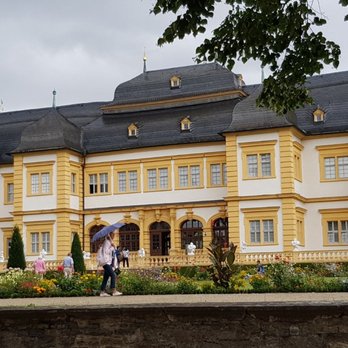
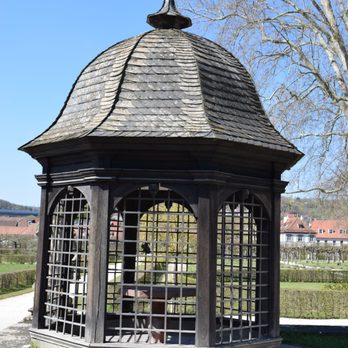
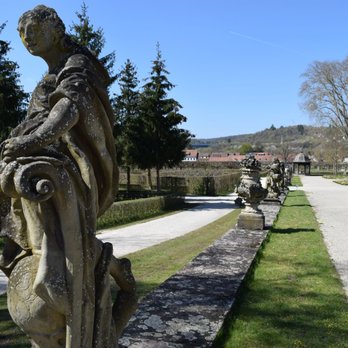
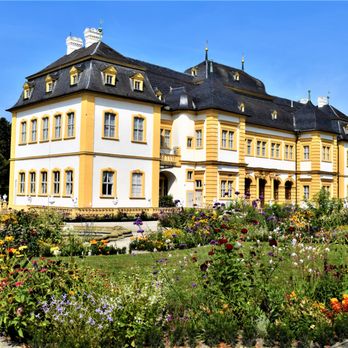
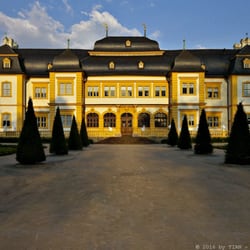
    What a magnificent and enchanting property! Even on an early spring day without too many green…read moreleaves on trees and bushes, we truly enjoyed strolling around this massive property with ponds and fountains, walkways with manicured hedges, numerous statues and figurines, or just being in the quiet highly orchestrated garden in Rococo style imagining how the royals and aristocrats may have lived in luxury in the times past. As a frame for the "summer and pleasure house," today's Schloss Veitshöchheim, a flower garden was created from 1702, which was roughly marked out in a square. This resulted in the creation of a front garden with a main entrance and driveway. On the north side there was a kitchen garden with a carp pond and on the south side an elongated tree garden, which served as a wood for pheasants and game. Under Prince-Bishop Johann Philipp von Greiffenclau (ruled 1699-1719), the fundamental work to convert the pheasantry into a representative garden was carried out in 1702/1703. The balustrades, lining walls, enclosing walls, main paths and lakes that still exist today were created. Under Prince-Bishop Carl Philipp von Greiffenclau (1749-1754), Johann Wolfgang van der Auwera (1708-1756) created the first figure cycles. The differentiated design of the garden that exists today was created from 1763 by Prince-Bishop Adam Friedrich von Seinsheim (1755-1779). He commissioned the "most important German garden sculptor of his time" Ferdinand Tietz (1708-1777) with the creation of further figure cycles. In just a few years between 1765 and 1768, he carried out the commission. The last phase of the figurative decoration took place from 1772 to 1780 by Johann Peter Alexander Wagner (1730-1809). After Seinsheim's death, the importance of the garden was not fully recognized for a long time until the garden was restored to the Rococo state of 1779 in the 50s and 60s of the 20th century . This garden is likely to be the most differentiated garden in the German-speaking area in terms of content and also practically comprehensible contexts of meaning. The cosmological program of this garden sees the Prince-Bishop's castle as a symbol of heaven. The large, freely grown trees at the castle, at the large and small lake and in the roundabout are ingredients of the 19th century .

    Beautiful chateaux! All the staff were very nice and willing to explain things about the this place…read morein English if I wished. They had a lovely very well maintained garden.

    Photos
    Hofgarten Veitshöchheim - Jagdschloss Veitshöcheim (04/2016)

    Jagdschloss Veitshöcheim (04/2016)

    Hofgarten Veitshöchheim - Grotto

    Grotto

    Hofgarten Veitshöchheim - Grotto

    See all

    Grotto

    Festung Marienberg - Festung Marienberg

    Festung Marienberg

    4.4(30 reviews)
    5.5 km

    It is a prominent landmark on the left bank of the Main River in Würzburg. The mighty Fortress…read moreMarienberg is a symbol of Würzburg and served as a home of the local prince-bishops for nearly five centuries. It has been a fort since ancient times. Most of the current structures originally were built in Renaissance and Baroque styles between the 16th and 18th centuries. After Gustavus Adolphus of Sweden conquered the area in 1631 during the Thirty Years' War, the castle was reconstructed as a Baroque residence. After it ceased to serve as residence of the Prince-Bishops of Würzburg, the fortress saw repeated action in the wars of the late 18th and 19th centuries. Festung Marienberg was severely damaged by British bombs in March 1945 and only fully rebuilt in 1990. Today, it houses two museums. In the early 8th century, the Franks under Duke Hedan II constructed a chapel dedicated to the Virgin Mary and a fortification (earth ramparts and half-timbered houses) on the hill. The chapel - probably built at the site of a former pagan holy site dedicated to some mother goddess - and later churches that replaced it, was the reason why eventually hill and fortress became known as Marienberg ("Mary's Mount"). This likely was the first Christian church built of stone north of the Alps outside of the territory formerly controlled by Rome (i.e. east of the Rhine and on the far side of the Limes). The Prince-Bishops of Würzburg moved their residence to Marienberg beginning around 1200 as medieval fortifications were constructed on the hill. Besides its historical and architectural interests, it makes a nice hike if you choose to walk from the old city-center. From the foot of fortress hill at the Alte Brücke, there are two ways to hike up...one is more direct way to the front gate (25 minutes) and the other through the vineyard (40 minutes). A must visit if you are in Würzburg.
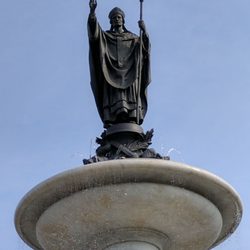
    Beautiful castle fortress! I recommend coming to see this! They have a decent amount of parking. We…read morewere there for about 2 hours and it cost 2euro to park. We did not even get to the museums because we had to go to our next stop, it's so huge and there are a lot of great views and photo spots.

    Photos
    Festung Marienberg
    Festung Marienberg
    Festung Marienberg

    See all

    Kollegiatstift Neumünster

    Kollegiatstift Neumünster

    4.2(9 reviews)
    5.9 km

    The "New Minster" of Würzburg is a riot of Baroque decoration, and is dedicated to the three Irish…read moremissionaries, Kilian, Colman and Totnan, martyred in 689 while bringing Christianity to the Thuringians under the rule of King Gozbert. Kilian travelled from his native Ireland leading a band of missionaries and arrived at Wurzburg by way of Rome, where their mission was blessed by the Pope. The band split at Würzburg, the three missionaries remaining while the others went further afield. All initially went well: Gozbert and many of his subjects were converted and baptised. But Kilian informed the King that his marriage to the his brother's widow Geilana was contrary to scripture. She was furious and had the three beheaded in the absence of her husband. The church was subsequently built at the scene of their martyrdom: in 1060 Adalbero of Würzburg founded the present church with an aisled nave and two choirs (east and west) in the Romanesque style. From 1180 to 1250 the church was further expanded. The first step towards its current form was the demolition of the west choir and the remodelling to form a new west front in the Baroque style between 1711 and 1716. More significant still was the thorough redesign of the interior by the Zimmerman brothers in 1725. The present Church therefore appears as a complete Baroque structure. It is painted in cool white, which highlights the baroque altar pieces and the ceiling frescoes. The fresco on the domed ceiling at the west front is a triumph of trompe d'oeil, which depicts different layers of cloud, drawing the eye upwards. In complete contrast, the casket containing the relics of St Kilian is found the the west crypt, which is dark, low-ceilinged, and a place of restful quiet - a perfect escape from tourist throngs above.

    The Neumünster church was built in the 11th Century as a Romanesque Basilica. It is constructed on…read morethe site where 798 Irish Missionaries from Franconia were murdered. Previously the church has served as the main cathedral in Würzburg owing to it sustaining less damage during the bombing of Würzburg in WW2. Its a gorgeous building with detailed paintings on the inside. Like many churches around Bavaria the ceiling is beautifully painted as are many sections of the church. Inside are many works of art, such as the 15th century Man of Sorrow, and a Madonna. Its located slightly away from the main square and very quiet inside. Well worth a visit.

    Photos
    Kollegiatstift Neumünster
    Kollegiatstift Neumünster - Neumünster Kollegiatstift

    Neumünster Kollegiatstift

    Kollegiatstift Neumünster

    See all

    Schloss Veitshöchheim - landmarks - Updated July 2026

    Loading...
    Loading...
    Loading...