Since this is essentially a secondary listing for "Pompeii Ruins" on Yelp, just adding a few more…read morenotes here that I didn't include in my main review.
Highlights for me were:
1) the Forum: on the south western side of the park, past the Temple of Venus which is fairly close to the entrance by Porta Marina. This was the main public square and socio-economic center for the city with many different government, religious and commercial buildings set around it. Some of the important ruins include the Basilica, the court of law and business center, and the Macellum, a covered food market and marketplace. Temples of Jupiter and Apollo served religious functions.
2) the bath houses: there are a few different locations Terme Stabiane, Terme del Foro, Terme Suburbane--though I went to the Forum location, was really impressed by how well laid out and preserved this building was.
3) thermopoliums: plural because around 80 different locations were found within Pompeii. These are the equivalent of street food vendors where the working class would procure hot food to go, since the majority of Pompeii's 10-35K residents at the time of its destruction in 79 AD didn't live in villas, rather in multistory buildings without kitchens, hence depended on these for sustenance. These L-shaped marble counters held terracotta jars of hot and cold food, such as stews, meats, and spiced wine.
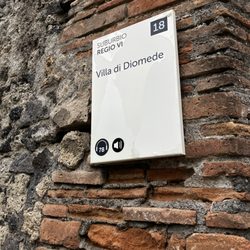
4) "suburban" Villa di Diomede and Villa dei Misteri which require a separate fee of €8 payable in cash or card at the gate to that section of the park, if it's not already included in your particular combo ticket.
These two villas underwent multiple restorations and haven't always been open to the public. Both are examples of larger, grand residences with more complex layouts, the latter housing famous colorful frescos depicting rituals related to an esoteric cult of Dionysus.
5) necropolises: a few different locations around the outskirts of the town, it was fascinating to see how ancient traditions of mausoleums carry into current conventions.
6) interesting signage: while I don't read Latin, from the translations I read about pertaining to some of the sites, they certainly got their point across. I chuckled at the mosaic with Latin phrase "Cave Canem" literally "beware of the dog" showing a snarling black dog, placed at the entrance of one of the domiciles.
Side note there is restoration and excavation work ongoing at different sites within the park, so not every building is open to the public. Even some structures that were open within the past several months like the House of Menander and Lupanare di Pompei (Pompeii's brothel) were not open.