Located close to Blackfriars, this small church is a haven of peace and quiet, with an interesting history, and an irresistibly unusual name.
History
The church is first mentioned in 1170, when its name was 'St Andrew juxta Baynard', denoting its location next to Baynard's Castle, a royal residence from Norman times until the Great Fire of London.
It acquired its present name during the 14th Century, when Edward III purchased a house nearby as a store for royal regalia, furniture, ceremonial robes, and armour. It became known as the 'Great Wardrobe', and lent its name to the adjacent church.
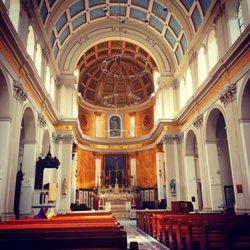
The church, wardrobe and Baynard's Castle were all burned down in the Great Fire in 1666; there were hopes that the castle's walls would stem the flames, but the fire consumed all. In the end only the church was rebuilt, in 1685-95, by Sir Christopher Wren. This was a simple structure, with plain brick walls and a barrel-vaulted nave, galleries and aisles.
The church suffered terribly in the Second World War: on 29-30 December 1940, incendiary bombs created a firestorm in the area, which gutted the church. Only the tower and walls survived. It was rebuilt 1959-61 to designs by Marshall Sisson.
The church
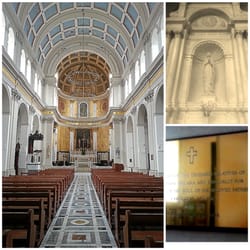
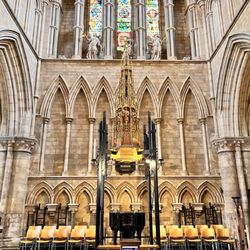
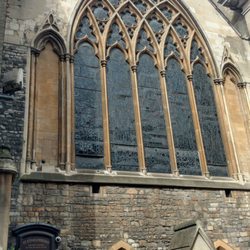
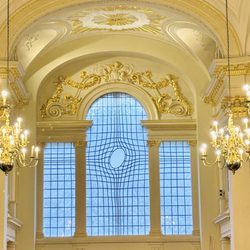
From the outside, the church presents itself as a simple, classical design, with a square tower, executed in brick with Portland stone dressings. There are two rows of windows, with grand rounded arches above, and smaller segmental arched windows below.
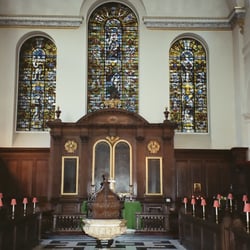
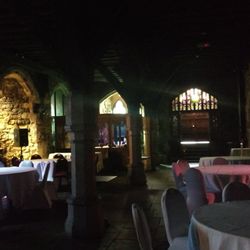
Inside, Sissons restored the nave in almost perfect facsimile, with rounded arcades on square columns. However, the aisles beneath the galleries were enclosed, on the north side to provide a parish hall and on the south to provide the chapel of Saint Ann, normally the only part of the church open except for services.
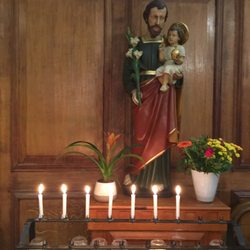
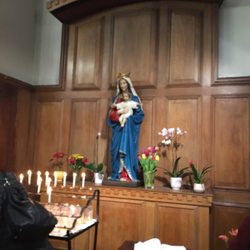
The interiors of both nave and chapel are panelled in a rather plain fashion in oak, although they building contains some interesting fittings from other churches: these include the pulpit, font and and cover from St Matthew, Friday Street (also rebuilt by Wren); a figure of St Andrew dated around 1600; and an Italian carving of St Ann holding the Virgin Mary, dated around 1500.
One of the most interesting items is a bell in the rear lobby, dating from around 1410. This (and 2 other bells) came from the church in Avenbury in Herefordshire in 1933, and is inscribed (in Latin) "I have the name Gabriel, sent from heaven". All three bells were damaged in the Blitz; the other two were recast, but a new Gabriel bell was cast, so this is now one of the oldest bells in the city (though not rung, of course).
Shakespeare fans will note the connection with the Great Bard; he bought a house in the Parish, and worked in the nearby playhouse located in the former refectory of the monastery of Black Friars. There is a joint memorial to him and to the great lute player and composer, John Downland (1562-1626), in the west gallery.
Practicalities
The nearest tube is Blackfriars, although Mansion House is also close by. The church is open on weekdays (St Ann's chapel only) 10:00 - 16:00 for prayer and visits, although a good view of the nave can be had through the internal glass doors, even if they are locked.
The main service is on Thursday at 18:30. The St Gregorios Indian Orthodox Church worships here at 9:30 on Sundays. read more