Cancel

    Open app

    Search

    St James's Church

    3.0 (1 review)

    St James's Church Photos

    Recommended Reviews - St James's Church

    Your trust is our priority, so businesses can't pay to alter or remove their reviews. Learn more about reviews.
    Yelp app icon
    Browse more easily on the app
    Review Feed Illustration
    Photo of David J.
    96
    2351
    12005

    18 years ago

    Helpful 0
    Thanks 0
    Love this 0
    Oh no 0

    Verify this business for free

    Get access to customer & competitor insights.

    Verify this business

    Church of St Mary Magdalene - St Andrew's Chapel

    Church of St Mary Magdalene

    5.0(3 reviews)
    0.1 mi

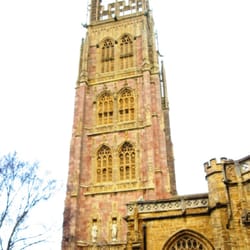
    The ancient County Town of Somerset has a church worthy of its status and history, famous for its…read moresplendid tower, which is a landmark for miles around. The early history of the church is obscure: Taunton was the home of a great Augustinian Priory under the control of the Bishops of Winchester, who were also Lords of the Manor until the 19th century. The town that grew up alongside the castle and Priory looked to the Priory for many of its spiritual needs, but the townspeople probably had their own church on the present site from at least the 11th century onwards. However, the first recorded mention of the church is in the 13th century, and foundations of that age have been found during various archaeological excavations. In 1308 the church became independent of the Priory, and over the next two hundred years was rebuilt into the form we see to-day. From the outside and particularly from the perfect view between the Georgian houses of Hammet Street the dominant feature is its tower. Somerset is famed for its huge towers, built in the 15th and early 16th centuries on the wealth that came from the wool trade. They are divided into the Wells group, with vertical emphasis, and the Taunton group, with horizontal emphasis. Unsurprisingly, St Mary's belongs to the latter group, and is the grandest by far. At 163ft, (50m) it can be seen for miles. It is built in a striking red sandstone, with window openings and tracery in golden Ham stone. Constructed in 1514, the present tower is actually a copy (albeit an exact one using much of the original materials) completed in 1862, after the original became unsafe. The other external feature is the generous south porch, dating from 1508, and decorated with elaborate niches, although the statues are Victorian replacements for those destroyed in the Reformation. Indeed, much of the decoration in the church had to be replaced, following extensive damage during the Commonwealth period Taunton was a staunch Puritan town. The interior is splendid the plan is almost square, thanks to its generous double aisles, giving the impression of a forest of columns. The oldest elements are the arcade arches at the east end of the nave, which date from the late 13th century. Otherwise, most of the fabric dates from the 14th and 15th centuries. Of particular note is the 15th century carved wooden roof, with its gilded angels a Somerset tradition. There are more angels carved on the nave capitals and corbels. Although most of the furnishings are Victorian, there are some attractive memorials: on the north wall, an almost life-size statue of Robert Graye, (1570-1635), flanked by columns and topped with a arched pediment, recalls a famous son of Taunton and a generous benefactor, who built almshouses for the poor in East Street, which are still in use to-day. The windows in the north aisle contain fragments of brightly coloured mediaeval glass. Another benefactor was Richard Huish, (d. 1615), and his plainer but still attractive memorial is found on the South wall. At the west end of the inner aisle, is a stone memorial to Thomas More, (d. 1576), second owner of the Priory following the Dissolution. To-day it provides the backdrop to the small shop, selling cards and fairly traded items. Opposite, in the North Aisle, is a small but lively café, apparently catering to a regular group of pensioners. Finally, this church has a personal connection, which makes it especially interesting to me: my Great-Great-Great Grandfather and Grandmother were married here, in July 1828.

    This is the largest church in Somerset, situated right in the centre of its county town, Taunton…read more I can thorougly recommend this as a place to get married! The church is really spacious and so you can have as many seated guests as you can wish. They will organise beautiful flowers for you and, of course, the photographs look great with such an amazing place in them. The vicar has changed since we got married and so I can't say what he is like but our day was really special.

    Photos
    Church of St Mary Magdalene - Tower of St Mary Magdalene. Red sandstone with Ham stone facings.

    Tower of St Mary Magdalene. Red sandstone with Ham stone facings.

    Church of St Mary Magdalene - Fragments of mediaeval stained glass in north aisle.

    Fragments of mediaeval stained glass in north aisle.

    Church of St Mary Magdalene - Chancel and High Altar

    See all

    Chancel and High Altar

    Parish Church of St Mary the Virgin

    Parish Church of St Mary the Virgin

    5.0(1 review)
    4.8 mi

    If ever there was a gem of a parish church, St Mary the Virgin in Isle Abbotts has a strong claim…read more Set in a small and relatively inaccessible village on the edge of the Somerset Levels, St Mary's demonstrates the ability of an isolated rural community to furnish us with truly glorious architecture. Its tower is regarded as one of the finest in Somerset, but the interior is also full of fascinating details. History The existence of an earlier church is testified by the well-preserved and unusually decorated Norman font. The present church dates from around 1300, when the nave, chancel and the main structure of the south porch were built. The tower was built between 1510 and 1520, and the splendid north aisle and porch fan vault were also added in the 16th century, although the details of the squint imply an earlier north aisle on the same position. Both the aisle and the vaulting are associated with Lady Margaret Beaufort (1441-1509), mother of Henry VII. Subsequent periods left the fabric relatively untouched, and Victorian repairs have been thankfully sensitive; although it has lost its original rood screen, the tower niches have retained their statuary. The roofs and bench ends have also survived from the mediaeval period. The church The tower faces Church Street and makes an immediate impact: although only 81ft high, the proportions and balance of its decoration are near-perfect. The tower is built of blue lias limestone, balanced by golden Ham stone for the decorative detail. The west side has a large, transomed four light window, with a transomed two-light window above, and twin transomed bell-openings above that, all flanked with pinnacles and niches. More pinnacles adorn the set-back buttresses, and the crown of traceried battlements. The other sides are simpler, but still with niches and pinnacles, and above ground level the niches retain their original statues a great rarity in a parish church. These include depictions of Christ steeping from his sarcophagus, St George mounted on his horse, St Clement of Rome and other saints. The crown is adorned with 'hunky punks' Somerset gargoyles, crouching on their haunches. My favourite is that on the north west corner, a man playing a rare double-barrelled bagpipe. Also worth a look is the exterior of the north aisle, again with a traceried pinnacle parapet, with more hunky punks and traditional gargoyles. Entry is via a lovely porch: the stoup has 14th century detailing, so the splendid fan vault was added later. On my visit, the central pendant provided a home to a nest of martins. Inside, the clear glass makes the most of the architecture, and particularly the beautiful north aisle, with its elegant late Perpendicular arcade, executed in honey-coloured stone, with its panelled Tudor roof. A large, pillared squint from the north aisle gives a view into the chancel, through the surviving rood staircase another great rarity. The font has a mixture of Norman motifs of birds and dragons with later motifs of heraldic shields with fleur-de-lis decoration (upside down, so it may have been reversed at some point). The chancel retains its 14th century windows, with the East window of five stepped lights, the north and south of three stepped lancets with quatrefoils above. These contain fragments of mediaeval stained glass. Below, the large and elaborately panelled piscina is surely worthy of a cathedral, as are the elegantly flowing sedilia of three seats. To the left of the altar are the remains of a large, crude and ancient sarcophagus, found in the churchyard. In contrast, the mediaeval rood screen is rather simple, and may have been moved here from elsewhere in the church. Finally, the nave has its original mediaeval bench ends, with simple but elegant tracery panel decoration, a Jacobean pulpit, and the original 14th century roof. The west (tower) arch is a suitably grand finish, rising two storeys in height, with a screen made from a Jacobean communion rail. The church is still used every week for services, albeit on a rather irregular pattern.

    Photos
    Parish Church of St Mary the Virgin
    Parish Church of St Mary the Virgin
    Parish Church of St Mary the Virgin

    See all

    St James's Church - religiousorgs - Updated June 2026

    Loading...
    Loading...
    Loading...