St Olaves Church Photos


Recommended Reviews - St Olaves Church
Start your review...



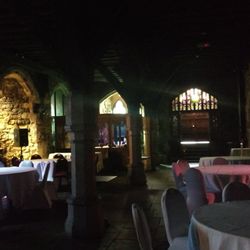
One of the few remaining mediaeval buildings in the city of London, St. Olave's church is a Church of England sanctuary and is also the final resting place of a certain Samuel Pepys (and his wife). With a rich history - it's origins date back as early as 1056 - this is a fascinating church. From Viking invaders to narrowly missing the Great Fire of London to Samuel Pepys' the parishioner and being damaged in the Blitz. A lot has happened to this small church but it's still here. The Reverend (who's name escapes me but he's a very nice man) enjoyed telling us all of this as an introduction to the building and to put in greater context the real reason we were all congregated there - a concert, not a service. A motet about the diaries of Samuel Pepys. The venue making greater sense now and indeed they complement each other. Great acoustics in this squared-ish church and the sound doesn't get lost as there isn't enough church for the sound to become lost in. This leads me to believe that regular church services and worship would also ring well in here but I can't account for that. With numerous statues and intrinsic sculpted work on the décor, as well as a large plaque featuring Mr Pepys high up on a wall where a balcony once sat - and, indeed, where the real Pepys regularly sat. There's also a crypt down some narrow, steep stairs at the back of the church which takes you to some centuries old bits of church and whatnot. Then there are more narrow, steep steps that lead further in to the crypt and the final resting place of Mr and Mrs Pepys. You can't see them, there's a wall in the way but they're there! Not to mention even more centuries old stuff. All in all, delightful and accessible being near Fenchurch St station and Tower Hill station. The power of Christ compels you! Ian read more


18 years ago
St Olave's Church, Hart Street, in the City of London is a small mediaeval church, where Samuel Pepys and his wife Elizabeth lie buried. It was saved from the Great Fire of London in 1666 by tearing down rows of houses between it and the fire. London was all wood remember. Pepys was was of the people who saved it. Then of course the Blitz in WWII destroyed most of it. The fire was so intense the bells melted but they scraped up the metal and took it back to the SAME foundry the bells were made and they were recast in the original moulds. It is suprising how many entries, in books written just after the war, say church destroyed in the blitz and yet there it still is. Heritage preserved. Charles Dickens was also very fond of the church. He nicknamed it the 'Churchyard of Saint Ghastly Grim' and wrote about it in The Uncommercial Traveller. He tells a wonderful tale about being an insomniac and at midnight, in the middle of a thunderstorm, decided to take a hackney carriage to look at the place. The gateway has skulls pierced by metal and he wanted to see them in lightening. He said the coach driver became extremely nervous and kept looking over his shoulder expecting to see a bat rather than himself. Apparently, Mary Ramsay, the woman who bought the plague to London, was buried here. Usually missed by the majority of tourists it is truely worth a visit. Other interesting stuff in the area too. Opening Times Monday - Friday 09:00 - 17:00 Nearest Underground (Tube) Station: Tower Hill Apparently, Mary Ramsay, the woman who bought the plague to London, was buried here. Here's Dickens on the place: One of my best beloved churchyards, I call the churchyard of Saint Ghastly Grim; touching what men in general call it, I have no information. It lies at the heart of the City, and the Blackwall Railway shrieks at it daily. It is a small small churchyard, with a ferocious, strong, spiked iron gate, like a jail. This gate is ornamented with skulls and cross-bones, larger than the life, wrought in stone; but it likewise came into the mind of Saint Ghastly Grim, that to stick iron spikes a-top of the stone skulls, as though they were impaled, would be a pleasant device. Therefore the skulls grin aloft horribly, thrust through and through with iron spears. Hence, there is attraction of repulsion for me in Saint Ghastly Grim, and, having often contemplated it in the daylight and the dark, I once felt drawn towards it in a thunderstorm at midnight. 'Why not?' I said, in self-excuse. 'I have been to see the Colosseum by the light of the moon; is it worse to go to see Saint Ghastly Grim by the light of the lightning?' I repaired to the Saint in a hackney cab, and found the skulls most effective, having the air of a public execution, and seeming, as the lightning flashed, to wink and grin with the pain of the spikes. read more

More info about St Olaves Church
St Olaves Church Reviews in Other Languages












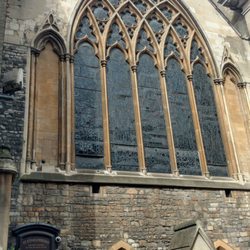




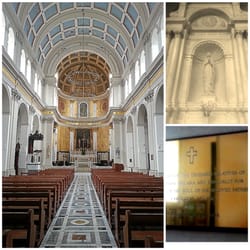


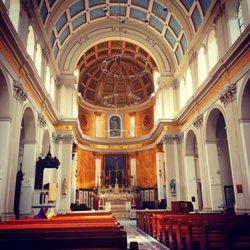
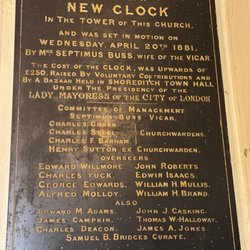
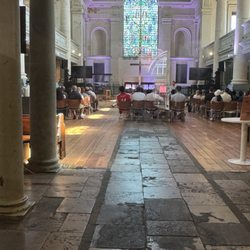

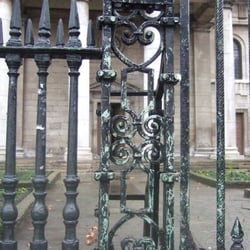


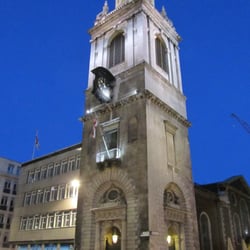
St Olaves Church - churches - Updated August 2026
Browse Brands
Browse Articles
People who viewed St Olaves Church also viewed

St Giles Cripplegate Church
1 review
Barbican

St Dunstan's in the East
18 reviews
Aldgate

Southwark Cathedral
29 reviews
London Bridge

Temple Church
16 reviews
Holborn

Westminster Cathedral
28 reviews
Westminster

St Helens Church
2 reviews
Aldgate

St Botolph without Aldgate
5 reviews
Aldgate

St Margaret's Church
12 reviews
Westminster

St. Bartholomew the Great Church
7 reviews
Farringdon

Westminster Abbey
450 reviews
Westminster