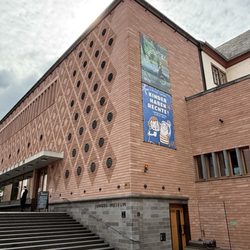
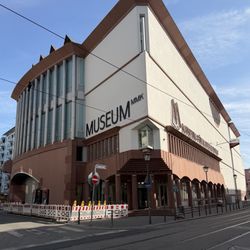
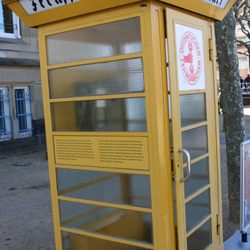
While a new building is being constructed to replace the old Gutenberg Museum since 2024, part of…read moreits collections are exhibited in the Natural History Museumin Mainz. This fact is so well known that when a fellow bus passenger overheard us talking about the Gutenberg Museum, he insisted that we get off a stop earlier than planned because there was a shortcut there that didn't appear on GoogleMaps. Gratitude!
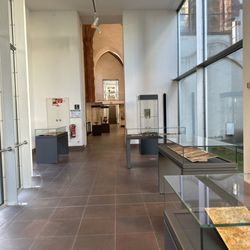
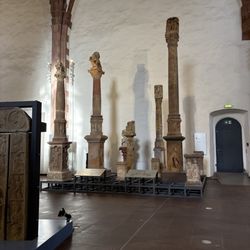
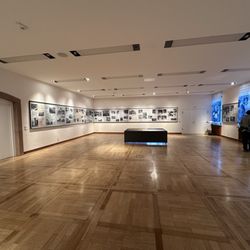
The exhibit is held in the left wing of the museum in what was the Reichklara, or the Poor Clare Monastery of St. Clare. Admissions includes a plain white card with an embedded chip in it which can be placed at various stations throughout the exhibit. The chip informs the station which language in which to present its visual information. Audio information is "only" available in German or English, but that is already pretty amazing. Both are interactive and save the exhibition space from being cluttered by lengthy summaries.
The card also works at a selfie station which transforms your likeness as if it were a black & white print and add it to a medieval background setting.
Was very impressed to hear during the presentation that movable type had already been invented in China in the 11th century. There is no evidence that Johannes Gutenberg was ever in that part of the world, which means he independently came up with the invention as well as a number of related innovations in the mid-15th century. As a goldsmith, he created an alloy of lead, tin, and antimony to cast his type pieces, an alloy with a low melting point. This alloy would remain in use for printing for the next 500 years. His type pieces were fashioned for an alphanumeric which made it efficient to cast mutiple pieces from the same mold. Finally, his black ink was a mixture created from linseed oil and coal.
Unfortunately, there was no protection for his invention or innovations in the 15th century. His investor walked away with Gutenberg's workshop as well as his apprentice, who was the investor's son-in-law.
Gutenberg's famous bible was printed only in black ink. He eventually innovated a way to add a second color, but in the original series of 180 bibles, he left spaces for illustrators to add color. The pages were sold for buyers to engage their own illustrators and bookbinders, so no two copies are identical. Only 49 copies are known to still exist, with only 25 copies of the 2-volume edition complete. They were styled after the handwritten manuscripts of the day, written in two columns. They were known as B42 because they had 42 lines of text per page.
The printing press made written work available relatively rapidly. In the past, a monastery could provide one bible every 3 years. With the printing press, 180 copies could be produced in the same period. Sadly, this probably led to the eventual decline of the monastery.