Beehive Hut Photos


More like Beehive Hut
Recommended Reviews - Beehive Hut
Start your review...



11 years ago
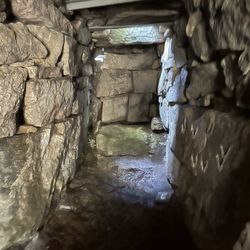
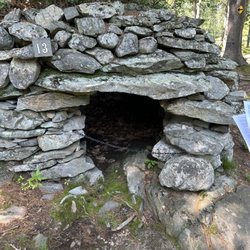
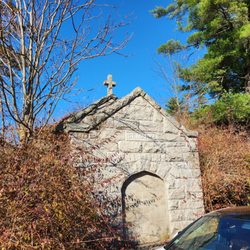
This is one of several mysterious stone chambers in New England, whose provenance and purpose is unknown. Usually they are square or rectangular in shape, with stone slabbed roofs and soil floors. Archaeologists usually try to claim that they were built by early colonists as 'root cellars' yet they are ill-suited to that task as the floors are soil, which is hardly conducive to dry storage. There is also some documentary evidence from early colonists saying that the chambers were there when they arrived. Other chambers have had very old trees growing out of their walls, evidence that the chamber must be older than the tree. Another theory is that they were sweat lodges used by native Americans, but there is no evidence to show that any native groups built stone sweat lodges. So who did build these things? The closest equivalent in Britain is the souterrains of Scotland or fogous of Cornwall, but these tend to be larger and have curved layouts. The corbelled roof construction is similar to the beehive cells constructed by early monks like the Culdees, but there the similarity ends. Maybe it was early Viking explorers? An earlier megalithic culture that we don't know about? It's a fascinating enigma. Research by antiquarians and earth mystery researchers has shown that many chambers have precise geometric ratios in their construction, and that they are aligned to significant solar events like midwinter solstice, and this Beehive Hut seems no exception. The proportions are almost exactly 2:1 - it is just short of being twice as long as it is wide, and the width and height are the same. The entrance (by my estimation) seems to be aligned to midwinter sunrise (it's hard to be precise because of the tree cover), and is situated part-way up a hillside, which would allow the rising sun to enter the chamber. There are an interesting couple of white quartz stones, one in the back wall and one in the left-hand side wall, which may mark the extremes of the sunrise positions between equinox and winter solstice. But as I'm not resident here I am unable to do the long-term observations that this theory would require to confirm it. Interested locals should get in touch with the New England Antiquities Research Association (NEARA), who will know more about these things. read more
More info about Beehive Hut























Beehive Hut - landmarks - Updated August 2026
Best of Danville
People found Beehive Hut by searching for…
Places to Take Pictures in Danville, NH
Scenic Overlook in Danville, NH
Arts & Entertainment in Danville, NH
Public Services & Government in Danville, NH
Historical Sites in Danville, NH
Hiking Trails With Waterfalls in Danville, NH
Urban Exploration in Danville, NH
Waterfalls and Swimming Holes in Danville, NH
Places to Walk in Danville, NH
Tourist Attractions in Danville, NH
Browse Nearby
BEST of Danville, New Hampshire Restaurants near Beehive Hut
BEST of Danville, New Hampshire Things to Do near Beehive Hut
BEST of Danville, New Hampshire Coffee near Beehive Hut
BEST of Danville, New Hampshire Attractions near Beehive Hut
BEST of Danville, New Hampshire Breakfast near Beehive Hut
BEST of Danville, New Hampshire Parks near Beehive Hut
BEST of Danville, New Hampshire Hotels near Beehive Hut
BEST of Danville, New Hampshire Ski Resorts near Beehive Hut
BEST of Danville, New Hampshire Campgrounds near Beehive Hut


