Was it only last year that we all got into a tizzy with the eclipse that was visible from Texas to…read moreMaine? People went NUTS. So I totally get that this marker is here, to an earlier eclipse and in a part of the country that was well populated.
The Smithsonian Astrophysical Observatory, which dispatched a team to Wadesboro, North Carolina, chosen for its optimal viewing conditions. Photographer Thomas Smillie rigged cameras to seven telescopes and captured eight glass-plate negatives of the solar corona--some as large as 30 by 30 inches. These images were considered groundbreaking for both photography and astronomy. The U.S. Weather Bureau selected Newberry, South Carolina for a meteorological study, based on historical cloudiness data. Their goal was to observe how the eclipse affected atmospheric conditions. Their gamble paid off: skies were clear, temperatures moderate, and pressure high, allowing for ideal observations. The eclipse's duration increased as it moved eastward, from about 72 seconds in New Orleans to roughly 100 seconds near Norfolk, Virginia.
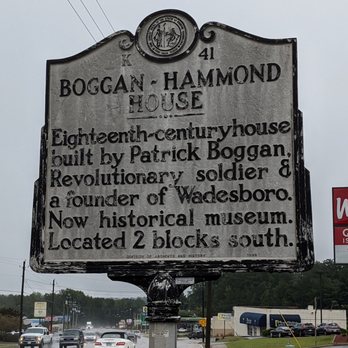
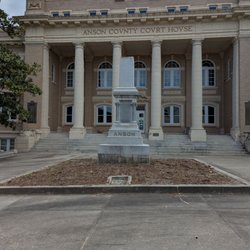
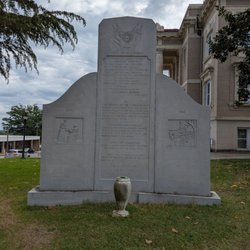
It is a black marker with white text. It has the same on both sides, reading , "In 1900, hundreds of astronomers and newspaper reporters from around the world descended on Wadesboro, the perfect place to view and report on a total solar eclipse that occurred on May 28 at 1:54 PM. The goal was the rare opportunity to study the corona around the sun at total eclipse. Preeminent scientists came from around the world, among these representatives from the University of North Carolina, University of Chicago-Yerkes Observatory, Princeton, Yale, the Smithsonian, and the British Astronomical Association. Newspaper reporters from the Charlotte Observer and Charlotte News, the New York Sun, the New York World and New York Journal, the Chicago Times-Herald, the Chicago Tribune. the Philadelphia Press, the London Times, and the local Anson Independent and the Messenger and Intelligencer covered the event.
"The event, which lasted precisely 2 minutes and 10 seconds, took years of planning, months of preparation, days of anticipation and hours of waiting. Tens of thousands of pictures and measurements taken that day would be studied for years to come."
The marker was erected in 2017 by the Anson County Historical Society.
The eclipse was one of the first eclipses to be widely documented by both scientists and the public, marking a turning point in eclipse science and public engagement.
[Review 1330 of 2025 - 4449 in North Carolina - 24882 overall]