Cancel

    Open app

    Search

    Cimitero di Poggioreale

    4.5 (2 reviews)
    Closed 8:00 am - 6:30 pm

    Cimitero di Poggioreale Photos

    Cimitero di Poggioreale Reviews in Other Languages

    Verify this business for free

    Get access to customer & competitor insights.

    Verify this business

    Piazza del Plebiscito - Piazza del Plebiscito

    Piazza del Plebiscito

    4.5(26 reviews)
    5.0 kmPlebiscito/Centro

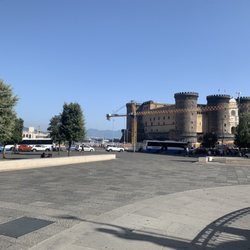
    Naple's most iconic square is framed by Prefettura di Napoli a government office on the north, on…read morethe south by Palazzo Salerno (Sede del Comando Territoriale Sud - currently military offices), by the royal palace on the east, and Basilica of San Francesco di Paola to the west. The last two are open for visitors and pretty quiet on an April evening. The port area and waterfront public park Giardini del Molosiglio are nearby within walking distance to the southeast. As magnificent and grand as these surrounding buildings and others nearby are, this piazza also very much a piece of the local cloth. Where school groups and tourists frequent during the day, is open space in the evening for kids riding bikes and playing soccer, for families taking walks with strollers and dogs. While I was there it was fun to see a group of students singing along to a couple musicians on a guitar and mic, a few kids flying kites, the sun setting to the west casting a warm glow onto the structures in the square. Fun facts: - named after a plebiscite (aka referendum or survey) which united Naples with the rest of Italy. - Joachim Murat, bro-in-law of Napoleon had planned to dedicate the square to the emperor though when the Bourbon rulers were restored to the throne plans changed. Hence today the two statues in from of the church are Bourbon kings Charles III and his son Ferdinand I. They also instructed the completion of the neoclassical basilica along this square. - there's a local game/tradition of attempting to cross the square blindfolded starting from the center of the main entrance of the royal palace with the goal of walking directly in the middle of the two statues. Legend is that it's an impossible feat, due to the irregular shape of the square, uneven cobblestones and slight slope. - the square became a parking lot in 1963 to deal with the overflow of cars in the city, then reconfigured back to pedestrian only in 1994.

    It's the main public square in front of the Royal Palace of Naples. It's very close to Stazione…read moreMarittima terminal where many cruise ships dock. I'd say this square is about a 10 minute walk away. There's a pedestrian walkway that makes it easy. This is another great walkable city, and much easier than navigating the narrow roads by car. It's a lively square full of tourists and local residents. There's much to do and see here. I think even the pickiest eater will find something delicious at any of the restaurants and bakeries around it. What attracted me the most were the statues in the niches between the arched columns of the palace. The stone work was also very impressive. This type of volcanic rock was readily used for construction throughout the city during that time period. It's very evident here. You'll continue to see it as you walk through the historical city center. It's a must just for the historical significance of it. You might as well see this plaza while walking around the city center.

    Photos
    Piazza del Plebiscito - Piazza del Plebiscito

    Piazza del Plebiscito

    Piazza del Plebiscito - Piazza del Plebiscito

    Piazza del Plebiscito

    Piazza del Plebiscito

    See all

    Piazza San Domenico Maggiore

    Piazza San Domenico Maggiore

    4.6(11 reviews)
    3.7 kmCentro Storico

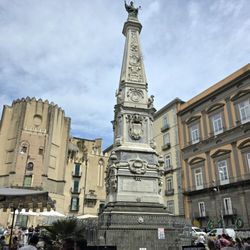
    You can't miss it. It's the public square in back of the Church of San Domenico Maggiore, and just…read moreoff of Spaccanapoli (or Via Benedetto Croce). This is also where you'll find the beautiful Obelisk of San Domenico which towers over the square. It's a symbol of resilience & hope, but I couldn't help but feel like it's also protecting everyone. It was erected after the plague of 1656 that devastated Naples. So, maybe its purpose is to make you feel that way. There are also former palaces on each side of it. The Palazzo Petrucci currently houses a Michelin Star restaurant of the same name. You'll also see the outdoor terrace of their pizzeria in the plaza. On the opposite side is the Palazzo Corigliano. It's currently occupied by a college of a university that teaches languages. There's history and worldliness all around this piazza. It's a lively public area that is frequented by locals, tourists, parishioners, and students. You'll see the young, the elderly, and all ages in between enjoying the shops & restaurants. You can ideally spend a couple of hours here just watching how Naples lives. It's a cool place to be when near this historic city center.

    Located on the edge of Spaccanapoli, (now renamed Via Benedetto Croce,) a main tourist promenade in…read morethe historic center of Napoli. At the center of this square is a 18th-century obelisk monument dedicated to San Domenico (Saint Dominic, founder of the Dominican Order), credited for eradicating the 1656 plague. On the northern edge of the square is the Chiesa di San Domenico Maggiore, a gothic church with a beautiful interior, completed in 1324, altered to a Baroque style in 1670 then back to Gothic in the 19th century. Sepulchers located in the sacristy house members of the royal family of Aragon. The neighboring buildings are comprised of former palaces of the aristocracy now repurposed for other uses. Palazzo Petrucci houses a pizzeria, B&Bs, and a cafe, Palazzo di Sandro is home to a lute maker, Palazzo Corigliano a library and cafes. The original location of Scaturchio, one of Naples' oldest pasticcerias (see my separate review) sits along the southern edge of the piazza. Walking around this oldest quarter of the modern city, you'll inevitably pass by, hopefully when it's not too crowded. I enjoyed walking through early morning while most stores were just opening up, a glimpse of the city's daily clockwork before the bustle sets in.

    Photos
    Piazza San Domenico Maggiore - Obelisk of San Domenico in the piazza.

    Obelisk of San Domenico in the piazza.

    Piazza San Domenico Maggiore - Obelisco di San Domenico in Piazza San Domenico

    Obelisco di San Domenico in Piazza San Domenico

    Piazza San Domenico Maggiore

    See all

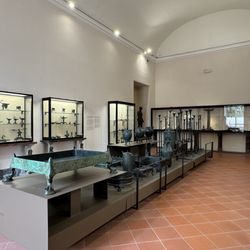
    Museo Archeologico Nazionale - Lighting and heating instruments collection

    Museo Archeologico Nazionale

    4.4(59 reviews)
    3.7 kmCentro Storico

    One of Naples' crowning museums, the artifacts here complement a visit to Pompeii in the same trip,…read moresince the collections span archaeological finds from Pompeii, Rome and beyond. From sculpture, sacred and funerary objects, mosaics, paintings, household items and furniture, to architectural models and decorative elements, there's plenty of intriguing objects to pique various interests. On a grey Sunday morning in April, I arrived at 10am, and was glad I didn't come later! There were two lines, one for those purchasing tickets at the entry and those with pre-booked tickets online in advance. The latter was a fairly short line, maybe about 10 people, while the former was about 20ish. When I left a couple hours later both lines had more than doubled in length. Inside, the exhibit halls begin with sculptures unearthed during archaeological finds, with the direction of visit encircling one of the smaller inner courtyards. They do an excellent job of providing Italian and English translations for didactic labels and descriptions, and I was able to learn much about a) the background and provenance of sculptures and other finds, b) key figures in archaeological excavations which discovered many of the pieces now housed here, and c) the history of this museum. The route of visit continues to a columned hall with some waiting area seating and contemporary local art pieces, (apparently where school groups rest before touring the museum with docents), which lead up a pair of curved stone staircases where you can look upwards at a central dome. On the second floor highlights include a collection of watercolor works from watercolorist Luigi Bazzani, who captured colorful paintings of Pompeii at the turn of the 20th century, a collection of elaborate furniture, and many rooms of artifacts from steles, ceramics, blown glass and tableware. Many colorful wall paintings found in villas and homes were transferred from archaeological sites to this museum. There's a curious collection of erotic art from antiquity called the Secret Cabinet* too. Unfortunately both these sections were closed: a) the mosaic floor where they previously allowed visitors to enter wearing cloth covers over shoes, and b) the sprawling mini replica of Pompeii that looked to be at least 12 x 15 feet. The latter I glimpsed thru a walkway that was cordoned off. The Sundial Hall, named after (you guessed it) a functional sundial installed in the SW corner of the room, was one of the most impressive rooms in the museum, originally serving as the Bourbon** Royal Library of Naples, then later as the National Library. The beautifully restored ceiling fresco depicts the Bourbon royalty as patrons of the arts. Among the most famous group of objects here are items from the Farnese Collection, begun by then Cardinal Alessandro Farnese (1468-1549), who later became Pope Paul III. Theses works were displayed in various settings notably the Farnese palace, villa and gardens in Rome, then subsequently passed down to descendants. Farnese Hercules, Farnese Artemis, the Farnese Bull and the Farnese Cup are all sublimely sculpted pieces. The total time recommended is easily 2.5-3 hours, additional if you want to read more of the placards. Free lockers, coat check and bathrooms are available. Admission is €20.00 for regular tickets, €2.00 for 18-25 year olds, free for teachers, disabled and those with certain city passes including Artecard and Naples Pass. Hours: 9.00 am - 7.30 pm with last entry at 6.30 pm Closed Tuesdays. *did not post these pics as I didn't want to get flagged for posting explicit content! lol **Bourbon as in the royal dynasty that ruled southern Italy from 1734 until 1860. Not the whisky made with a higher percentage of corn from the southern United States. =)

    If you visit Pompeii or Herculaneum, you must visit this museum to see the treasures found in those…read morelocations. Sign up for their free Wi-Fi so that you can download the map because there is very poor signage throughout the museum to help guide you. I was disappointed by the T-shirts they had available because they didn't show the name of the museum in a prominent way, only teeny little letters below an image.

    Photos
    Museo Archeologico Nazionale - Museum cafe

    Museum cafe

    Museo Archeologico Nazionale - Paintings from early 1st century AD

    Paintings from early 1st century AD

    Museo Archeologico Nazionale - Stairs to second story

    See all

    Stairs to second story

    Cimitero di Poggioreale - landmarks - Updated June 2026

    Loading...
    Loading...
    Loading...