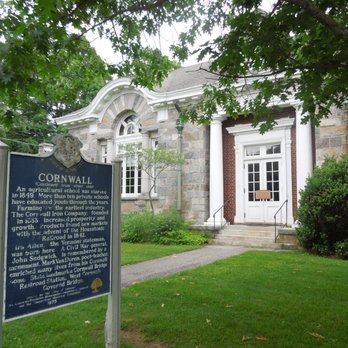
Cornwall Historical Marker Photos


More like Cornwall Historical Marker
Recommended Reviews - Cornwall Historical Marker
Start your review...



So my dog and I decided to take a nice socially distanced walk in Cornwall, and see this lovely sign while there. Right now, being between two blizzards, it's really hard to get to the back of the sign, but the front is readily accessible from the cleared sidewalk. Interestingly, the Town Hall still has Christmas decoration up in the windows. You can literally hear cows mooing in the distance, that's how peaceful and country this sign is. read more

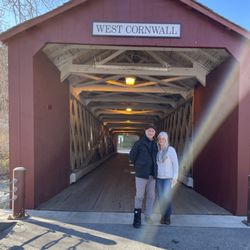
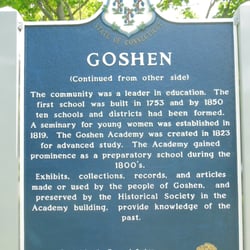
This is the 140th historical marker I photographed and wrote about. But it's the very first time that what I read and what I'm writing includes the word "Obookiah". That's a "who?" and not a "what?", because the O Man was a Hawaiian student at Cornwall's Foreign Mission School two hundred years ago. That's one of the historical nuggets you'll read about on this marker. It's a two-sided marker from the CT Historical Commission with the familiar white lettering on a blue background. Its located on the front lawn at Town Hall on Pine Street. The sign dates to 1975, and its condition shows some signs of wear and tear -staining, fading, and peeling. Obookiah would be sad to see that. The full inscription reads: This area was once part of the Western Lands ordered surveyed by the Legislature in 1731. Yale Lands were surveyed and three hundred acres were set aside for income for Yale College in 1732. At an auction in Fairfield in 1738 the town was sold in fifty shares, named Cornwall, and incorporated in 1740. After the church "gathered" in 1740 schools began to open. In time there were seventeen school districts. The Foreign Mission School in 1817 numbered among the students an Hawaiian, Obookiah, who links Cornwall eternally to Hawaii. An agricultural school was started in 1849. More than ten private schools have educated youth through the years. Farming was the earliest industry. The Cornwall Iron Company, founded in 1833, increased prosperity and growth. Products found new markets with the advent of the Housatonic Railroad in 1842. Ira Allen, the Vermont statesman, was born here. A Civil War general, John Sedgwick, is remembered by a monument. Mark Van Doren, poet-teacher, enriched many lives from his Cornwall home. State Landmarks: Cornwall Bridge Railroad Station, West Cornwall Covered Bridge. Erected by the Town of Cornwall The American Revolution Bicentennial Committee of Cornwall and the Connecticut Historical Commission 1975 read more


More info about Cornwall Historical Marker

















Cornwall Historical Marker - landmarks - Updated September 2026
Best of Cornwall
People found Cornwall Historical Marker by searching for…
Browse Nearby
BEST of Cornwall, Connecticut Restaurants near Cornwall Historical Marker
BEST of Cornwall, Connecticut Museums near Cornwall Historical Marker
BEST of Cornwall, Connecticut Things to Do near Cornwall Historical Marker
BEST of Cornwall, Connecticut Coffee near Cornwall Historical Marker
BEST of Cornwall, Connecticut Hotels near Cornwall Historical Marker
BEST of Cornwall, Connecticut Parks near Cornwall Historical Marker
BEST of Cornwall, Connecticut Ski Resorts near Cornwall Historical Marker
BEST of Cornwall, Connecticut Campgrounds near Cornwall Historical Marker
BEST of Cornwall, Connecticut Breakfast near Cornwall Historical Marker


