Cancel

    Open app

    Search

    Kobyliská střelnice

    3.5 (2 reviews)

    Kobyliská střelnice Photos

    Kobyliská střelnice Reviews in Other Languages

    Verify this business for free

    Get access to customer & competitor insights.

    Verify this business

    Orloj

    Orloj

    4.4(102 reviews)
    6.0 kmStaré Město, Praha 1

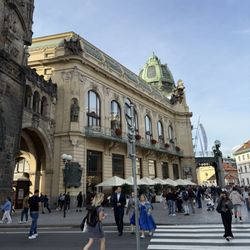
    Oldest working astronomical clock in the world faithfully performed at top of the hour.read more

    This magnificent clock is not just a timekeeper but also an impressive work of art that tells a…read morestory about the history of Prague and its people..Many call this one of the most over-hyped attractions in Europe, but I did find some interesting points after listening to our tour guide. The Astronomical Clock was built in the 15th century and is the oldest working clock of its kind in the world. It consists of three main components: the astronomical dial, the calendar dial, and the figurines. The astronomical dial displays the position of the sun, the moon, and the stars, as well as the time of day. The calendar dial shows the current date, zodiac signs, and saints' days. Finally, the figurines perform every hour, with the twelve apostles appearing in a procession. The clock face displays four different times, some recognizable and others ancient. Beginning on the outer edge of the dial, in deep blue, is Bohemian (or Old Czech) time shown in the Gothic numbers. The day consists of 24 hours and starts from the sunset (rather than midnight, as we'd use today). Bohemian time was utilized by Holy Roman Emperor Charles IV, and is pointed by the golden hand. Next is Central European Time (CET) Zone, two sets of 12 hours shown in Roman numerals inside the Bohemian time numbers. CET is also indicated by the golden Sun hand. Third is Babylonian (or Arabian) time, the oldest time displayed on the astronomical dial. Babylonian time, displayed in black Arabic numerals, separates the time between sunrise and sunset; that's why there are only 12 hours. Finally, there's star time, or sidereal time. Sidereal uses the time it takes Earth to rotate once on its axis and return facing a distant star. Its time is 23 hours and 56 minutes, four minutes shorter than a solar day. A solar day is defined by when the Sun is overhead at noon, which must account for the Earth tracking one degree, or day, along its orbit around the Sun and hence is longer. Follow the little golden star among the Roman numerals for sidereal time. Now you are prepared to tell time via the stars or even back in the Middle Ages. Fun piece of workmanship.

    Photos
    Orloj - People around every turn

    People around every turn

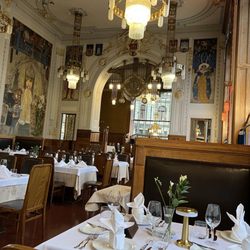
    Orloj - Dining area inside

    Dining area inside

    Orloj - The famous astronomical clock in Prague, it was constructed in 1410

    See all

    The famous astronomical clock in Prague, it was constructed in 1410

    Národní památník Vítkov

    Národní památník Vítkov

    4.6(7 reviews)
    5.0 kmŽižkov, Praha 3

    You really do earn your views, walking up to this monument…read more I have to put a disclaimer out there, though - we made the mistake of trying to visit Vitkov without checking their site. I had us allotting time to this monument on a different day in the week, but we needed to make adjustments on the fly, which led to us making the long hike up the hill and many steps only to find...the museum was closed. Yeah...that blew. But - the views! The WIND! It was super windy the day we went. It was also a beautiful sunny day. There were a few people that were hanging out in the sun, or taking pictures of the fantastic vistas, and even - crazily enough! - running up and down the steps. We were surprised by how devoid of people it was, but once we found out that the museum was closed, it made a ton of sense. The monument is HUGE. There just aren't any words to describe how freaking big this thing is. My husband spent a good few minutes staring, wondering aloud how they got something so large up so high. It's incredibly impressive, and I'm sad that we weren't able to visit the museum to learn more about the history of the place. We actually walked the whole way up and down. I'm sure there are trams and/or buses that can get you there faster, but we didn't feel comfortable with public transit at that point, and thought the walk would be nice. We were right, but it's tough. Definitely worth the time and effort, though. Even with the wind and the many steps, I'd go back (when it's open) to visit.

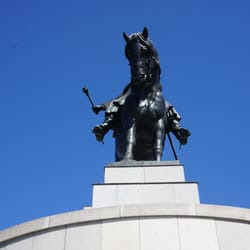
    Instantly recognizable from afar... this is no small hill... It stretches and it looms... from it,…read moreone can see loads of landmarks, including Černý's weird baby TV tower. But I digress... This kicked us into gear..... located in Zizkov (Praha 3), we walked from our garsonka and through the tunnel that leads up on a trial to climb the very visible hill which has at its top, the Hussite leader Jan Zízka (not to be confused with Jan Hus), and then OVER the top of it into Karlin, Praha 8. In fact, all of the Praha 3 quarter is named after this dude who courageously fought a historic battle, pushing back the Crusaders. It was a very cold day and the hike took a good few hours.....most memorial was the large equestrian statue by Bohumil Kafka was erected in 1950. Too, there is a large mass of marble and granite overlooking the city. Super interesting; glad I did it. Lots of locals to say "Dobry den" to.

    Photos
    Národní památník Vítkov - From the base of the statue

    From the base of the statue

    Národní památník Vítkov - Entering the courtyard

    Entering the courtyard

    Národní památník Vítkov

    See all

    Kobyliská střelnice - parks - Updated September 2026

    Loading...
    Loading...
    Loading...