Cancel

    Open app

    Search

    Lienzo Charro del Peñón

    3.0 (1 review)

    Lienzo Charro del Peñón Photos

    Lienzo Charro del Peñón Reviews in Other Languages

    Verify this business for free

    Get access to customer & competitor insights.

    Verify this business

    Templo Mayor - Busto de Cuauhtémoc

    Templo Mayor

    4.6(78 reviews)
    7.3 kmCentro Norte

    The history in this part of Mexico City is incredible. If you're visiting, you should absolutely…read moremake time to stop at Templo Mayor--it gives you a completely different understanding of the region. Templo Mayor was the central temple of the Aztec capital, Tenochtitlán, which once stood in the middle of Lake Texcoco. After the Spanish conquest led by Hernán Cortés, the city was destroyed, and much of its stone was reused to build what is now the Metropolitan Cathedral and surrounding colonial structures. What's fascinating is that the ruins remained hidden for centuries. The first parts of the ruins were discovered during construction work in the 1970s and earthquakes in the 1980s revealed more of the remains. Standing here, you really feel the layers of history. Within a short walk, you can see modern Mexico City, Spanish colonial architecture like the cathedral, and the exposed Aztec ruins--all in one place. It's a powerful visual of how this city has evolved over time. If you made the trip to Mexico City, don't skip this stop. Even just walking through the area gives you a sense of history spanning from the Aztec empire, through Spanish colonization, to the present day. It's an experience that really stays with you.

    Built initially in the early 14th century, Templo Mayor aka the "Main Temple" sits in the middle of…read morewhat was originally the geographic and religious center of the capital city of Tenōchtitlan, when it was still an island city in the middle of Lake Texcoco. As a sacred site for the Mexica peoples, the structures erected here were dedicated to two deities--Huitzilopochtli, god of war, and Tlaloc, god of rain and agriculture. A shrine was built for each at the top of the temple on the main pyramid. From archaeological analysis, the temple was rebuilt six times, with the largest expansion under Mocteczuma I in 1454, though in 1521 the majority of the building was destroyed by Spanish colonizers when the whole city was razed and rebuilt following Spanish occupation. Notably the Metropolitan Cathedral which stands today adjacent to this site was one of the buildings which were built over it. By the 19th century the exact location and history of this sacred precinct had been lost but toward the end of the 1800s part of the temple corner was uncovered. However there wasn't an official organized effort to excavate and preserve the site until 1978-82. In 1987 the site became listed as an UNESCO world heritage site and a museum was built to house its artifacts and findings. When I was there in January I didn't go into the museum though walked around the edges--they've done an excellent job framing it with walkways along the west side, so it's somewhat of a public park. There are a few small scale models of what the precinct would've looked like in different eras, and a dedicated viewing platform. With entry to the museum you get closer access into the site with some walkways within the site itself. The entrance to the museum is free for Mexican citizens and 95 pesos for foreigners. Three floors with eight main exhibition halls focused on the deities, rituals (including human sacrifice), the role of the temple in economics and trade of the time, and flora and fauna of past Mesoamerica. In excavations more than 7000 objects were found and work continues on the site today.

    Photos
    Templo Mayor - Busto de Cuauhtémoc

    Busto de Cuauhtémoc

    Templo Mayor - Busto de Cuauhtémoc

    Busto de Cuauhtémoc

    Templo Mayor - Tenochtitlan

    See all

    Tenochtitlan

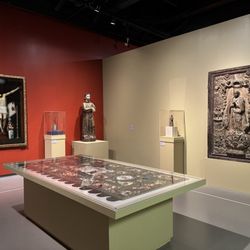
    Antiguo Colegio de San Ildefonso - Delicate beadwork and embroidery used on shawls and apparel for the upper crust

    Antiguo Colegio de San Ildefonso

    4.4(28 reviews)
    7.3 kmCentro Norte

    In doing some research on CDMX prior to visiting, this former college came up as one of the OG…read moremural sites. I'm glad I stopped by! Located in the central historic district a half a block walking from the northern entrance to Templo Mayor, its unassuming exterior belies an interior of several courtyards encircled by arched columns. Looking closely past the arches to the shadows behind, shapes and colors shift into the foreground. Three stories of murals along the walls and stairwells draw you closer to examine. Images of historical events, symbolic figures, cultural events, depictions of native peoples to modern Mexico, you'll find a bit of it all here. The building started as a Jesuit boarding school, then a national boarding school in the late 1800s. Painters were given government commissions to paint murals featuring historical and political events in the 1920s, which is how paintings from artists like José Clemente Orozco, Diego Rivera, David Alfaro Siqueiros, and Jean Charlot came to live here. When the school closed in 1978, it was reinvented as a museum and cultural center in 1992, with temporary art and history exhibits. When I visited there were a few exhibits going on, notably "Somos" detailing the role of Mexico in the Pacific to Atlantic trade route, from Manila to Aculpoco, and its lasting cultural artifacts visible in Mexican society. Another adjacent exhibit "TROPICAL: Stories from Southeast Asia and Latin America" brings together waves of art in reaction to major political changes in Mexico then more recently in SE Asian cultures. I felt enlightened learning about the cross-cultural exchange and how certain imported and exported items perpetuated like china poblana shawls. Most info placards were in Spanish so if you don't know the language, then a translation app would be helpful. For more info: https://www.sanildefonso.org.mx/

    We hadn't planned on visiting the Colegio de San Ildefonso but the beautiful building stopped me in…read moremy tracks when we were exploring the area. We happened to walk in on a Sunday, when it's free to visit. So we spent an hour or so wandering around the colegio, which I learned is considered to be the birthplace of the Mexican muralism movement! The history: The Colegio began as a Jesuit boarding school and then was the National Preparatory School. When the National Preparatory School closed in 1978, the building wasn't in use until it reopened as a museum in 1992. The Colegio is now a museum and cultural center which hosts exhibitions. But it's also to many murals - by Jose Clemente Orozco, Diego Rivera, and other artists! It's worth visiting the Colegio to see these murals alone. When we visited, there was also an amazing exhibit - Vlady: Revolucion y Disidencia (at the museum through April 2023). The Colegio was really beautiful (the building, the murals, the art), and it's well worth a stop if you're exploring in the area!

    Photos
    Antiguo Colegio de San Ildefonso - Cabinet inlaid with carved ivory figures

    Cabinet inlaid with carved ivory figures

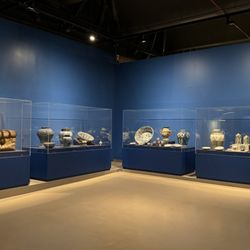
    Antiguo Colegio de San Ildefonso - Objects obtained in trade with Asian countries

    Objects obtained in trade with Asian countries

    Antiguo Colegio de San Ildefonso

    See all

    Lienzo Charro del Peñón - arts - Updated August 2026

    Loading...
    Loading...
    Loading...