Cancel

    Open app

    Search

    McCormick Farm Photos

    You might also consider

    Recommended Reviews - McCormick Farm

    Your trust is our priority, so businesses can't pay to alter or remove their reviews. Learn more about reviews.
    Yelp app icon
    Browse more easily on the app
    Review Feed Illustration

    1 year ago

    Helpful 0
    Thanks 0
    Love this 0
    Oh no 1

    1 year ago

    Helpful 11
    Thanks 5
    Love this 15
    Oh no 0
    Photo of Mer B.
    0
    16
    6

    7 years ago

    Helpful 0
    Thanks 0
    Love this 0
    Oh no 0

    5 years ago

    Helpful 0
    Thanks 0
    Love this 1
    Oh no 0
    Photo of WS U.
    3
    204
    175

    13 years ago

    Helpful 1
    Thanks 0
    Love this 0
    Oh no 0

    Verify this business for free

    Get access to customer & competitor insights.

    Verify this business

    Stonewall Jackson House - The Jackson House

    Stonewall Jackson House

    4.3(32 reviews)
    16.0 mi

    I've visited here thrice over 2 decades and learn something new every time. I went on a Saturdsy in…read moreearly April was was unreasonably warm at 80 degrees. Our tour guide Wanda was informative. A family with 4 children between ages 3 to 8 were the others on my tour. The parents indicated that they were being home schooled which to me explained their good behavior and genuine interest in history. Understandably, the presentation was geared to the 4 children which I was fine with. The adjoining museum holds a surprising amount of Jackson paraphernalia, and the attendants were most helpful. Heard of Stonewall Jackson but interested in Major Jackson the family man and husband? Then check this out!

    I did not visit the house but I stopped and reviewed this wonderful historical marker that is…read moreplaced outside. It's worth pointing out that we're in the south and Virginia fought for the Confederacy which may be a problem for some. The marker has the same text on both sides, reading "Virginia Military Institute instructor Maj. Thomas J. Jackson (1824-1863) and his second wife, Mary Anna Morrison (1831-1915), bought this house in 1858. Built ca. 1801, this typical middle-class dwelling was the only house Jackson ever owned. Enslaved African Americans Amy, Hetty, George, Cyrus, and Emma worked and lived on the property. Jackson left Lexington in April 1861 to fight for the Confederacy. Later known as "Stonewall," he became a lieutenant general. Mary Anna Jackson moved to North Carolina but owned this house until 1906, when it became the community hospital. The house has been a museum since 1954 and is listed on the National Register of Historic Places." This is marker number Q-11-a and was erected by the Department of Historic Resources in 2021. [Review 19589 overall - 1426 in Virginia - 560 of 2023.]

    Photos
    Stonewall Jackson House - A painting bought in Niagara Falls where he'd honeymooned

    A painting bought in Niagara Falls where he'd honeymooned

    Stonewall Jackson House - The Jackson House Historical Marker, Lexington

    The Jackson House Historical Marker, Lexington

    Stonewall Jackson House

    See all

    Woodrow Wilson Presidential Library & Museum

    Woodrow Wilson Presidential Library & Museum

    4.2(32 reviews)
    17.1 mi

    My partner and I are trying to visit all of the Presidential Museums/Libraries, and were here this…read moremorning. The Museum is a relatively small building on the street (with exhibits primarily on one floor), with Wilson's birthplace in a home a few doors down. Despite the small size, the exhibits did a decent job of highlighting some of the positives (League of Nations, less dependence on tariffs for government income, workmen's compensation, among others) and negatives (the guy was, shall we say, not supportive of integration when it came to African Americans). We spent about an hour in the Museum, including a few minutes in the WWI trench exhibit in the basement. All very interesting, well presented, and easy to understand. The highlight of our time was the docent-led tour of the Wilson home. Although Wilson lived in the home only for his first 18 months, the docent told a number of stories about Wilson's parents, Wilson's life there and later and it was a fascinating almost-hour time touring the building, asking questions and hearing the history.

    Since I'm a history buff, I have been meaning to visit this Presidential Library. It's not a large…read moremuseum but very informative. I recommend taking the guided tour of Wilson's boyhood home and then visiting the museum. It's located in a residential neighborhood next to Mary Baldwin college. The staff was very friendly and they have a well stocked gift shop. Plenty of parking. I really enjoyed the WWI exhibit down stairs and the President's automobile. I did learn quite a bit about post WWI and the woman's suffrage movement. If you enjoy Presidential history this is a good museum.

    Photos
    Woodrow Wilson Presidential Library & Museum
    Woodrow Wilson Presidential Library & Museum
    Woodrow Wilson Presidential Library & Museum

    See all

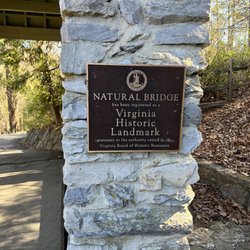
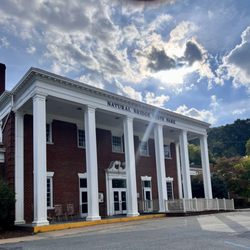
    Natural Bridge National Historic Landmark

    Natural Bridge National Historic Landmark

    4.1(177 reviews)
    27.6 mi

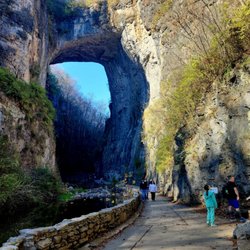
    I enjoyed learning the history of the bridge. The cave arches were breathtaking. I did not enjoy…read moreclimbing the stairs to return to the main building, but the experience was definitely a hike! I was excited to watch otters fish for food in the streams. The waterfall was not as grand as I expected it to be, but the natural scenery was worth viewing for $9. As a bonus, there is a trail to a cave.
    This is a perfect place to take a road trip break! We did exactly that on a recent drive from…read moreAsheville to Richmond. The visitor center was easy to find and the building reminded me of those found at the University of Virginia, which was founded by Thomas Jefferson. Coincidentally, Thomas Jefferson also owned the land on which the Natural Bridge is located. After paying your admittance fee at the center, you head down several stairs and will pass a small waterfall. Very soon thereafter, you will see the Natural Arch. There is a flat path that leads you through the arch where you can continue your stroll along a steam for about 15 minutes to see a larger waterfall. "Saltpeter Cave" can also be found along the path. It was interesting to read that Mr. Jefferson leased out this shelter for the excavation of potassium nitrate which was eventually used to make gun powder. While I would not make the Natural Bridge a destination trip, it is definite worthwhile to explore if passing through the area.

    Photos
    Natural Bridge National Historic Landmark
    Natural Bridge National Historic Landmark
    Natural Bridge National Historic Landmark

    See all

    Blue Ridge Tunnel

    Blue Ridge Tunnel

    4.6(17 reviews)
    20.9 mi

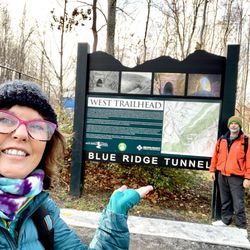
    We chose to park in the West Trailhead side and walked in from that direction of the tunnel. We…read morestarted out with our flashlights on but wanted to walk the tunnel without the flashlights. The Experience was fantastic. We did turn on our flashlights when we saw people approaching so we would not startle them. It is dark, damp, and cold in the tunnel. You hear the little water falling inside. We had pocket warmers and I think they were needed. We were both happy we had our pocket warmers. The hike to the tunnel has wonderful forest views and an excellently maintained trail. They also have some plaques with historical information on them. We really thought that was a nice additions to our hike. Both sides of the tunnel has picnic tables. The picnic tables are brand new this year. We stopped and had lunch. There are 2 parking areas. East Trailhead Blue Ridge Tunnel and West Trailhead Blue Ridge Tunnel. Both have a porta potty but no running water. So you will want to take some hand sanitizer. Easy hike, 4.6 miles. Out and back. 370ft elevation gain. The best maintained trail I have ever seen. Hiker friendly, kid friendly. Dogs on leash, Forest view, tucked away on the side of a mountain, Historical tunnel view. Some of the trail is paved, then gravel, and then dirt with gravel mix. Make sure you leave no trash behind

    We had a group of eight for the hike. We started on the east side. The walk through the tunnel…read morewas great. I was thankful that started on the east side because it was a pretty steep and long climb after the tunnel. It was 4.5 miles total for the walk. To have the steepest part at the middle was perfect rather than having it at the end. Highly recommend. The tunnel is not claustrophobic at all as it is large inside and you can see the end the entire time. It was a perfect fall hike with the leaves changing. We stopped at Blue Mountain Brewery afterward (only 6 minutes away) for lunch.

    Photos
    Blue Ridge Tunnel - Tunnel on the east side of

    Tunnel on the east side of

    Blue Ridge Tunnel - West Trailhead is great parking

    West Trailhead is great parking

    Blue Ridge Tunnel

    See all

    Museums At Washington And Lee University

    Museums At Washington And Lee University

    4.7(19 reviews)
    16.1 mi

    This university has a unique historical niche. The name really is what it sounds like, and the…read moreuniversity has a several exhibitions memorializing George Washington and Robert E. Lee. Most notable is the university's chapel and Lee memorial, which had a volunteer out to explain the history (and the fact that the museum was being renovated so there wasn't a ton to see). Several other buildings were within walking distance, including one which housed exhibitions of porcelain, and some interesting pictures of mines with brightly colored chemicals. The individual museums were not large, but the combined experience is worth stopping to take a look at. There is no charge to enter and there is a small circle dedicated to museum parking.

    Absolutely jaw dropping experience. I am a hugeeee civil war buff and seeing this in person was…read moreamazing. You enter the chapel doors and see Lee's bodice. You are able to walk around it and take pictures. Downstairs is his crypt and office. And outside the door downstairs is all the information about Traveller! Here's some history! It was 1861, Lee was in the mountains of West Virginia commanding a small Confederate force that would suffer defeat in the Battle of Cheat Mountain; this earned him the nickname "Granny Lee" because people thought he was afraid to shed blood. Here he met Captain Joseph M. Broun, quartermaster of the 3rd Infantry of Wise's Legion, mounted on a steed that would eventually become Lee's famous warhorse Traveller. The original owner named the horse Jeff Davis after the Mississippi senator who would become President of the Confederacy; but when Broun bought the horse for military service he renamed him Greenbriar. Before Lee had an opportunity to acquire the horse, he was sent on orders to the Palmetto State. Captain Broun's company was also later transferred to the Lowcountry. As fate would have it, he met Lee again at Pocotaligo. Immediately recognizing "his colt," the general still showed such a fancy for the horse that the junior officer realized he had little choice but to offer it up as a gift. Lee declined, saying he would gladly purchase the animal. Broun let Greenbriar go for the same price at which he purchased him: $175, or approximately $4,500 in today's currency, but the General added a tip of $15 to compensate for the depreciation of Confederate money. Lee named him Traveller. At the 2nd Battle of Bull Run, Traveller spooked and threw his master down against a stump. Lee broke both hands and finished out the campaign in an ambulance, or with a courier leading his horse. But, more generally, Traveller was noted for bravery and, at times, soldiers had to literally surround him and grab the reigns to keep him from plunging ahead with their commander onto the front lines of battle. In his final years, Lee served as President of Washington College in Lexington, Virginia. Traveller was allowed to graze about the campus, but so many star-struck students stole hairs from his mane and tail that Lee complained in a letter to his daughter, "He is presenting the appearance of a plucked chicken." In the fall of 1870, Lee suffered a stroke and died two weeks later. For the funeral procession, Traveller was saddled up and decked out with black crepe. He led along behind the ammunition cart bearing Lee's casket. Within a year, Traveller stepped on a rusty nail and contracted tetanus. He was shot to end his misery. Traveller was initially buried behind the main buildings of the college, but was unearthed by persons unknown and his bones were bleached for exhibition in Rochester, New York, in 1875/1876. In 1907, Richmond journalist Joseph Bryan paid to have the bones mounted and returned to what was now Washington AND Lee University. The skeleton was periodically vandalized there by students who carved their initials in it for good luck. In 1929, the bones were moved to the museum in the basement of the University Chapel, where they stood for 30 years, deteriorating with exposure. Finally in 1971, Traveller's remains were buried in a wooden box encased in concrete next to the chapel a few feet away from the Lee family crypt inside, where his master's body rests. The stable where he lived his last days, directly connected to the Lee House on campus, traditionally stands with its doors left open; this is said to allow his spirit to wander freely. When the 24th president of the university violated this tradition, he caught so much flack from the community that he had to have the doors repainted in a color he called "Traveller's Green," just so he could redeem himself.

    Photos
    Museums At Washington And Lee University
    Museums At Washington And Lee University
    Museums At Washington And Lee University

    See all

    McCormick Farm - landmarks - Updated May 2026

    Loading...
    Loading...
    Loading...