O Max Gardner Historical Marker Photos
More like O Max Gardner Historical Marker
Recommended Reviews - O Max Gardner Historical Marker
Start your review...



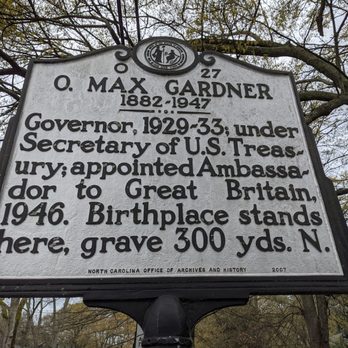
This historical marker is located along busy US-74 Business but is accessible. It recalls a former governor of North Carolina. It reads, "O. Max Gardner. 1882-1947. Governor, 1929-33; Under Secretary of U.S. Treasury; appointed Ambassador to Great Britain, 1946. Birthplace stands here, grave 300 yards north." Online, there is more information. "Oliver Max Gardner, whose political organization dominated state politics for a generation, took office only months before the stock market crash of 1929 and responded to the economic crisis with retrenchment and centralization of governmental functions. Like his brother-in-law Clyde R. Hoey part of the "Shelby Dynasty" (a term Gardner disliked), the future governor was born on March 22, 1882 in the Cleveland County town." "In 1900 Max Gardner enrolled at the North Carolina College of Agriculture and Mechanic Arts (present North Carolina State University) and in 1906 he studied law at the University of North Carolina. At both schools he captained the football team." "In 1910 Gardner was elected to the state senate and four years later was returned for a second term, during which he served as president pro tem. In 1916, the year Thomas W. Bickett was elected governor, Gardner was elected lieutenant governor. In 1920 Gardner entered the race to be Bickett's successor. In the first primary Robert N. Page was eliminated but in the second Cameron Morrison, with the backing of the political machine of Senator Furnifold Simmons, defeated Gardner. The Shelby attorney returned to his law practice and to his farm. With partner O. M. Mull he founded Cleveland Cloth Mill. Gardner remained active in party politics and in 1928 was unopposed for the Democratic nomination. He defeated Republican Herbert F. Seawell handily in the fall." "For eight years, under the administrations of Cameron Morrison and Angus W. McLean, the state had witnessed relative prosperity. The onset of the Depression presented Governor Gardner with unforeseen challenges. In 1930 he authorized a study of state government by the Brookings Institution which recommended a massive shift of power from county courthouses to Raleigh with the state taking responsibility for all secondary road maintenance and public school costs. Other reforms included reduction of property taxes, limits on local bond issues, and creation of a central purchasing agency. With the governor's support, the legislature approved workmen's compensation, the secret ballot, and abolition of the chain gang system." "On racial matters, Gardner was perhaps the most progressive Democratic governor to date. While his record on race is imperfect, he seemed to genuinely care about the plight facing Black North Carolinians and championed continued improvements in education, social services, and public health." [Review 14966 overall, 468 of 2021, number 2846 in North Carolina.] read more