Cancel

    Open app

    Search

    Parrocchia San Giovanni

    5.0 (1 review)

    Parrocchia San Giovanni Photos

    Recommended Reviews - Parrocchia San Giovanni

    Your trust is our priority, so businesses can't pay to alter or remove their reviews. Learn more about reviews.
    Yelp app icon
    Browse more easily on the app
    Review Feed Illustration
    Photo of Richard F.
    156
    2682
    12009

    9 years ago

    Helpful 0
    Thanks 0
    Love this 0
    Oh no 0

    Verify this business for free

    Get access to customer & competitor insights.

    Verify this business

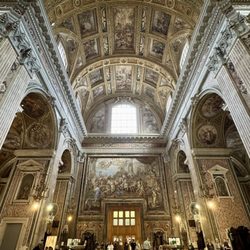
    Chiesa del Gesù Nuovo - Closer look at the main altarpiece in the front

    Chiesa del Gesù Nuovo

    5.0(7 reviews)
    44.7 km•Centro Storico

    Naples has no shortage of historic basilicas and church buildings and this is one of the most…read moreimpressive in the city. Highly recommend to drop by for a look as admission is free (donations accepted), and they are open later until 7pm so it's convenient to swing by before heading to dinner. On a cloudy day in April apparently many like-minded visitors had the same idea as it was fairly busy, though not extremely crowded. Located on the western edge of the Centro Historico district, the "New" in its name distinguishes it from another existing church of the name Gesu Vecchio. Initially the palace residence built in 1470 for Roberto Sanseverino, Prince of Salerno, political divisions led to his son and heir Ferrante Sanseverino being exiled and property confiscated, and this property sold to the Jesuit order. In 1584 construction began, led by appointed architect Giuseppe Valeriano, to convert this aristocratic palazzo to Jesuit church. The palace's unique facade was the only remnant left, with its bugnato (rusticated) grey volcanic-stone punta di diamante (diamond point) protrusions. What's even more intriguing is that this facade, designed by original palazzo architect Novello da San Lucano, who was also a composer, incorporated musical notes in Aramaic letters incised into the stone, which has been interpreted by musical historians as sheet music. The music has been named "Enigma" and you can find it played on YouTube. Other scholars interpret these symbols to be related to alchemy and esoteric practices popular in the day. This building passed between different hands thru the centuries though in 1900 definitively returned to the Jesuits. Nowadays it's known for the vast number of artworks that line its ceilings and chapels. They were certainly awe-inspiring to see! I spent about 30-45 minutes walking around, this is a functioning parish so administrative offices, prayer sections, a shop for purchasing ex-votos and souvenirs, and other functional facilities are also present. Hours: 8am-12:45pm, 4-7pm daily.

    What a big surprise! There's a hidden gem behind that palace facade. You enter through the Baroque…read morelooking entryway at the Piazza of the same name. We were totally amazed at what we saw inside this church. I would have never known based on its exterior. It's immensely grand and ornate as you walk inside. The ceiling and chapels are covered in Italian Baroque art from famous artists such as Francesco Solimena and Luca Giordano. There are alters made of precious stones and marble statues. All of which are saintly and historical. I didn't realize it at the time, but people do go there to be healed. There is a chapel dedicated to a Naples doctor & saint named Giuseppe Moscati. His tomb lies under the chapel altar. He is known for taking care of the sick and the poor. There was a line of people waiting to enter a part of the church that houses his personal quarters and belongings. We didn't get to see it, so I can't comment on it. It's just something to consider seeing while you're there. This whole area is full of historical churches. I mean, you could visit churches all day long if that's your thing. This is a great option if you only have time to visit one, and it's free to the public. They accept donations as most churches do.

    Photos
    Chiesa del Gesù Nuovo - The Chapel of St. Francesco

    The Chapel of St. Francesco

    Chiesa del Gesù Nuovo - Looking towards the entrance

    Looking towards the entrance

    Chiesa del Gesù Nuovo

    See all

    Cattedrale di Sant'Andrea Apostolo - Some of the basilica's treasures

    Cattedrale di Sant'Andrea Apostolo

    4.7(27 reviews)
    11.3 km

    Absolutely stunning architecture. So much history built on…read morethis beautiful part of the Amalfi coast. We enjoyed the coolness of the cathedral. And all of the express expressions of Art throughout.. It is so worth the time to go and enjoy the incredible history.

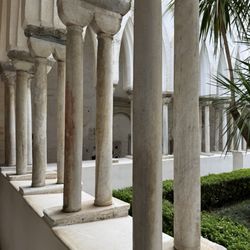
    Standing at the foot of the famous steps of Amalfi Cathedral (aka Duomo di Amalfi Or Cattedrale di…read moreSant'Andrea), it's hard not to stop and take in how beautiful this place is. Located in Piazza Duomo, the cathedral is one of Amalfi's most important landmarks and dates back to the 10th century, when it was built under Duke Manso I. Over the centuries, it has been rebuilt and redecorated, blending Romanesque, Baroque and other architectural influences. Most famously, it is home to the relics of the Apostle Andrew, which were brought to Amalfi in 1208 and remain in the cathedral's crypt. We climbed the steps, purchased our modestly priced tickets, and started by walking through the Cloister of Paradise, with its beautiful arches and columns. We browsed some of the exhibits before heading down into the crypt, where St. Andrew is said to be laid to rest. The crypt was probably my favorite part--beautifully and intricately decorated, with detailed frescoes, gilded stucco and a large bronze statue of the apostle at the altar. We then made our way into the cathedral itself and spent some time soaking in the beautiful architecture. There's quite a bit to see here without needing a huge amount of time, took us maybe 30-40 minutes to make our way through. The cathedral is conveniently located right in the center of Amalfi, making it an easy addition to any itinerary. Overall, I enjoyed our visit. It's beautiful, historic and definitely worth climbing those steps for. The green marble and intricate details reminded me of the Cathedral in Siena, which was one of the most beautiful cathedrals I've ever been to. Definitely take the time to go inside rather than simply admiring the cathedral from the piazza if you have the time.

    Photos
    Cattedrale di Sant'Andrea Apostolo - Ceiling art

    Ceiling art

    Cattedrale di Sant'Andrea Apostolo - In front of the Cathedral

    In front of the Cathedral

    Cattedrale di Sant'Andrea Apostolo - Double columns around a small courtyard

    See all

    Double columns around a small courtyard

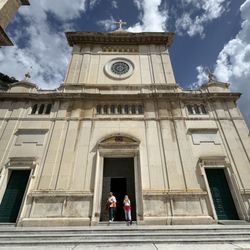
    Church of Santa Maria Assunta - Front facade

    Church of Santa Maria Assunta

    3.7(3 reviews)
    20.9 km

    Situated close to water level in a central part of Positano, in Piazza Flavio Gioia, this church is…read morean easily recognizable landmark with it's colorful gold and teal majorlica-tiled dome visible from the east, and it's clean, rectangular facade. Founded as a Benedictine abbey dedicated to Saint Vitus around the 10th century, even then, it was built over a former Roman villa previously established in the 8th century, (now excavated and able to be visited via guided tours). Known for its Black Madonna and Child, a Byzantine iconographic painting above the main altar, this arrived in the 12th century supposedly under curious circumstances. Story goes that enroute from Constantinople, smuggled on a pirate ship, the ship experienced a lull in wind and current close to Positano, where the sailors heard a voice calling "Posa, posa!" ("Put me down, put me down!") so the icon was brought to shore and placed in a church. The next morning the icon was found outside on the ground, wrapped in a bush, and locals were mystified, taking this as a sign to build a church on that site and dedicate it to the Virgin Mary as their new patron saint. The free-standing bell tower was built later in 1707. On a sunny day the cool interior provided a welcome shelter for a short while from the sun. The interior reads a blend of Baroque and Neoclassical, with last major renovation affecting the building layout in the late 18th century. White walls with gold trim, along with arched windows set into the ceiling and bringing in sunlight, give the interior an elegant, warm feel. It's also popular for weddings in this region, so on a weekend you might run into a wedding being held here. For more info: https://www.travelamalficoast.it/en/the-church-of-santa-maria-assunta-in-positano-amalfi-coast https://chiesapositano.it/en/church-of-s-maria-assunta/

    You must have seen its dome in the foreground of Positano landscapes. The church's colorful…read moremajolica tiled dome is one of the town's iconic symbols, its pattern of yellow, green and blue tiles shining against the blue sky and the Mediterranean Sea. Famous for its fashion design and nearly vertical setting with colorful villas stacked one on top of another up the cliff side, the Church of Santa Maria Assunta is an important part of Positano's cultural, religious and architectural landscape. The church is one of the town's most prominent and photographed sights, as it is located right in the center of Positano just a few steps from the Marina Grande beach. Walking along the beach or through the narrow staircases lined with boutiques, the Church of Santa Maria Assunta is always at the center of attention. Most of the staircases leading up from the Marina Grande Beach pass behind or through the small piazza in front of the church. From there you can enjoy the view of the façade of the church and the 18th-century bell tower.

    Photos
    Church of Santa Maria Assunta
    Church of Santa Maria Assunta - Bell tower

    Bell tower

    Church of Santa Maria Assunta - View from the hillside opposite

    See all

    View from the hillside opposite

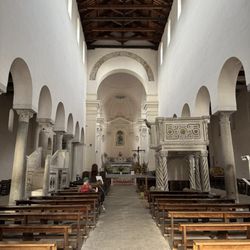
    Duomo di Ravello - Inside nave

    Duomo di Ravello

    4.5(2 reviews)
    10.1 km

    This simple yet imposing structure dominates Piazza Vescovado, the main town square in Ravello…read more With its origins dating back to the 11th century, its style mixes Romanesque and Baroque, though its current minimalist facade is a result of restoration in 1931. Dedicated to St. Pantaleone, the patron saint of physicians and midwives, martyred in the 4th century, he is also the patron saint of Ravello. The construction of this duomo was ordered by Orso Papice, the first bishop of Ravello, supported by the Rufolo family, a wealthy merchant household that also built the nearby Villa Rufolo (see my separate review for that!). The church is known for containing a relic from the saint, a vial of his blood that supposedly liquefies annually on his feast day July 27. Another notable feature are its ornate bronze doors, dating back to 1179. The bell tower of this church dates to the 13th century, I didn't climb up since it was close to closing when I visited, though I imagine the views are stellar. A small church museum is accessible via a side entrance, holds a notable marble bust believed to be Sigilgaida Rufolo, the wife of Nicola Rufolo, the 13th-century merchant who commissioned the cathedral's pulpit. Detractors maintain the sculpture depicts the Madonna or Joanna, Queen of Naples in the 14th century. For more info: https://www.ravello.com/attractions/duomo/

    The itinerary did not include an event here, but to pass it several times a day is an honor. It's…read moresurprising to say no one has written anything about this quaint beauty. Until now. Perfectly located.

    Photos
    Duomo di Ravello - Side view

    Side view

    Duomo di Ravello - Front facade

    Front facade

    Duomo di Ravello - A little about the church

    See all

    A little about the church

    Parrocchia San Giovanni - churches - Updated September 2026

    Loading...
    Loading...
    Loading...