I often wonder if my reviews are boring but some places have a fascinating history for those…read moreinterested. This is well worth a look if only for the beautiful setting and the views.
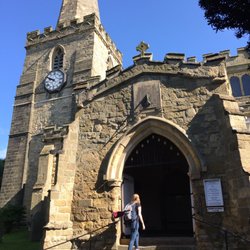
The church enjoys a commanding position above Scarborough's 'old town' and offers excellent views over the harbour and South Bay. It occupies one of the highest points in Scarborough and is close to the entrance to Scarborough Castle.
There's been a church on this site since at least 1150. During the 1400s St Mary's was extended and was much bigger than it is today. The church was severely damaged in 1645, during the Civil War, when it caught up in a siege of the nearby castle.
The parish church of St. Mary, originally a convent for the Cistercians, is a vicarage, in the patronage of Lord Hotham. This church was formerly a spacious and magnificent
structure, as the ruins at the eastern part of it sufficiently indicate, and in the time of Henry VIII. It was adorned with three ancient towers; but during the siege of the castle, a lodgment was made in it by Sir John Meldrum, and the present edifice is only a fragment of that which the
Carmelites enjoyed. This was the only church in Scarborough, though the town could once boast its three houses of friars -grey, black, and white as many places did.
It was originally built (1170-1200) with imposing twin towers possibly by the Masons at the Castle. Extensions and
alterations, including the removal of the twin towers, were carried out during the fourteenth century. The Central Tower and the Chancel were destroyed by artillery during the Civil War when the Parliamentarians used the Church for their batteries to attack the Royalist held Castle. The existing tower was rebuilt in 1670 and the extent of the original Chancel is marked by masonry.
St Mary's Chapel. First built about AD 1000 and rebuilt in the 12th century and again in the 14th century, it stands in the ruins of a Roman Signal Station built AD 370, to give warning of Anglo-Saxon raiders. Before this time the headland was occupied about 500BC by Iron Age settlers from the
Low Countries or the Rhineland.
St Mary's church is situated a short distance from Scarborough Castle, high above the harbour and the old town. As I said the church was badly damaged during the siege of the Castle in 1644-45, and its central tower collapsed in 1659.
The church of St Mary belonged to the Abbey of Citeaux, but passed to Bridlington with the confiscation of the property of the Alien Houses. The twelfth century church was probably an aisle-less building and a much larger new church was begun around it 1180. The West front, formerly with two towers, is the earliest art of this structure and was followed by the nave arcades of which the arches sit irregularly upon cylindrical piers. This may mean that the bays and piers were inserted individually in the walls of the earlier nave.
The western part of the South arcade has a thinner wall and a different types of pier rather later date than the rest.
The surviving south transept was built in the second quarter of the fourteenth century and late in the same century the barrel-vaulted chapels were added to the South aisle and a second aisle was added on the North.
The aisled chancel was rebuilt about the middle of the fifteenth century. It was much damaged in the siege of the Castle in 1644-45, and ruined by the fall of the central tower in 1659; the North transept also fell into ruin. The present tower was built in 1669 and the outer North aisle in 1848-50.
Anne Bronte (sister of Charlotte) was buried in St Mary's churchyard after her death in 1849. Her funeral service was held at nearby Christ Church because of restoration work being carried out at St Mary's. (Christ Church was demolished in 1979).
She worked as a governess and only became noted as a great author in her own right many moons later.
She was obliged to accompany the family on their annual holidays to Scarborough. Between 1840 and 1844, she spent around five weeks each summer at the resort, and fell totally in love with the place. It is evident from her novels that Anne explored almost every corner of Scarborough. she died
of consumption (TB) Over the following few days, Charlotte made the decision to
'lay the flower where it had fallen':
Charlotte only re-visited the grave once - on 4 June 1852 - a few days after the third anniversary of Anne's death. She did not stay in Scarborough - the memories being too painful, but spent the following three - four weeks in a cottage at the southern end of Filey - a smaller, more
reserved resort, situated about eight miles further down the coast. On her arrival at Scarborough she discovered five errors in the inscription on Anne's gravestone, and had to arrange for it to be refaced. It still carries one error today - stating Anne 'died Aged 28': she was, in fact, 29.