Cancel

    Open app

    Search

    Saddlescombe Farm Photos

    Recommended Reviews - Saddlescombe Farm

    Your trust is our priority, so businesses can't pay to alter or remove their reviews. Learn more about reviews.
    Yelp app icon
    Browse more easily on the app
    Review Feed Illustration
    Photo of Georgia A.
    0
    210
    319

    16 years ago

    Helpful 0
    Thanks 0
    Love this 1
    Oh no 0

    Verify this business for free

    Get access to customer & competitor insights.

    Verify this business

    Church of St Michael and All Angels, Southwick

    Church of St Michael and All Angels, Southwick

    5.0(1 review)
    4.3 mi

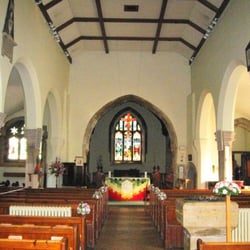
    Southwick is now firmly part of the suburban sprawl running from Brighton and Shoreham, and is…read moreknown to most people for the power station that dominates the far side of Shoreham Harbour. But there was a community here in Saxon times, and its church is surprisingly ancient. In fact, the walk from the station crosses the Green, an attractive and villagey stretch of tree-lined common which splits Southwick into two halves. There are some handsome cottages surrounded by well appointed semi-detached suburban homes, and a rather less appealing row of post-war shops. St Michael and All Angels was, until the 18th century, dedicated to St Margaret, and sits among a very pretty churchyard, thickly studded with trees. Although there was probably a church here in Saxon times, it first recorded in 1086, and in 1206 the right to appoint the rector was granted to the Templars, and then to the Hospitallers, although much of the early mediaeval period was taken up with disputes over these rights with the monks of Sele Priory. The ownership passed from Sele Priory to Magdelene College at the Dissolution, and patronage thereafter passed to the Crown until the 20th century. Fire in the 19th Century damaged the nave and an unexploded bomb (and the subsequent excavation to remove it) damaged the tower in 1941. The church itself is built of flint, and is essentially in three parts: the tower, nave and chancel. The tower is by far the most impressive part: its foundations and lower walls are said to be Saxon, although it mostly dates from the late 12th and 13th centuries. It is an attractive composition, with paired round-headed arches with narrow openings surmounted by paired gothic lancets and, above that, a shingle broach spire. The west door is also attractive, but a modern addition: the tower was carefully taken down and faithfully rebuilt in 1950 after the bomb damage, with vestries built either side. The chancel is mostly 13th century, with two original lancets, framed by a 14th century chancel arch. There are two round headed arches to the south, although the central column probably dates from the Victorian rebuilding. A 14th wooden screen with narrow lancets also survives in the south aisle. The nave burned down in the 1830s and was rebuilt with narrow lean-to aisles in 1834, with round-headed arcades and lancet windows. Pevsner's Buildings of England described the nave as a 'loveless cover for pew-space', which I think is a bit harsh, although there's no doubt it doesn't match the quality of the tower. The furnishings other than the south aisle screen - are limited in interest to what appears to be a mediaeval aumbry, some 18th and 19th century tombs and memorials, and a sturdy, square font, probably from the 13th century. The church is today the centre of large and busy parish, and has a vibrant church life, with services daily through the week.

    Photos
    Church of St Michael and All Angels, Southwick
    Church of St Michael and All Angels, Southwick
    Church of St Michael and All Angels, Southwick

    See all

    Bramber Castle - Bramber castle - dry moat

    Bramber Castle

    3.8(6 reviews)
    5.2 mi

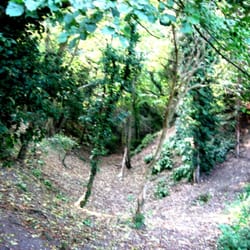
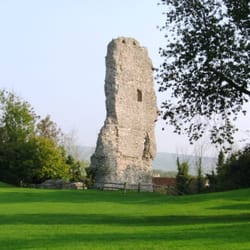
    Built to defend an important port on the River Adur, Bramber Castle was constructed as a motte and…read morebailey castle around 1073 by William De Braose, who fought alongside William the Conqueror at the battle of Hastings in 1066. Apart from a period of confiscation during the reign of King John, it remained in the ownership of the De Braose family until themale line died out in 1324. Thereafter, it passed via the Mowbray and Howard families into the estate of the Dukes of Norfolk, who held it until it until 1926. It was given to the National Trust in 1946. Very little survives of the original castle, thanks to a gradual decline over the years, damage during the Civil War in 1642 and looting of the stones as a quarry for building by the locals. The most prominent feature is the tall and unsteady-looking fragment of the Gatehouse tower, still standing to almost its full original height. In the centre of the grounds is the impressive original motte, its earthen mound rising some 30ft (10m). A short distance away is a section of the curtain wall which survives up to 10ft (3m) in places. Around the perimeter are also the remains of the castle's impressive moat. (NB be careful with small children, as there are some sheer drops in places). Although the ruins are rather fragmentary, the grounds are beautifully kept by the National Trust, and make a wonderful place for a picnic, as well as affording excellent views of the surrounding countryside.

    This place is a bit of a let down. There seems to be no effort to make it obvious where/what parts…read moreof the ruins were. They have a lame sign at the entrance but little else. It just seems like an enclosed play field.

    Photos
    Bramber Castle
    Bramber Castle - Bramber Castle - remains of main gatehouse

    Bramber Castle - remains of main gatehouse

    Bramber Castle

    See all

    Woods Mill Nature Reserve - from website

    Woods Mill Nature Reserve

    4.0(4 reviews)
    3.4 mi

    Woods Mill is a lovely nature reserve located in the picturesque village of Henfield. Its the…read moreheadquarters for the Sussex Wildlife Trust and is also an Environmental Education Center so is an ideal place to take the kids for an afternoon out. I'd be inclined to wait for the summer months as you can spend longer looking around at the Nightingales, woodpeckers, warblers, turtle doves and dragonflies that are all on offer to see without developing early stage pneumonia. They have a beautiful lake here as well and there's plenty more wildlife to hunt around for. Its free admission all year round except for two weeks over Christmas. No dogs allowed obviously but it is a must for anyone interested in wildlife.

    I visited Woods Mill today and was in a very short space of time enraptured with the same sense of…read moreexcitement that I used to feel as a small boy on school trips. This might in part have been brought about by the fact that, for the larger proportion, that's what Woods Mill Nature Reserve is all about. Aside from the preservation of large quantities of birds, fish and amphibians the nature reserve succeeds at every turn to bring you small and interesting amounts of information on each habitat and creature therein. As you enter from the car park there's a notice board with details of events and leaflets for you to pick up. I recommend grabbing the one on the nature reserve itself first as it has a map outlining the route of the winding, sometimes tree covered, path and all the exciting features along the way. In some ways I did get the feeling that the whole place was a little over engineered with so many habitats, which would normally have so much more space, all so close in together. But once you start to see the results of this arrangement such as the lake literally heaving with fish, you soon lose that feeling to fascination. There is also a bird hide, a small wood and perhaps most exciting of all a "Dipping Pond" where in the right months of the year you can head down with your jam jar on a bit of string and catch sticklebacks and newts. All very Gussie Fink-Nottle, but then this is one of the few remaining places where you might still be able to train boys to be the kind more commonly found in a P. G. Wodehouse novel.

    Photos
    Woods Mill Nature Reserve
    Woods Mill Nature Reserve
    Woods Mill Nature Reserve

    See all

    Pyecombe Church

    Pyecombe Church

    5.0(1 review)
    1.6 mi

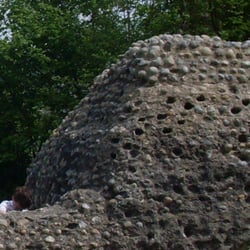
    Pyecombe is a lovely little village, famed for its unique design of shepherd's crooks, and boasting…read morea delightful Norman church. In the 17th century, the plague forced a temporary abandonment of the original village around the church, which led to the modern village being effectively in two distinct parts. Alas, the motorway-like A23 has intruded rather more permanently on the village, although in the churchyard it is still possible to imagine yourself in more tranquil surroundings. The church itself was built in 1170. Its exterior is attractively rendered and inlaid with Sussex flints. The low tower, with its pyramidal cap was added in the 13th century, and the porch - roofed with massive Horsham stone slabs - in the 14th century. The interior has a simple plan, without transepts, plain whitewashed walls and the most basic of Norman chancel arches. But it is beautifully maintained and boasts some interesting fittings: a Jacobean pulpit, dated 1636; very rare decorated 13th-century encaustic tiles in the sanctuary; and, best of all, a Norman lead font, also dating from 1170, decorated with an arcade of perfect romanesque arches and swirling patterns. Although not as fine as that in Brooklands, it is one of only three in Sussex and considered the finest of those. Legend has it that during the Civil War, the villagers whitewashed the font to conceal the fact it was made from lead, lest it be melted down to make bullets. The churchyard has a rare Tapsel gate, pivoted centrally. These gates are found only in Sussex. Pyecombe's is also surmounted by a shepherd's crook, of a type made in the one-time forge opposite. Apparently, tapsel is so local a word it doesn't even feature in the Oxford English Dictionary.

    Photos
    Pyecombe Church
    Pyecombe Church
    Pyecombe Church

    See all

    Clifton Terrace

    Clifton Terrace

    5.0(2 reviews)
    5.0 mi

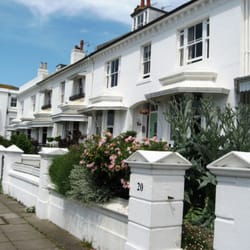
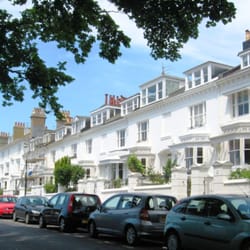
    Clifton Terrace is regarded as one of the most desirable addresses in Brighton, if not the most…read moredesirable. Situated in the Clifton Hill area of Brighton, the Terrace was built in 1847 after the opening of the railway to London, funded by the Barings Bank family and the widow of Thomas Kemp, builder of Kemp Town. The houses are in a single terrace, in the villa style, all in whitewashed stucco. The distinctive ground floor bay windows have deep awnings, some glazed and others covered in lead. The central group of houses has a pair of blind windows with classical pediments, and no awnings. The overall effect is of genteel elegance; homely yet refined. The Terrace is listed at Grade II. The design incorporates Clifton Terrace Gardens opposite - still retained for the sole use of residents - which helps to preserve the stunning sea views from the houses. The gardens were originally the site of Clifton Windmill, removed in 1837. Many of the individual front gardens to the houses are also beautifully kept. This is where I'd love to live - if I could afford to. It's quiet and surprisingly green, yet minutes from the centre of Brighton and around 5 minutes from the sea front. Just perfect. Unfortunately, a house here will set you back about £1 million

    A Beautifull place, situated in a tranquil often overlooked part of brighton. back in the 70's I…read moregot well paid to demolish a complete house in clifton hill over a weekend to create a bigger entrance into the yard of an antique dealer so he could get his lorries in, when eventually the house was rebuilt it was twice as big and afforded covered access to the the rear, a win win situation, but back then not to many people worried about preserving or conserving our heritage. luckily the magnificent terrace and its fine gardens remain as a unequalled example of gentile regency brighton.

    Photos
    Clifton Terrace
    Clifton Terrace
    Clifton Terrace

    See all

    Saddlescombe Farm - landmarks - Updated August 2026

    Loading...
    Loading...
    Loading...