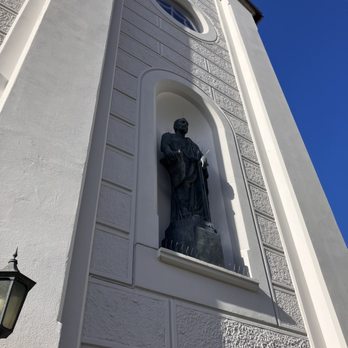
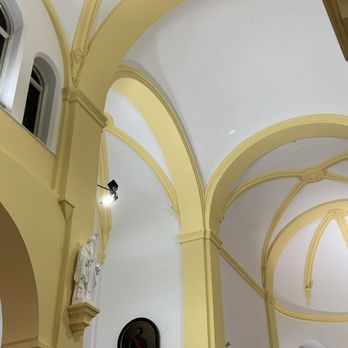
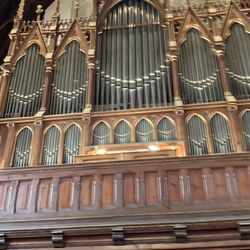
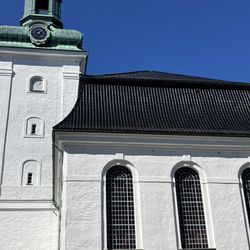
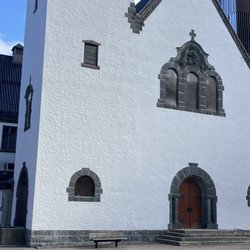
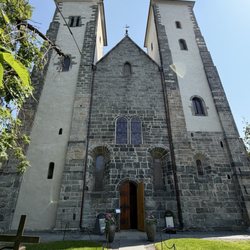
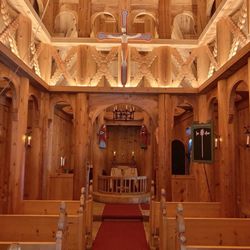
St Mary's church is around 900 years old and the oldest building in Bergen, built between 1130 &…read more1170. It was ravaged by two great fires which swept timber built Bergen in 1198 & 1248. The church has been in continuous use since early medieval period.
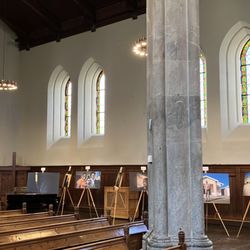
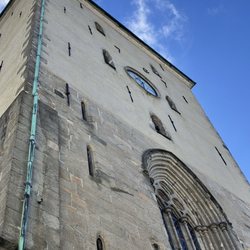
The church is a basilica: the body of the church is divided into a lofty nave and two lower side aisles with separate roofs. This is a feature borrowed from medieval cathedrals, and is relatively seldom found in an ordinary parish church. The two towers must be original though they must have been repaired after the fire in 1248. No other Norwegian church has such a west front.
The pulpit is something of an enigma in Norwegian art history; it resembles no other pulpit in the country. It was presented to the church in 1676, by a group of prominent merchants who had their place of business on the old Hanseatic Warf (Bryggen).
Who actually made it is unknown, but the use of tortoiseshell and lacquer work is foreign to Norway, and suggests countries connected with East Asia, perhaps Holland.
The pulpit and staircase are divided into panels by richly decorated columns. Here we find 8 of the 9 original cardinal virtues, represented by women with various attributes.
Penitence with a pelican, Prudence with a snake, the naked Truth, Chasity with two turtle doves, Patience with a lamb, Hope with a dove, and part of an anchor, Faith with book and cross, and Charity with two children.
The portals of St Mary's are also especially interesting. There are four in all, but the western portal (between the towers) has been added after the completion of the church. However, they are still original from the Middle Ages.
The oldest of the portals, is the one in the northern side aisle. This type with its straight lintel crowned by a discharging-arch, can be traced back to Roman times, and was widely used in the Middle Ages. The portal in northern wall in, is totally different and more usually found in medial churches. The portal is recessed in three steps, so that the door lies approximately in the middle of the wall. The next step in development is the late Romanesque and Gothic grand portal, which is typical of the thirteenth century.
We found it really worth a visit.