Cancel

    Open app

    Search

    Welcome To Rome

    4.5 (2 reviews)
    Open 9:00 am - 7:00 pm

    Welcome To Rome Photos

    Recommended Reviews - Welcome To Rome

    Your trust is our priority, so businesses can't pay to alter or remove their reviews. Learn more about reviews.
    Yelp app icon
    Browse more easily on the app
    Review Feed Illustration

    9 months ago

    Helpful 1
    Thanks 0
    Love this 1
    Oh no 0

    8 years ago

    Helpful 0
    Thanks 0
    Love this 0
    Oh no 0

    Verify this business for free

    Get access to customer & competitor insights.

    Verify this business

    Museo Ebraico Di Roma - The synagogue

    Museo Ebraico Di Roma

    4.4(8 reviews)
    0.8 kmCentro Storico

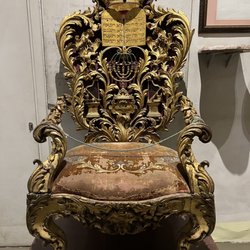
    Explore over two thousand years of history at the Museo Ebraico di Roma, the Jewish Museum of Rome…read more Located in the basement of the Great Synagogue of Rome, it offers insight into the Jewish community in Rome since the second century BCE. The museum explains the history and relationship of the Jewish community with Rome. Jews have lived in Rome for over two thousand years. Their presence in Rome predates Christianity. It is probably the oldest continuous Jewish community outside of the Israel and the Middle East. Written records trace the Jewish community to as early as 161 BCE when Judah Maccabee sent envoys to Rome. During the Roman Imperial period, as many as twelve synagogues existed in the city. During the Middle Ages, Jews spread out throughout Europe, but were often forced to flee and relocate from the city where they had settled due to religious persecution. They often move to Rome. In 1492, all Jews (and others who were not Catholic) were expelled from Spain. Many fled to Rome. This led to a great diversity in religious customs and traditions. Despite tension and restrictions, Rome is the only city in Europe to never expel Jews. For hundreds of years, Jewish families coexisted with their neighbors. They worked as bakers, butchers, physicians, money lenders and craftsmen. As the friction between the papacy and the Jewish community in the 1500s escalated, walled off Jewish ghettos were created following the model in Venice. The Roman Ghetto was established as a result of Papal bull Cum nimis absurdum mandated by Pope Paul IV on 14 July 1555. The bull required that the 2,000 Jews who lived in Rome at the time to live in the ghetto, which was not only walled off, but the gates were also locked from the outside at night to keep them in. The Jewish community was also forced to pay 300 Roman scudi for the construction of the wall and gate. The location was prone to flooding and quite undesirable. By the late 1580s, roughly 3,500 inhabitants were living in inhuman conditions. During the plague of 1656, 800 of the ghetto's 4,000 inhabitants died. The bull revoked almost all the rights of the Jewish community. It placed many restrictions on Jews including prohibition on property ownership (even within the ghetto), not being allowed to provide medical care to Christians and compulsory Catholic sermons on the Jewish Shabbat Following the unification of Italy in 1870, the Jews were granted citizenship of Italy. In 1888, after an agreement between the Jewish Community and the city authorities, the Roman Jewish Ghetto was demolished, including five historic synagogues. The Great Synagogue was subsequently built in the former Ghetto area in 1904. The Roman Ghetto was the last remaining ghetto in Western Europe until ghettos were reintroduced by Nazi Germany in the 1930s. Today, the museum houses artifacts that span those two thousand years of history, including historic menorahs, torahs, circumcision chairs and tombstones. It was also interesting to see rimonim and menorahs from contemporary Roman artists. Check the hours for a visit. The museum also includes a guided timed visit to the Great Synagogue of Rome. Dress code restrictions apply. It is closed on Shabbat and Jewish holidays. Security in place as well.

    The museum is opened 10 to 5, admission is 11 Euro's. We passed airport security, barricades & men…read morewere given head coverings. We wandered through the museum Seeing Jewish life in Rome from the 1400s to the present. About 50 of us took a :30 English tour starting at the old synagogue of Rome. This orthodox temple was built in 1904. The windows are the colors of Rome, it's a square dome to display freedom of the Jews. During the holocaust 2,000 Jews from here were carted to Auschwitz & 41 returned. The temple has been attacked and since the 1980's security has been tight. Currently there are 14,000 congregants; many Libyan Jews have been welcomed. Jew have been a part of Rome since the 1400's. The temple is still being used today and there was a wedding while we were there.

    Photos
    Museo Ebraico Di Roma - Menorah

    Menorah

    Museo Ebraico Di Roma
    Museo Ebraico Di Roma - Circumcision chair

    See all

    Circumcision chair

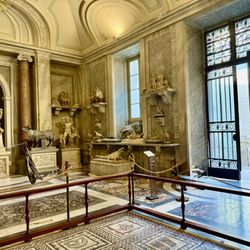
    Musei Vaticani - Hall of Animals in the Pio Clementino Museum

    Musei Vaticani

    4.2(546 reviews)
    1.8 kmVaticano, Città del Vaticano

    The Vatican Museums are vast and absolutely beautiful from the tapestries, to the sculptures, to…read morethe frescoes. Pictures do not capture the beauty of the art that has been collected over the years by the Vatican. This is an extraordinary experience for people who enjoy art, history, and religion. Highly recommend doing a tour that includes the Vatican, Museums, Sistine Chapel, and St. Peter's Basilica. The early morning tour is the best to avoid the crowds and the lines. The downside of the tour is that there is so much to see in the museums - so the tour is a great way to start and then to go back and spend time in each of the museums to fully enjoy the experience. For a full list and description you can visit the Vatican's website https://www.museivaticani.va/content/museivaticani/en/collezioni/musei/galleria-arazzi.html

    This is of course a beautiful attraction if you're visiting Rome, and it's full of history. There…read moreare amazing statues, paintings, and tapestries throughout. I highly recommend booking a guided tour well in advance which lets you skip the massive lines to get in. Additionally, a guide will help you locate the best and most beautiful things to see inside and will help you understand the unique history of the Vatican and the museum. A big negative - nothing in here is air conditioned which I was quite surprised about. We happened to visit during a heatwave which made the experience quite uncomfortable, so bear this in mind if you're visiting in warmer weather.

    Photos
    Musei Vaticani - Vatican Museum

    Vatican Museum

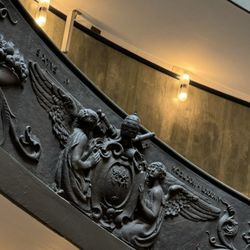
    Musei Vaticani - Details of the double helix staircase

    Details of the double helix staircase

    Musei Vaticani - The Laocoon Group. Made around 40 BC in Rhodes, Greece

    See all

    The Laocoon Group. Made around 40 BC in Rhodes, Greece

    Museo e Galleria Borghese - Bernini sculpture featuring a family fleeing

    Museo e Galleria Borghese

    4.5(146 reviews)
    2.5 kmPinciano
    €€

    The Borghese Museum houses an unmatched collection of Italian baroque and renaissance masterpieces…read more Artworks by Bernini and Caravaggio are among their popular pieces and a whole lot more including sculptures. Not to miss pieces are Bernini's marble sculptures - Apollo & Daphne and The Rape of Proserpina. Canova's neoclassical Paolina Borghese as Venus Victrix and Carravaggio's painting - David with the Head of Goliath. We came in immediately after checking in to our hotel for a 4pm timed entry. Reservation is a must. Bought our tickets a month in advance back in 2023. This was still early on after covid so restrictions still apply. I love how we were able to savor every moment we spent here because it wasn't congested at all. From the outside, it was a beautiful building in a magnificent park. I would call this a hidden gem in Rome. Borghese museum is a must go to when in Rome. The time we spent was good enough. During that time, there weren't a lot of people as they control the number of people entering the museum. Definitely 5 thumbs up. August 2026

    I didn't know that this museum is so popular and that you must purchase your tickets in advance…read more Luckily, I was able to purchase tickets before our trip to Rome, but they had only a limited number of tickets available for the time that we were going to be there. So if you are planning on going to Galleria Borghese, make sure to purchase your tickets in advance. We visited the Borghese in the afternoon during the week, and I think that was a great idea because it was pretty empty, and we had yet another chance to see everything with almost no one around. I'm not sure if it's always like that or if we got lucky. Either way, I was able to take my time to look at all the beautiful art pieces. Everything was so beautiful. I recommend going to this museum if you have the time; it's definitely worth it.

    Photos
    Museo e Galleria Borghese - Bernini's sculpture of Pauline Bonaparte.

    Bernini's sculpture of Pauline Bonaparte.

    Museo e Galleria Borghese - Sculpture

    Sculpture

    Museo e Galleria Borghese - Admiring All of the Art Pieces

    See all

    Admiring All of the Art Pieces

    Accademia di Francia Villa Medici - Villa Medici

    Accademia di Francia Villa Medici

    4.2(17 reviews)
    1.5 kmPinciano, Centro Storico

    Located on the edge of Villa Borghese, Villa Medici is a peaceful cultural oasis above the Spanish…read moreSteps that blends art, history, and gardens with stunning views over Rome. The guided tour is worth it, insightful and surprisingly serene. Don't miss the gardens or the chance to catch a rotating art exhibit. A hidden gem away from the crowds.

    This palace can be viewed only by taking one of the guided tours so make sure you plan for the tour…read morein your language. The exterior front of this palace may be very humble but it was intended to be that way because it hides from the public what is an otherwise very ornate facade in the rear of the building that when you stand in the internal Courtyard and private plaza looks out and over the Vatican. This is now a functioning school to a small collection of dedicated artists who have a one year residency here and come from all over the world to study participate learn and in some cases to replicate the marbles that can be found elsewhere in the city. The guided tour in English was excellent, filled with facts and interestings things about this location and a walk through the garden was a pleasant experience that takes you out and away from the bizziness of the city of Rome. Make sure you ask them about The Secret passage that connects this house to the Vatican. There are a lot of stairs here small narrow and steep so be prepared to do some walking but it's well worth it so you can get out into the garden and find the beautiful little Bunny rabbit that habitats this local.

    Photos
    Accademia di Francia Villa Medici - Melted butterflies on the ceiling

    Melted butterflies on the ceiling

    Accademia di Francia Villa Medici - Victor Hugo's art!

    Victor Hugo's art!

    Accademia di Francia Villa Medici

    See all

    Welcome To Rome - childrensmuseums - Updated September 2026

    Loading...
    Loading...
    Loading...