Cancel

    Open app

    Search

    WiderstandsDenkmal Photos

    WiderstandsDenkmal Reviews in Other Languages

    Verify this business for free

    Get access to customer & competitor insights.

    Verify this business

    St. Michael Kirche - Interior view from the rear

    St. Michael Kirche

    4.7(22 reviews)
    3.0 kmAltstadt, Altstadt-Lehel

    We really enjoyed visiting this beautiful historic church in the Old Town area of Munich. The…read morecrypt below is definitely worth exploring too as it is the final resting place of many members of the Bavarian royal family from the 16th to 20th centuries. The Church itself is an amazing sight inside and with artistic and religious treasures all around. Its also a great place to worship and much less crowded with tourists than the Frauenkirche nearby.

    This huge renaissance church, completed in 1597, is famous for its huge barrel-vaulted roof and as…read morethe burial place of King Ludwig II and his brother, King Otto. The Church was commissioned by William V, Duke of Bavaria, as a centre for the Counter-Reformation, and a base for the Jesuits, who were already established in Munich. Building began in 1583, but the church itself had to be partially rebuilt after the tower collapsed through the choir in 1590: ironically, it was the huge vault - then the widest after St Peters in Rome - that people feared would fall. Rebuilding began immediately with a new choir and large transept, and an elaborate facade with statues depicting the lineage of the Bavarian Royal Family. It's early baroque style influenced many other churches, but it also incorporates many motifs of the Counter-Reformation within its decoration: the transept vaults appears as triumphal arches, and the bronze statue of St Michael on the main facade shows him fighting a humanoid devil - often taken as an allegory of fighting for the faith against the Protestants. Badly damaged in World War Two, it's restoration was completed in 1983. It remains one of the largest renaissance churches, north of the Alps. King Ludwig II and his brother King Otto are buried in the crypt, alongside other Wittelsbachs. Access to this is via stairs in the south (right-hand) transept. There's a fee of €2, but they don't accept small change and photography is not permitted. I don't mind that, or paying a fee, but the person taking the money had to the least welcoming and grumpiest individual in Munich. Not much of a Christian welcome, I'm sad to report.

    Photos
    St. Michael Kirche - High Altar

    High Altar

    St. Michael Kirche - One of many Side Altars

    One of many Side Altars

    St. Michael Kirche - One of many Side Altars

    See all

    One of many Side Altars

    Die Bavaria

    Die Bavaria

    4.3(26 reviews)
    2.7 kmSchwanthalerhöhe, Ludwigsvorstadt

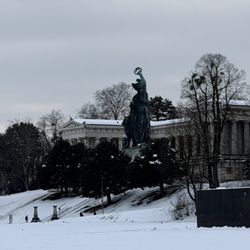
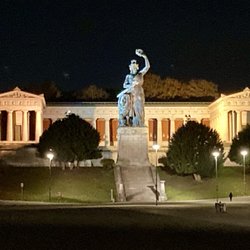
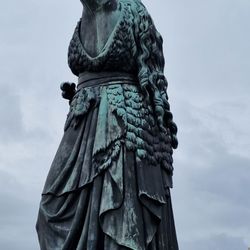
    Nine years since I was here last and I took my drunk picture with my Oktoberfest hat. Sorry, that…read moreone's not going on Yelp. It barely went on Facebook. So I'm back now and I took another selfie with my new hat and that one's not going on Yelp either. But the picture of the Bavaria statue sure is. This 19th century statue was cast in the 19th century and is the personification of the strength and glory of Bavaria. It is apparently the first colossal statue since Classical Antiquity to consist entirely of bronze. A massive statue, 60 feet high and weighing more than 87 tons. It is apparently possible to climb inside the statue with a staircase to a platform in the head. I didn't opt to do that today and I'm not sure that it's even allowed during the Oktoberfest. As much as the Olympic tower or the BMW tower, it is one of the most unique symbols of Munich and Bavaria. It's a must stop for your time here. [Review 12042 overall, 1825 of 2019.]

    The scale of this statue is really hard to appreciate until you see people standing next to it and…read morewalk up to it yourself. This monument, at the Theresienwiese in Munich, is part of an ensemble which also includes the Ruhmeshalle and a stairway leading up to the statue. This impressive work was commissioned by Ludwig I of Bavaria, who had a contest to choose the specific design. The final design selected was a female personification of the Bavarian homeland which represented its strength and glory. The monument was cast at the Munich foundry of J.B. Stiglmair between 1844 and 1850 and it was the first colossal statue since Classical Antiquity to consist entirely of cast bronze. Inside the statue there is a circular staircase leading up to a platform in the head, where four openings in the helmet provide a view of the Theresienwiese and downtown Munich (which you have to pay a fee to enter and climb to the top). Due to the size the monument had to be produced in several parts; it is 18.52 metres (60 ft. 9 in.) high, weighs about 87.36 tons and it rests on a stone base which is 8.92 (28 ft.) metres high.

    Photos
    Die Bavaria
    Die Bavaria
    Die Bavaria - Bavaria von hinten

    See all

    Bavaria von hinten

    WiderstandsDenkmal - landmarks - Updated June 2026

    Loading...
    Loading...
    Loading...