Cancel

    Open app

    Search

    Chiesa Monumentale di San Michele

    5.0 (2 reviews)

    Chiesa Monumentale di San Michele Photos

    Recommended Reviews - Chiesa Monumentale di San Michele

    Your trust is our priority, so businesses can't pay to alter or remove their reviews. Learn more about reviews.
    Yelp app icon
    Browse more easily on the app
    Review Feed Illustration

    2 years ago

    Helpful 1
    Thanks 0
    Love this 1
    Oh no 0

    Chiesa Monumentale di San Michele Reviews in Other Languages

    Verify this business for free

    Get access to customer & competitor insights.

    Verify this business

    Chiesa del Gesù Nuovo - Closer look at the main altarpiece in the front

    Chiesa del Gesù Nuovo

    5.0(7 reviews)
    32.5 kmCentro Storico

    Naples has no shortage of historic basilicas and church buildings and this is one of the most…read moreimpressive in the city. Highly recommend to drop by for a look as admission is free (donations accepted), and they are open later until 7pm so it's convenient to swing by before heading to dinner. On a cloudy day in April apparently many like-minded visitors had the same idea as it was fairly busy, though not extremely crowded. Located on the western edge of the Centro Historico district, the "New" in its name distinguishes it from another existing church of the name Gesu Vecchio. Initially the palace residence built in 1470 for Roberto Sanseverino, Prince of Salerno, political divisions led to his son and heir Ferrante Sanseverino being exiled and property confiscated, and this property sold to the Jesuit order. In 1584 construction began, led by appointed architect Giuseppe Valeriano, to convert this aristocratic palazzo to Jesuit church. The palace's unique facade was the only remnant left, with its bugnato (rusticated) grey volcanic-stone punta di diamante (diamond point) protrusions. What's even more intriguing is that this facade, designed by original palazzo architect Novello da San Lucano, who was also a composer, incorporated musical notes in Aramaic letters incised into the stone, which has been interpreted by musical historians as sheet music. The music has been named "Enigma" and you can find it played on YouTube. Other scholars interpret these symbols to be related to alchemy and esoteric practices popular in the day. This building passed between different hands thru the centuries though in 1900 definitively returned to the Jesuits. Nowadays it's known for the vast number of artworks that line its ceilings and chapels. They were certainly awe-inspiring to see! I spent about 30-45 minutes walking around, this is a functioning parish so administrative offices, prayer sections, a shop for purchasing ex-votos and souvenirs, and other functional facilities are also present. Hours: 8am-12:45pm, 4-7pm daily.

    What a big surprise! There's a hidden gem behind that palace facade. You enter through the Baroque…read morelooking entryway at the Piazza of the same name. We were totally amazed at what we saw inside this church. I would have never known based on its exterior. It's immensely grand and ornate as you walk inside. The ceiling and chapels are covered in Italian Baroque art from famous artists such as Francesco Solimena and Luca Giordano. There are alters made of precious stones and marble statues. All of which are saintly and historical. I didn't realize it at the time, but people do go there to be healed. There is a chapel dedicated to a Naples doctor & saint named Giuseppe Moscati. His tomb lies under the chapel altar. He is known for taking care of the sick and the poor. There was a line of people waiting to enter a part of the church that houses his personal quarters and belongings. We didn't get to see it, so I can't comment on it. It's just something to consider seeing while you're there. This whole area is full of historical churches. I mean, you could visit churches all day long if that's your thing. This is a great option if you only have time to visit one, and it's free to the public. They accept donations as most churches do.

    Photos
    Chiesa del Gesù Nuovo - The Chapel of St. Francesco

    The Chapel of St. Francesco

    Chiesa del Gesù Nuovo - Looking towards the entrance

    Looking towards the entrance

    Chiesa del Gesù Nuovo

    See all

    Church of Santa Maria Assunta - Front facade

    Church of Santa Maria Assunta

    3.7(3 reviews)
    23.9 km

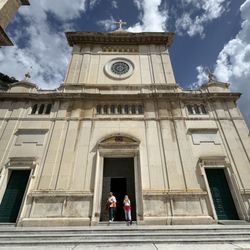
    Situated close to water level in a central part of Positano, in Piazza Flavio Gioia, this church is…read morean easily recognizable landmark with it's colorful gold and teal majorlica-tiled dome visible from the east, and it's clean, rectangular facade. Founded as a Benedictine abbey dedicated to Saint Vitus around the 10th century, even then, it was built over a former Roman villa previously established in the 8th century, (now excavated and able to be visited via guided tours). Known for its Black Madonna and Child, a Byzantine iconographic painting above the main altar, this arrived in the 12th century supposedly under curious circumstances. Story goes that enroute from Constantinople, smuggled on a pirate ship, the ship experienced a lull in wind and current close to Positano, where the sailors heard a voice calling "Posa, posa!" ("Put me down, put me down!") so the icon was brought to shore and placed in a church. The next morning the icon was found outside on the ground, wrapped in a bush, and locals were mystified, taking this as a sign to build a church on that site and dedicate it to the Virgin Mary as their new patron saint. The free-standing bell tower was built later in 1707. On a sunny day the cool interior provided a welcome shelter for a short while from the sun. The interior reads a blend of Baroque and Neoclassical, with last major renovation affecting the building layout in the late 18th century. White walls with gold trim, along with arched windows set into the ceiling and bringing in sunlight, give the interior an elegant, warm feel. It's also popular for weddings in this region, so on a weekend you might run into a wedding being held here. For more info: https://www.travelamalficoast.it/en/the-church-of-santa-maria-assunta-in-positano-amalfi-coast https://chiesapositano.it/en/church-of-s-maria-assunta/

    You must have seen its dome in the foreground of Positano landscapes. The church's colorful…read moremajolica tiled dome is one of the town's iconic symbols, its pattern of yellow, green and blue tiles shining against the blue sky and the Mediterranean Sea. Famous for its fashion design and nearly vertical setting with colorful villas stacked one on top of another up the cliff side, the Church of Santa Maria Assunta is an important part of Positano's cultural, religious and architectural landscape. The church is one of the town's most prominent and photographed sights, as it is located right in the center of Positano just a few steps from the Marina Grande beach. Walking along the beach or through the narrow staircases lined with boutiques, the Church of Santa Maria Assunta is always at the center of attention. Most of the staircases leading up from the Marina Grande Beach pass behind or through the small piazza in front of the church. From there you can enjoy the view of the façade of the church and the 18th-century bell tower.

    Photos
    Church of Santa Maria Assunta
    Church of Santa Maria Assunta - Bell tower

    Bell tower

    Church of Santa Maria Assunta - View from the hillside opposite

    See all

    View from the hillside opposite

    Cattedrale di Sorrento - Main nave

    Cattedrale di Sorrento

    4.0(2 reviews)
    15.0 km

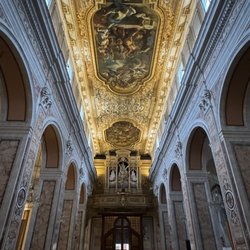
    Meandering down Corso Italia, this church set back from the street caught my eye. A simple facade,…read moreI figured to give it a go and check if it was open. Cattedrale dei Santi Filippo e Giacomo (Cathedral of Saints Philip & James), also known as the Sorrento Cathedral, is one of the most well-known and culturally significant important churches in town. As a functional parish, regular masses are held here and it's a central gathering place for local religious festivities. Dedicated to Our Lady of the Assumption and Saints Philip and James, its history dates back to the 11th century, with a plethora of changes altering its appearance from its Romanesque origins to add Baroque and neo-Gothic components. An example of this is the cathedral clock tower, which sits apart from the main building, having been built later in the 16th century over ancient Roman ruins, with vertical extensions adding the top levels in the 18th century. Inside the church, multi-hued marble walls and columns, vibrant ceiling frescos with swirling gold acanthus leaves* and scenes of the aforementioned saints, baroque wall accents, and a number of side chapels in various states of decor, ornate wood inset paneling, etc. all combine for what appeared to me a somewhat restrained appearance (compared to most other church buildings I visited on this trip). A serene atmosphere pervaded the main building; since it was late afternoon on a weekday, only a handful of other visitors walked about. No fee for admission and I spent about 20 minutes here. Note there's a break in the daily hours so plan around it! Opening hours: 8:00AM- 12:30PM ​4:30PM - 8:30PM *I was today years old when I learned that's what those curling leaves are called which form the basis of much classic Greek/Roman architectural and ornamental painting motifs! For example used atop Corinthian columns.

    Photos
    Cattedrale di Sorrento - Closer view of front altar

    Closer view of front altar

    Cattedrale di Sorrento - Looking towards the entrance and organ upstairs

    Looking towards the entrance and organ upstairs

    Cattedrale di Sorrento - Side chapel

    See all

    Side chapel

    Basilica di Sant'Antonino Abate - Heading downstairs

    Basilica di Sant'Antonino Abate

    4.0(1 review)
    15.3 km

    A simple, unadorned exterior belies a beautiful interior within. Basilica di Sant'Antonino is the…read morechurch where the patron saint of Sorrento is honored; his remains are in the crypt below the church. He is also commemorated in statue form in two nearby locations. Across the road from the entrance, in the middle of a small piazza is a monument, with Saint Antonino shown in a monk's garb and staff. Several blocks away in Piazza Tasso, a different statue depicts him triumphing over a sea creature. Saint Antonino was an abbot in the Catholic Church in the 6th century, and is known as the patron saint of animals, farmers and the poor. Legend has it, he saved a child from being eaten a sea monster (hence his depiction in the statue mentioned above), and even after death protected the city from Moorish invaders. Story goes that his wish was to not be buried within or outside of Sorrento, so he was buried in between--what was part of the city walls. The crypt below the church is vibrantly colorful with varied hues of marble. Paintings depict his guidance over Sorrento's sailors. A significant number of talismans in the shapes of different body parts are displayed, tokens of gratitude by parishioners for healing. The church nave is also filled with scenes in painting and wood inset panels of miracles performed by Saint Antonino. They reminded me of the ancient frescos displaying conquests of Greek/Roman mythological heroes. There's no fee to enter the church, though donations are accepted. It's not large so worth spending 20-30 minutes here. For more info: https://turismo.diocesisorrentocmare.it/sanctuaries/basilica-di-santantonino-abate/?lang=en https://www.santannainstitute.com/la-basilica-di-san-antonino/

    Photos
    Basilica di Sant'Antonino Abate - Front altar with a peak of the lower level below

    Front altar with a peak of the lower level below

    Basilica di Sant'Antonino Abate - Ceiling and front altar

    Ceiling and front altar

    Basilica di Sant'Antonino Abate

    See all

    Cattedrale di Sant'Andrea Apostolo - Some of the basilica's treasures

    Cattedrale di Sant'Andrea Apostolo

    4.7(25 reviews)
    33.5 km

    As the key historical attraction in Amalfi, located in Piazza Duomo minutes from the waterfront,…read moreits dominating Moorish-influenced facade of alternating stone colors catches the attention of every passersby. The exterior renovated in the 19th century resulted in its current form today, the interior is much older dating back from 10th century. The building was constructed over a 6th century church, with those remains composing the simple and austere Basilica of the Crucifix that houses a museum of the church's treasures of religious ritual objects and artifacts. Other decorative styles are represented here as well--the main nave and aisles of the cathedral originally erected in the 1st century then revised in the 18th century, and the ornate Crypt from the early 13th century exemplify lavish Baroque designs, while the remaining frescoes within the chapels surrounding in The Cloister of the Paradise are 13th and 14th century Byzantine works. As of April 2026, tickets to enter are €4 for adults and €2 for children. Hours are daily between 9:00am to 6:55pm, last entry at 6:30pm. The cathedral only is open for prayer daily from 7:30-10:00am and 5:00-7:30pm. While not large, it's worth a look--the design of the cloister is intimate and unique. It's always awe-inspiring to come face to face with art that's outlived so many centuries of history, and probably will endure for much longer than us. They have placards in most spaces with English translations, though more details in Italian. You could spend about 30-45 minutes here. For more info: https://www.visitamalfi.info/en/points-of-interest-in-amalfi/st-andrews-cathedral/ https://www.travelamalficoast.it/en/the-cathedral-of-amalfi

    This church is absolutely stunning and worth the trip up all those stairs to get to see it…read more I honestly do not think it's worth any admission price to enter, even if it's under 5 euro each to get in. We paid less to see some amazing things at other places so the value wasn't there for me. So even if you don't want to enter, I still think it's a great view from the cathedral down to the city. There are also some cool architectural details you can look at without going inside. Ans it's cool up here, so if you're trying to get away from the heat, for free, this is your place to go.

    Photos
    Cattedrale di Sant'Andrea Apostolo - Ceiling art

    Ceiling art

    Cattedrale di Sant'Andrea Apostolo - In front of the Cathedral

    In front of the Cathedral

    Cattedrale di Sant'Andrea Apostolo - Double columns around a small courtyard

    See all

    Double columns around a small courtyard

    Chiesa Monumentale di San Michele - churches - Updated August 2026

    Loading...
    Loading...
    Loading...