Cancel

    Open app

    Search

    COVertNKY Photos

    You might also consider

    Recommended Reviews - COVertNKY

    Your trust is our priority, so businesses can't pay to alter or remove their reviews. Learn more about reviews.
    Yelp app icon
    Browse more easily on the app
    Review Feed Illustration

    5 months ago

    David is very knowledgeable and a great storyteller! Highly recommend the Covington Vice tour. Thank you!!

    Helpful 0
    Thanks 0
    Love this 0
    Oh no 0

    Ask the Community - COVertNKY

    Verify this business for free

    Get access to customer & competitor insights.

    Verify this business

    Treasures of the Queen City Tour

    Treasures of the Queen City Tour

    5.0(1 review)
    2.9 kmDowntown

    Heritage Programs presents an amazing tour of the Geier Center, which stores all of the artifacts…read morenot on display at Cincinnati Museum Center. The Geier Center is home to 350,000 Cincinnati history objects, and a total of over one million history and natural history items. The four hour tour costs $35.00 and includes a show-and-tell with the Geier Center curator as well as a walking tour to view all the shelves in the depository. Here's a small list of what I saw: - A trowel from 1928 which was used to lay the first cornerstone at Union Terminal. - A leather baby shoe from Mary Ludlow, the first infant born in Cincinnati in 1788. - Colonel James Findlay's dress cutlass, circa 1825. He was the founder of Findlay Market. - A pocket-sized tin to save chewed gum, invented in Cincinnati. - A firefighter's top hat, worn in parades in 1853. - A miniature milling machine used as a sales model which helped found Cincinnati Milling Machine Company (Milicron.) - A Crosely-brand car, drove by none other than Powel Crosley himself. The roof was only 5-feet tall and its maximum speed was 70 mph. - Boxes from Ivory Soap, the first floating soap, which was invented after too much oil was added to the mixture. - Ulysses S. Grant's baby crib. - An extensive collection of Civil War General William Lytle's belongings are in the depository, including his Union battle coat, writing desk, liquor chest, and war medal. A well-respected General, Lytle's soldiers fashioned the award by melting their wedding rings for gold. The medal also features a large emerald and several diamonds. - The hangman's hood from the execution of Alonzo Walling and Scott Jackson, who murdered Pearl Bryan after learning of her pregnancy. (Also known as Bobby Mackey's haunting.) The hood still has a mouth print on it. - A wooden, coffin-like "pen" for mental patients. Doctors would lock the patients in them when they went to bed. - Early dental tools, which resembled a nail on a metal stick and a hand-crank drill. People were terrified of dentists, as tooth extractions would often break of at the root leading to a painful infection. - Medical quackery devices, such as a Bleeder. Bleeding someone was thought to reduce the pressures in the body and keep fluids in balance. The bleeder was a sophisticated, "modern" device that had been invented to "reduce the humors". Bloodletting was used to treat a variety of illnesses and injuries and was a common practice for many centuries. - A wine cask that symbolized a pact between a group of men during a cholera outbreak. Every year on October 6, the men would meet and one bring the cask. The men vowed to never open the wine. Once all the members in the group died, the last man living would drink the wine. Most died in their 30s and 40s, but the oldest lived into his 80s and drank the wine. Inside the cask is the empty bottle as well as papers with details of each member, birth and death date. - A campaign poster from William Henry Harrison, one of the first Presidential candidates to create propaganda for themselves. During the Presidential election of 1840, Harrison was portrayed as an out-of-touch hard cider drinker who lived in a log cabin. To combat this stereotype, Harrison distributed large linen campaign posters embroidered with log cabins and cider jugs. He also passed out small jugs that were shaped like glass cabins and filled with cider. The liquor was distilled by the E.C. Booz company, which led to the origin of the word "booze." --- During this same election, Martin Van Buren was nicknamed "Old Kinderhook" after his birthplace in Kinderhook, NY. His supporters formed the "O.K. Club" and the phrase "He's O.K.!" This later developed of the word "okay." --- Harrison's campaign also consisted of a huge wooden ball that had slogans on it. The ball was rolled from town to town. It was a lot of work to "keep the ball rolling", and originated this figure of speech. All of these are a drop in the bucket compared to vast collection you will see on this tour. The variety of artifacts is amazing, and each has a vivid story. Whether you like the Civil War or dark history, Treasures of the Queen City has something for everyone.

    The Betts House - The Betts House in the 1980s

    The Betts House

    3.6(5 reviews)
    3.9 kmDowntown

    We arrived on Wed 5/19/21 during regular business hours and no one was…read more there to help us. We struggled to finally find a parking space around the block.We also tried calling the phone number listed on the board at the entrance to no avail ,window shades were drawn. If they were possibly closed due to Covid there was no indication of notice. It was a great disappointment ,especially with the hassel of finally parking. Hopefully not to many people have to go thru what we did!!

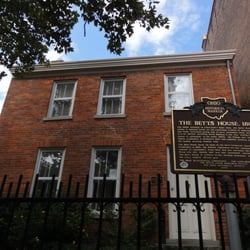
    The Betts House is a small museum tucked away in the West End, just off of Central Avenue. Clark…read moreStreet looks like it is miles away from Downtown Cincinnati, with its Italianate houses and gigantic canopy of oak trees. This part of town looks like it's straight out of a New England movie, with historic houses to boot. The Betts House is the oldest house in Cincinnati and Ohio, erected in 1804, just one year after Ohio became a state. The Betts family originally owned several blocks of land on the West End, but as generations passed, Cincinnati expanded and plots of land were split. Surprisingly, when the Betts lived here, the West End was considered rural. Just two stories tall and consisting of eight rooms, the house chronicles the history of the Betts family and the evolution of the West End in the permanent upstairs exhibit. Downstairs features a rotating exhibit, currently which is about the New Madrid Earthquake in 1811. The earthquake was felt here in Cincinnati and caused extensive damage to the Betts' kitchen. Sounds pretty cool, so why only three stars? During my visit, a mother brought her toddler to visit one of the docents. Their conversation could be heard loudly throughout the house, even when I was on the second floor and they were downstairs. The toddler was screaming and crawling all over the place. The docent didn't seem to mind that she was getting weird looks from myself and a few of the other guests. That being said, please do not bring children to the Betts House. It's a museum for adults or mature youth. Most of the exhibit features text and diagrams which are much too complex for anyone under age 10. Also, since there is a lot of reading, excessive noise and talking disturbs other patrons. Lastly, when I went upstairs to view the Betts Family exhibit, the room featured a few posterboards propped up on the floor. They weren't on stands or affixed to the wall like a normal museum. I actually had to kneel to read the end of the paragraphs. As a historical landmark, the Betts House is worth a look. The presentation at the museum, on the other hand, I could go either way. Cost per person: $2.00 Viewing Time: 1 hour Tips: - Ample, free street parking - Not handicapped accessible, as it is preserved as a historic house. - Check out the neighboring house with a placard, where the Gamble Family once resided.

    Photos
    The Betts House
    The Betts House - The Red Room, the largest room of the rotating exhibit

    The Red Room, the largest room of the rotating exhibit

    The Betts House

    See all

    Cincinnati Subway - Race Street Station

    Cincinnati Subway

    5.0(1 review)
    3.9 km

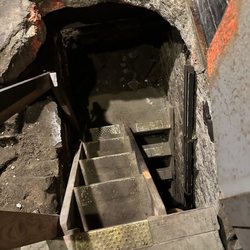
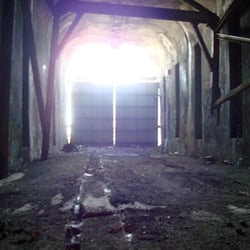
    Did you know Cincinnati is home to the World's Largest Unfinished Subway System?…read more In 1916, Cincinnatians had a dream: to relieve traffic congestion and improve health concerns by creating a rapid transit system underneath present day Central Parkway. Originally part of the Miami-Erie Canal, the unused waterway was drained, dug out by horse-and-plow, then filled in with concrete. The plan was to create a 16-mile loop of mass transit around the city, stretching from Race Street at Central Parkway, to Clifton, Norwood, Oakley, then back Downtown. The project progressed for ten years then came to a halt after a change in political leaders and financial troubles. The completed portion included six stations along a route spanning from Downtown to Norwood. In 1928, the Cincinnati Subway project was officially abandoned. Over the years, people tried to revive the subway system as well as proposing other uses for it, such as: a wine cellar, a mushroom farm, an aeronautic wind tunnel, and an entertainment venue similar to Underground Atlanta. The Cincinnati Subway is still in tact today. Two miles of tunnels are located underneath Central Parkway between Race Street to just north of the Western Hills Viaduct. Three of the stations remain; the other three were demolished in the 1950s to make way for I-75. While the concrete structure is complete, no rails, electricity, or trains were ever installed. The structure itself is in good condition, especially for being almost 100 years old. While it is off-limits to the public, Cincinnati Museum Center gives an annual tour of the subway in May; an excellent opportunity to go exploring in our city's deepest secret. The tunnels have the potential to be used for modern-day rail transit, with a few improvements, of course.

    Photos
    Cincinnati Subway
    Cincinnati Subway

    See all

    COVertNKY - historicaltours - Updated August 2026
    Loading...
    Loading...
    Loading...