Cancel

    Open app

    Search

    Estero Island Photos

    Recommended Reviews - Estero Island
    Your trust is our priority, so businesses can't pay to alter or remove their reviews. Learn more about reviews.
    Yelp app icon
    Browse more easily on the app
    Review Feed Illustration

    12 years ago

    Helpful 0
    Thanks 0
    Love this 0
    Oh no 0

    Verify this business for free

    Get access to customer & competitor insights.

    Verify this business

    Koreshan State Park

    Koreshan State Park

    4.4(78 reviews)
    4.7 mi

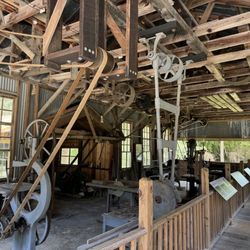
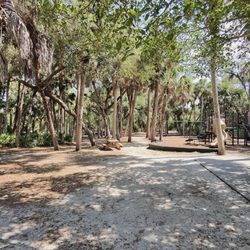
    a fascinating stop that preserves the historic site of the Koreshan Unity -- a utopian religious…read morecommunity founded in the late 19th century by Cyrus Teed. The park has a $5 per car entrance fee and plenty of parking. There are two main areas: One side leads to a picnic area and campsites -- perfect for relaxing or spending the night. The other takes you to the historical settlement, where multiple preserved buildings are open for exploration. You can take a self-guided tour using a $1 handout map from the visitor center or simply read the detailed informational signs posted around the site. Walking through the grounds feels like stepping into a ghost town, complete with original structures and remnants of a once-thriving community. Despite the eerie history, the park is peaceful, quiet, and well-shaded, making it a nice place to wander, learn, and take a break from the Florida heat. It's definitely worth a stop if you're in the area.

    I have heard about the Koreshan State Park and the cult with the same name from my previous visits…read moreto the Bonita Springs area. But after reading the novel "The Magic Kingdom" written by Russell Banks recently (I do recommend) based on the history of the Koreshan cult, I wanted to visit the park during my next trip. And we did. The park is open daily from 8 am to 5 pm. They have tours and demonstrations on the property. You can browse on your own of you want. We opted for a guided tour that starts at 10 am for $10/person, you can book online ahead of time or just pay and join on the spot. It was well worth it, our guide gave us a lot of interesting information (although she didn't know about the books), about Dr. Cyrus Teed, the guru of the Koreshan who started the religious cult in New York, moved it to Chicago, then to Estero Bay in Florida where they helped develop the area. Lots of fascinating stories about their settlement, religion concepts, work in the area, business, the role of women within the cult. We lingered afterword to browse some more, lots of memorabilia on display and we were lucky to witness some demonstrations. You need at least 2-3 hours to see everything. You can bring lunch, there are picnic tables. A lot of places and houses in this big park. Wear comfy shoes, bring a hat. You will also see cool plants and animals in the wild (cool lizards, small iguanas). It's worth checking out if you're looking for an activity that opens a big window into the history of the area!

    Photos
    Koreshan State Park
    Koreshan State Park
    Koreshan State Park

    See all

    Murphy - Burroughs House

    Murphy - Burroughs House

    4.8(6 reviews)
    16.8 mi

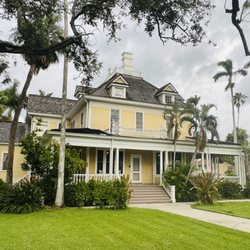
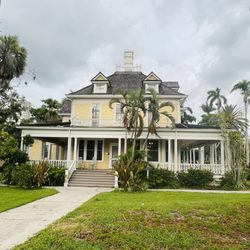
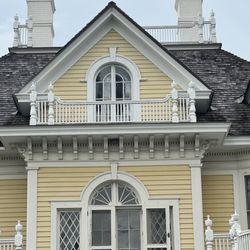
    I love old houses and this yellow beauty is an architectural gem. The Murphy-Burroughs House is a…read moreGeorgian Revival style mansion built in 1901 for John T. Murphy, a cattle rancher from Montana. It is located in the River District of Fort Myers on two acres of land on the Caloosahatchee River. The house was built on First Avenue, the first house on what would become known as Millionaires Row. Materials to build the house were brought in by train and then carried the rest of the way to Fort Myers by barge. After construction was completed it drew other wealthy people to build their homes on the street. It is the only one of Millionaire Row's mansion that is still standing in its original position. Murphy was very involved in local civic and business affairs during his time in Fort Myers. He was a major shareholder of a bank and helped built a seawall that protected the downtown area. He passed away in 1914 and the house was sold to a businessman from New Jersey. In 1919 Nelson Burroughs purchased the house so his family could escape the frigid Chicago winters. Nelson made his fortune in land investments and banking. While in the home the family hosted lavish parties attended by famous winter Fort Myers residents Thomas Edison, Henry Ford, and Harvey Firestone. In 1922 Burroughs transferred ownership of the house to his daughters, Mona & Jettie. Mona bequeathed the property to The City of Fort Myers prior to her death in 1978. After her husband died in 1983 it was no longer used as a residence. On August 1, 1984, the house was added to the U.S. National Register of Historic Places. Today you can tour the home that has been lovingly restored with a grand staircase, beautiful fireplaces, and antique furnishings. Features of the house include a veranda wrapping around three sides, a large dancing porch on the east side, bay and stained glass windows, a widow's walk on the roof, and decorative woodwork. The house is a popular wedding venue. Every December, the Fort Myers Community Women's Club decorates the historic mansion for the holidays. The Uncommon Friends Foundation manages the house as well as the Burroughs family records.

    What a beautiful place to throw a party, host an event or have a wedding…read more The sunset here is absolutely magnificent and there are trees and flowers everywhere.

    Photos
    Murphy - Burroughs House
    Murphy - Burroughs House
    Murphy - Burroughs House

    See all

    Rosemary Cemetery - Naples first pioneer.

    Rosemary Cemetery

    4.4(5 reviews)
    14.4 mi

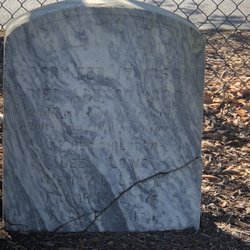
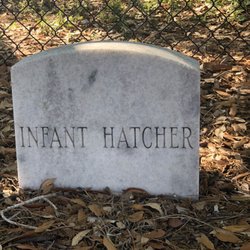
    I've always remembered this little cemetery as I was born in Naples, and have been here my entire…read morelife. But, it's been decades since I have walked through here. I remember my mom explaining to me when I was a kid that this cemetery was for original settlers of Naples. It's still in great shape, and looks like it has regular visitors as there were flowers on every grave when I visited. Some of the markers have no visible lettering, so must've been worn away over time and replaced with just a new stone. Definitely an interesting piece of Naples history, and as a native of our beautiful town, I'm glad that I made the time to give my thanks and respects to those who came here long before me to establish this beautiful place I call home.

    Located in literally the parking lot of a CVS is the historic Rosemary Cemetery. Some of the people…read moreburied here were originally buried at a cemetery at the corner of 3rd Street South and 10th Avenue South St. near St. Ann's Catholic Church in old Naples. As Naples became developed in the 1930's it was decided that the bodies should be moved to the outskirts of town. The Rosemary Cemetery Corp. was formed to find a suitable location for the new cemetery and a 20 acre plot was donated by Edward W. Crayton, president of the Naples Improvement Company. The name of the cemetery was taken from the highly scented rosemary bushes that once grew here. It is believed that Naples earliest settlers are buried here including John and Madison Weeks, Naples first permanent settlers. The cemetery opened in 1931 and the last known interment was in 1947. It had to be closed because the high water table caused some of the caskets to pop up back out of the ground during rainy season. It is believed that approximately 20 people remain here but who they are is a mystery because some of the headstones are no longer legible. The cemetery is listed as Unit B on a 1944 map that lists the graves in the area. In 1943 when the city registered the cemetery it listed over a hundred graves. What happened to those graves is unknown. Hurricane Donna destroyed the cemetery records in 1960. This was the only cemetery in Naples until Naples memorial Gardens opened in 1955. What was once the outskirts of town is now a major road and an empty lot is now a CVS parking lot. A historical marker was added to the cemetery in 1993. The next year the Collier County Museums restored the cemetery and added marble headstones. The city held a formal re-dedication ceremony of the cemetery on November 27, 1994. If you didn't now this cemetery was here it would be easy to drive past it. Once you pull in to the CVS parking however you can't miss it. The gate is left open so you can come by to visit the Naples pioneers.

    Photos
    Rosemary Cemetery
    Rosemary Cemetery
    Rosemary Cemetery

    See all

    The Attack on Fort Myers - The Attack on Fort Myers historical marker

    The Attack on Fort Myers

    4.0(2 reviews)
    16.3 mi

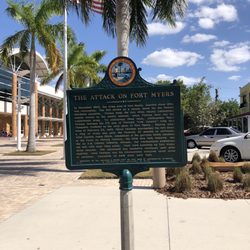
    The Attack on Fort Myers is a historic sign located in front of the Lee Public Library, The sign…read moredetails an interesting bit of Civil War History. It turns out Fort Myer was the location of the southernmost battle during the Civil War. Marker F-297 was installed in 1982 by Col. Abraham C. Myers Camp #1322, Sons of Confederate Veterans in cooperation with Department of State. After the Seminole Wars, Fort Myers was abandoned but Union soldiers moved in December 1863. Their plan was to confiscate the cattle from area ranches in order to cut off the food supply to the Confederate Army of Tennessee in Georgia. By 1865 they had stolen 4,000 head of cattle. By that time Fort Myers had become a refuge for escaped slaves and Union sympathizers. At one point there were 400 people there. In response to the cattle thefts the Confederates organized a militia to stop the raids. Among them was Capt. Francis A. Hendry who Hendry County Florida is named for. They were called the Cattle Guard Battalion or "Cow Cavalry." In early February 1865, 275 of the Cattle Guard Battalion prepared the attack Fort Myers because they learned it might be abandoned. They arrived at Fort Thompson in LaBelle Florida where they shot several black Union soldiers who were attempting to flee. They then marched on to the gates of Fort Myers. The group led by Major Footman approached the fort under the flag of truce and gave them 20 minutes to surrender. Fort commander Capt. James Doyle sent his response " "Your demand for an unconditional surrender has been received. I respectfully decline; I have force enough to maintain my position and will fight you to the last." Doyle wheeled his cannons outside the fort and began firing on the Confederates. Throughout the day both sides fired on each other. During the fighting one black Federal soldier was killed. Firing ceased at dark and the next morning, the Cattle Guard Battalion returned to Fort Meade. After defending the fort, Fort Myers was again abandoned in early March.

    Did you know that the Civil War went as far south as Fort Myers? Further South even than here, but…read morethis is where we are so here's the history. This marker recalls an otherwise unimportant skirmish between Union and Confederate forces, noteworthy only because it was here in Southwest Florida. The marker reads, "In December 1863, the Army post of Fort Myers, inactive since 1858, was reoccupied. The fort served as a supply depot for the Federal blockade squadron. Troops from the fort often raided Confederate supply depots in the state's interior, since Florida beef fed the Confederate army. To discourage these raids, Confederate Major William Footman led 275 men of Florida's "Cow Cavalry" from Fort Thompson (LaBelle) to the very gates of Fort Myers. Shortly after noon of February 20, 1865, Major Footman approached the fort under a flag of truce and gave the Federals 20 minutes to surrender. After Captain James Doyle, commander of the garrison which consisted of the Union 2nd Florida Cavalry, the 110th New York Infantry, and the 2nd U.S. Colored Infantry, refused, the Confederates bombarded the fort with their field piece. They were answered by Fort Myers' three cannons. The cannonade and musketry continued until after nightfall, when Footman and his Confederates withdrew under cover of darkness. Casualties on both sides were light." [Review 13322 overall, 640 of 2020.]

    Photos
    The Attack on Fort Myers
    The Attack on Fort Myers

    See all

    McGregor Boulevard - These flowering trees r so pretty!

    McGregor Boulevard

    4.3(3 reviews)
    11.0 mi

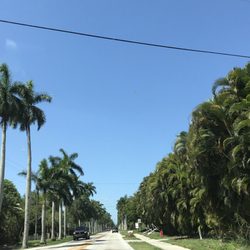
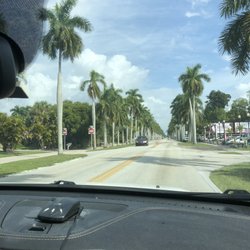
    The woman known as Tootie McGregor was born in 1843 as Jerusha H. Barber in Cleveland Ohio. She…read moremarried a man named Ambrose McGregor who became the president of Standard Oil. The couple had one son named Bradford who was ill. To improve his health the doctor recommended that the family spend the winters in Florida. They picked Fort Myers because of the excellent tarpon fishing and they purchased the home next to Thomas Edison in 1892. The couple became real estate and business developers in the Fort Myers area, at one point owning more than 30 properties. Ambrose died of cancer at the age of 58 on October 28, 1900. His fortune at the time of his death was 12 billion dollars in today's rates. Bradford died in 1902, two days after marrying his high school sweetheart. With a broken heart and free time on her hands Tootie set about developing Fort Myers. Tootie was heavily involved with the hotels in the area which allowed Fort Myers to become a tourist destination. Tootie is most remembered for her efforts to improve the roads in Lee County. At the time the only road in town was a narrow strip of graded, crushed shell down the middle of First Street. Tootie struck a deal with the county where she would pay to pave 20 miles from Whiskey Creek to Punta Rassa if the county agreed to pave Riverside Drive from Whiskey Creek to downtown Fort Myers. In exchange for 200 to 300 million dollars to build the first road the city council agreed to name the road McGregor Blvd. Tootie died six months later before the road was started but her second husband, Dr. Marshall Terry completed her wishes. Dr. Marshall had been Tooties first love but he was too poor to marry her at the time and she went on to marry Ambrose but the couple reconnected after his death. Tootie and Marshall were married for six years until she died on August 17, 1912. Dr. Marshall decided to donate a fountain to the city in honor of his late wife. McGregor Blvd turned 100 years old in 2015. When completed in 1915 it was the only hard surface road in the city. It was a pebbly macadam road only 50-feet wide, but it allowed building materials to be transported to the south and west areas of towns which allowed Fort Myers to expand and grow. A visit to Fort Myers wouldn't be complete without a drive down this historic road. On McGregor Blvd is Fort Myers most famous landmark, the Ford and Edison Winter Estates. On the corner of Colonial Blvd. and McGregor Blvd. there is a monument celebrating Tootie McGregor's accomplishment. She had the foresight to see that a little town on the Caloosahatchee had the potential to become a major winter resort and tourist destination.

    Taking a drive down McGregor Boulevard is an experience you don't want to miss when visiting Ft…read more Myers. This area truly reflects the vibe of the area and demonstrates why Ft. Myers is "The City of Palms". It's part of our standard "tour" for family and friends. Seeing the majestic Royal Palms lining the street definitely brings the "wow" factor.

    Photos
    McGregor Boulevard - And this is why Ft Myers is the City of Palms!

    And this is why Ft Myers is the City of Palms!

    McGregor Boulevard
    McGregor Boulevard - Old Fort Myers -- historical area and street lined with royal palm trees that are just gorgeous!

    See all

    Old Fort Myers -- historical area and street lined with royal palm trees that are just gorgeous!

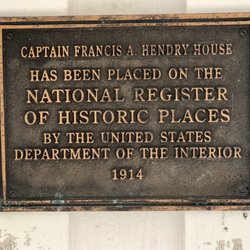
    Captain Francis A. Hendry House

    Captain Francis A. Hendry House

    5.0(1 review)
    36.7 mi

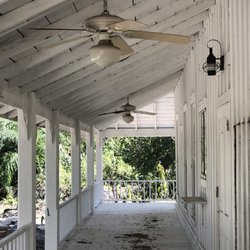
    As a fan of historic architecture I was excited to find this structure on a recent trip to Labelle…read more The house is located at 512 Fraser Ave. next to the LaBelle Nature Park. This historic vernacular one and one and a half story home was built in 1914 for Captain Hendry who fought in the Confederate Army in the Civil War. After the war Hendry became a cattle rancher. Hendry hired self taught builder Benjamin F. Magill to supervise the construction of his home in the town of LaBelle which he founded on the western end of his vast ranch holdings in Monroe County. Hendry moved into the home at the age of 81 with his wife. Due to his poor health, Hendry was only able to live in the house for a few months before moving to Fort Myers for better access to medical care. He passed away in 1923 and his final resting place is a private family cemetery in Fort Myers. When Hendry County was formed in 1923 it was named after Captain Hendry. This is is the only surviving structure left associated with him. After Hendry's death, the house had numerous owners through the years. On February 5, 1998, it was added to the U.S. National Register of Historic Places. The house is not open for visitors. It looks like construction is being done on the stairs and porch. It was still fun to peek in the windows and around the outside. I love the huge wraparound porch. It looks like there are a few period furnishings inside and historic photos on the wall. I saw online that LaBelle uses the grounds for outdoor events and weddings.

    Photos
    Captain Francis A. Hendry House
    Captain Francis A. Hendry House
    Captain Francis A. Hendry House

    See all

    Plot N - Heading east on pineridge road looking south onto goodlette Frank.

    Plot N

    4.7(3 reviews)
    14.5 mi

    I was born in Naples, I've lived almost every year of my life here since Nixon was President. The…read morehouse I grew up in backs up to Goodlette Road, and I'm old enough to remember the trains rolling behind our house frequently and learned how to count by the number of cars on the trains. I also remember when Goodlette Road stopped at Pine Ridge, and there were these strange concrete pilings at the corner of both roads and where the train tracks continued north past Pine Ridge Road. We never really knew their meaning or their purpose when we were kids because there was nothing there to explain what they were. I only learned about their meaning over the past 20 years. As Naples has grown over the past 5 decades, I know I'm not the only one who has forgotten about Plot N the thousands of times I've driven by it in my lifetime. I'm ashamed to say it. I won't forget now, and I'm definitely going to be telling more people about it. Today, I finally took some time to come back here and pay my respects to these forgotten souls. I was pleasantly surprised to see a dedicated plaque from a local Boy Scout Troop explaining the history and significance of Plot N. There are 8 new, beautiful markers that say "Rest In Peace" on each one. The entire area looks well managed with new landscaping. The Troop who rededicated this plot needs to be commended for preserving and honoring these original Neapolitans who richly deserve to be remembered. I hope they put another sign on the opposite side of the post that faces the parking lot for South Street so more people would be aware of what is there. I'd bet 99% of people who shop in this plaza have no idea of the significance of this little strip of land. If you've lived in Naples for a significant amount of time, I'd recommend everyone take a moment to visit.

    Plot N is a quirky part of Naples history. At the corner of Pine Ridge and Goodlette-Frank roads…read moreare four concrete posts that are the site of 8 graves. A map from 1944 that plots out where graves are located has this spot labeled as labeled 'Plot N 8 Negro Graves Unmarked'. In the 1930's Naples was home to less than 3,000 people. Most of the people who came to Naples were wealthy snowbirds from the north. Only a few people lived here year round. It is believed that the people buried here were involved in the building of the railroad. Naples like all of Florida was segregated. African-Americans of the time worked as laborers laying the railroad tracks, logging, farming and domestic work. A train used to run where Goodlette-Frank road is today which is why it is thought that the people buried here had something to do with the railroad. It is believed that people who are buried were possibly killed while working on the railroad. With no permanent records it is unlikely that the mystery of who is buried here will ever be solved. Another site listed as plot W was paved over before any examination for graves was ever done. Plot B is the Rosemary Cemetery which has a wrought iron fence around it and is in the parking lot of a CVS. The city restored that site in the mid nineties. Paved over and lost graves is not an unusual story in Florida. As cities grew they weren't always precise in moving graves before building. Unless someone can find documentation or do ground penetrating radar, how many people are here and who they were will remain a secret.

    Photos
    Plot N
    Plot N
    Plot N

    See all

    Fort Denaud

    Fort Denaud

    5.0(1 review)
    32.9 mi

    As white settlers flooded into Florida the government became determined to relocate all Native…read moreAmericans west of the Mississippi. This forced removal policy sparked the Second Seminole War in 1835. The Seminoles fled south into Florida to evade capture and being sent out west and they moved into the Everglades in order to hide. In response the army set up forts south of Tampa to the east coast along rivers as they chased after the Seminoles who were much more skilled at surviving in the terrain than the soldiers. Fort Denaud was established by Captain B. L. E. Bonneville and troops of the 7th Infantry in 1838 on the the south side of the Caloosahatchee River. The fort was named in honor of Pierre Denaud, A French-Canadian trapper who had traded with the Seminoles and who owned land in the area in the 1830's. The fort consisted of a blockhouse with tents around it and it served as a supply depot for troops in Lake Okeechobee. The stockade at the fort guarded a bridge over the river on a military highway between Fort Myers and Fort Meade. The Fort Denaud historical marker marks the site of the blockhouse at Fort Denaud. Fort Denaud was closed after the end of the Second Seminole War and reopened at the beginning of the Third Seminole War in 1855 under Brevent Major William Hays. Soldiers added a hospital, guardhouse, jail, Sutler's store, and stables. A fire ravaged the fort in 1856 and it was rebuilt two miles downstream on the north side of the river. The fort was abandoned in May of 1858. After the war settlers moved into the town of Fort Denaud that sprang up and began farming sugar cane and citrus but most of them left after the fort was abandoned. Although there is no trace of the fort a few historic structures still remain. Today the area is mainly citrus groves and a new housing development.

    Photos
    Fort Denaud
    Fort Denaud
    Fort Denaud

    See all

    Estero Island - landmarks - Updated July 2026

    Loading...
    Loading...
    Loading...