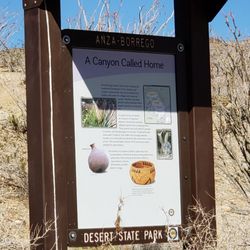
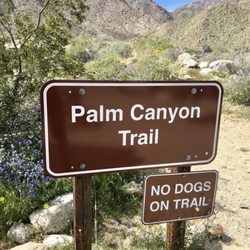
I have explored Anza-Borrego Desert State Park on eight different occasions, and have been once to…read moreYaqui Meadows and the nearby Glorietta Canyon. Yaqui Meadows and Yaqui Pass have beautiful wildflowers during the annual desert bloom (February through March). I've taken photographs of wildflowers at both of these places.
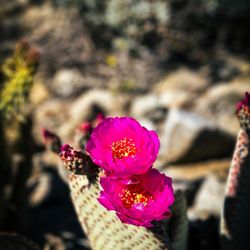
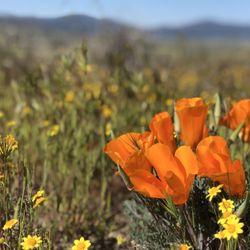
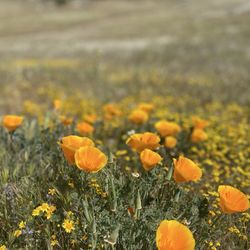
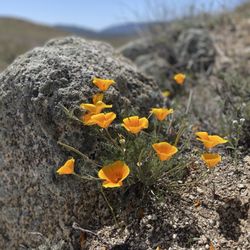
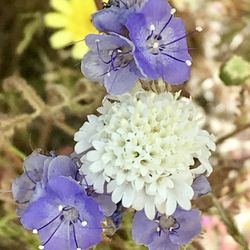
FLOWERS. What I've posted here are some of my photos of cactus flowers by the east edge of the dirt road that leads through Yaqui Meadows to Glorietta Canyon. One of my posted photographs shows an ocean of yellow flowers during the March desert-bloom in Yaqui Meadows. There I am kneeling next to a little barrel cactus, with a vast ocean of yellow flowers behind me.
One of my photographs shows a close-up of some dark red cactus flowers, with mountains on the horizon. The peak of these mountains have a characteristic shape that is called, INDIANHEAD PEAK. See, pages 4 and 57 of Geology of Anza-Borrego:Edge of Creation, by Remeika and Lindsay. Each of these pages have a photo of Indianhead Peak, but taken from different distances away. When viewed from the trail leading to HELLHOLE CANYON, Indianhead Peak looks like a reclining woman, and I have named her "Nina Simone," because there are sufficient details in the mountain peak to distinguish lips, eyes, and forehead. You need to CLICK on my photo to make BIG, in order to see Indianhead Peak. But you need to go to my YELP review of HELLHOLE CANYON TRAIL to see my photo that clearly shows Nina Simone.
Glorietta Canyon does not have many flowers during the annual desert bloom (February to March), but there will be some blossoming ocotillo and some pink-colored barrel cacti. The flowering time of ocotillo is described by, Waser (1979) Oecologia. 39:107-121. Lifespan of ocotillo is over 200 years, but this can be shortened by gophers who weaken the roots (see, Cox and Hunt (1994) Southwestern Naturalist. 39:364-370). Another article teaches us that the ocotillo's flowers last only one month (March) (see, Gallina, Feria, Gonzalez-Trapaga (2017) Therya. Vol. 8).
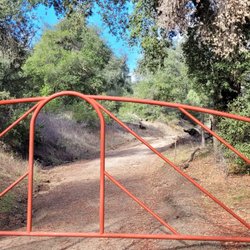
DIRECTIONS TO THE DIRT ROAD GOING THROUGH YAQUI MEADOWS TO GLORIETTA CANYON. Starting from Christmas Circle, drive south on Borrego Spring Road (Route S3) for about 2 miles, and you'll reach a gentle curve that levels out and then heads directly east. As soon as the road points east, drive for 1,500 feet and look south (look to the right) and watch for the dirt road. This dirt road leads you through Yaqui Meadows, where colorful cactus flowers can be found, and where a bit further down the road, you encounter a huge ocean of short yellow-colored flowers growing directly from the ground. My photographs show that the desert area at the east edge of the dirt road is filled with blooming cactus flowers in February to March. Your drive on the dirt road will be like this. Go south on dirt road 'til it comes to a T-shaped intersection (this segment of the dirt road is filled with colorful cactus flowers in Feb. to March). At this intersection, turn west and drive west for 2,000 feet 'til you reach yet another T-shaped intersection. Turning to the left, you then drive south for 2,500 feet, and finally turn west (turn right) when you reach the next intersection, and keep driving 'til you reach the parking lot at Glorietta Canyon.
GEOLOGY. Geology of Anza-Borrego by Remeika and Lindsay provides a huge amount of information on how the mountains, canyons, and unique stone formations in this park were created. Page 112 provides some information about Glorietta Canyon. We read that the dirt road to Glorietta Canyon takes you into Yaqui Meadows. The book tells us that Glorietta Canyon was carved out of Yaqui Ridge detachment fault of Mid-Tertiary Age, and that this fault is a major tectonic feature of the landscape here.