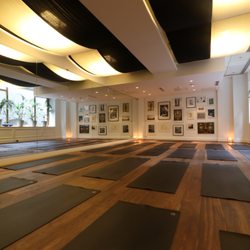
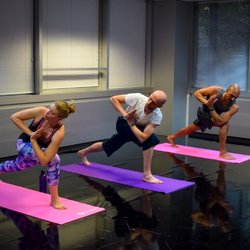
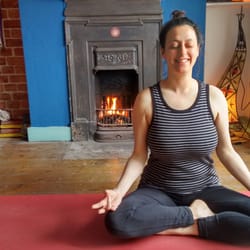
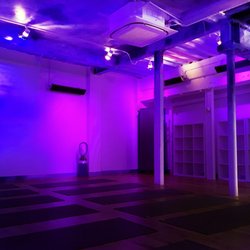
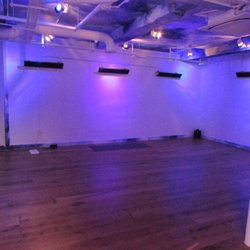
When you walk in to Hamish Hendry's Ashtanga Yola Shala at 92-94 Drummond Street, the warm air…read moreembraces you. Even May through August in London is chilly. Unlike New York where I live, and sweat happily in tropical air after May 1, London remains brisk, rainy autumn coldish, evidently throughout the summer. Now I could see why the British constantly run off to the Caribbean, or the Mediterraneanean, or to this Shala. I agree with Hamish's definition of yoga: "[Yoga] can get you through some rough patches in this life." I've found that yoga has heped me to survive difficult challenges. It makes me feel more alive in my skin.
Unlike the more extremely Puritanical versions of Ashtanga that you can find in New York, where one is hard-pressed to find someone who will make gentle adjustments, here I found that Hamish and his assistants apply pressure to the lower back from the minute you get into downward dog. Whereas some dissent from the model of adjustments has emerged from some of Jois' earliest and most devoted practitioners, such as David Williams (who says he was injured by Jois although he never stoped practicing even at 68), I still find gentle adjustments such as I've received at Hamish's studio to be inspiring. Revelations have emerged about the guru who founded "mysore style," Pattabhi Jois, groping some of his women students in front of other students, male and female, which is pretty horrifying. I think #metoo has amplified the need to reckon with pervasive abuse of children and women by adults, coaches, potential employers, and yoga instructors. I think we all need to be wary of inappropriate, invasive touching and intimacy. But touch, which is a transfer of energy, can also be a key to healing. I speak from personal experience. Non-invasive adjustments offer gentle help in getting into postures and push the student to a limit without crossing it. They can help to open the body and difficult previously inaccessible emotional traces. It is one of the aspects of ashtanga yoga that led me to stick with this practice, rather than the quieter, less demanding hatha, the more precise "Ayengar," the hot, aggressive Bikram, or the repetitive, breathy Kundalini styles of practice. Many of these gurus too have scandals associated with them. I've tried them all since I took my first yoga class in 1998, in multiple locations across the globe. Mysore-style in a place heated only by bodies moving and breathing deeply, with no sound besides the soothing murmur of human breath, powerfully repetitive, like waves on the seashore, is the only yoga to which I look forward to four-five days per week.
I want to note that Hamish's place is, according to him, the only studio in London where all the instructors receive training not only in teaching yoga, but also in Trauma Sensitivity. I'm not sure what that entails, but it seems to be working well. Perhaps other studios should begin to incorporate this kind of training.