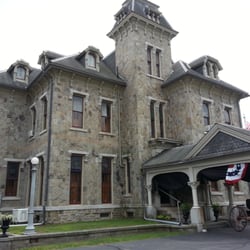
"The Lemon House is a museum, not a working tavern or restaurant." So says my guidebook from the…read moreAllegheny Portage Railroad National Historic Site. Located just south of the visitor's center and the engine house, it's one of the major attractions at the site and one of the few that has been completely restored. The Lemon House shows how the socioeconomic structure developed along the railroad and the Main Line. It was owned by Samuel and Jean Moore Lemon, two of the many entrepreneurs who used the development of the areas natural resources and transportation links in order to make a living. Travelers along the Main Line would stop here to eat, drink, and regale each other with their journeys' tales.
The Lemon House was restored in 1997 in the style of 1830-1850, specifically what it might have looked like in 1840. I say "might" because as with the engine house, any plans or schematics for the design of the building have been long lost. There's also little evidence as to how the tavern was operated or what the menu might have been. What the restorers did know however were such things as period artworks and documentation of other 19th century taverns (many had remained in business into the 20th century). Also historians do know what the social mores were at the time, so we will keep them in mind as we tour the building.
Historians also do know a few things about the Lemons. Jean Moore Lemon (1797-1880) was well educated and apparently was the bookkeeper for the tavern. The local banks have records of her signature. Her obituary praised her for her charity works. Samuel Lemon (1793-1867) was born in Huntingdon County, PA. His grandfather served in the War of Independence and his father in the War of 1812. He was best known as a tavern owner and businessman. He must have had some business acumen because the Lemon House was very solidly built.
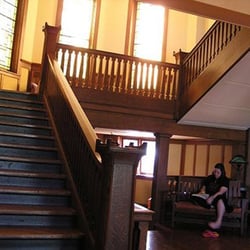
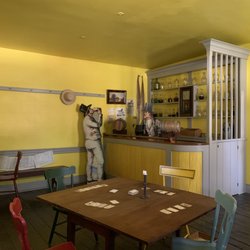
So let's take a tour of the Lemon House. Like the travelers of the day, we enter through the central hallway. In most houses the hallway was very welcoming and it's likely that travelers preferred this room. Here travelers could read the paper, play games, or catch up on the stories of the day. It is furnished with simple wooden chairs and benches which could withstand the elements. Period paintings, not original to the house, adorn the walls.
The next room is the bar room. Ladies, we are allowed in here today but we would not have been back when the tavern was operating. The social mores of the day required men to act as gentlemen and women to act as ladies. In general, women of any social standing did NOT go into bar rooms. Here the men could ignore the social graces of the day. Guys, imagine such notorious behavior as removing your dress coat or tilting your chair back. Imagine uttering such oaths as "hell" and "damn"! Now the barroom was restored based on a watercolor "Country Inn" by August Koller. The watercolor was painted in 1840 in western PA.
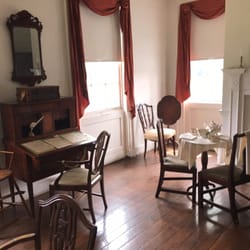
We proceed into the fancy parlor. Here a man or woman who wished to have a more quiet retreat could dine or relax (notice girls, we don't get our own room here--ah, the Victorian social graces). You did not have to be rich in order to use the fancy parlor, but you had to exhibit social graces. The furniture was designed for correct posture and appropriate behavior. Chairs were uncomfortable because they did not want you to linger or sleep here. Interestingly, you could smoke or chew tobacco in here and you can see the silver spittoons on the floor. Of course there is a piano because refined ladies would know how to play one. It's likely that Mrs. Lemon entertained neighbors and guests here.
The last room we'll take a look at is the Double Dining Room, also known as the Common Room. Travelers and the occasional local foik could stop for a meal here. Unlike today, it was one set meal. There were no choices of what you wanted to eat. Stew was the most likely meal to be served because it could be kept hot on the stove all day. Trains would pull in and the crew would shout out "1 hour for lunch!". Community seating was the rule of the day, meaning you dined with strangers. This was done for efficiency's sake. This community seating lives on today--if you've ever eaten in an Amtrak diner car, you'll know what I mean.
I could go on, but I'm almost out of space here. The Lemon House is my favorite site here because it's so complete and it gives you an idea of how people traveled back then. Quite a difference from the Holiday Inns and Denny'ses of today, huh?