Cancel

    Open app

    Search

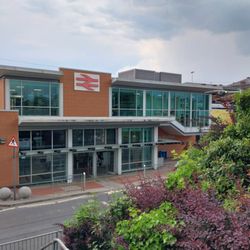
    Moreton-in-Marsh station

    3.0 (3 reviews)

    Moreton-in-Marsh station Photos

    Recommended Reviews - Moreton-in-Marsh station

    Your trust is our priority, so businesses can't pay to alter or remove their reviews. Learn more about reviews.
    Yelp app icon
    Browse more easily on the app
    Review Feed Illustration

    2 years ago

    Helpful 3
    Thanks 1
    Love this 2
    Oh no 0
    Photo of Hazel C.
    244
    976
    10502

    9 years ago

    Helpful 18
    Thanks 0
    Love this 18
    Oh no 0

    8 years ago

    Helpful 0
    Thanks 0
    Love this 0
    Oh no 0

    Verify this business for free

    Get access to customer & competitor insights.

    Verify this business

    Stratford-upon-Avon - Concourse

    Stratford-upon-Avon

    4.0(2 reviews)
    14.0 mi

    Okay, while this station doesn't have any lockers, it turns out that if you look around a bit you…read moremight find some other place that will store your bags. However, it doesn't help when the station isn't all that close to the centre of town. However, this station was still rather nice, and a little touristy as well. Yeah, it was cool.

    Occasionally, I happen across some ne'er-do-well chuntering on about Stratford-upon-Avon being a…read more"one-Horse town." "Well kind sir," I respond, "if Stratford-upon-Avon is indeed a 'one-horse town,' that horse is bloody Secretariat." To be or not to be ... that is NOT the question. To be here a few hours or to stay the night, THAT is the question. I have "long weekended" in Stratford, and 3 days was a bit much, even for this two-degreed English major. I've also "day toured" on a motor coach starting the day in London ... they gave us about 2 hours in Stratford betwixt Warwick Castle and Oxford, and that was not enough. The third proverbial bowl of porridge was driving in: Two days, one night ... just right! Yes, indeed, SuA is the town where William Shakespeare spent most of his life. His memory oozes from every pore of the town ... as, indeed, it should. Not only is it the epicenter of his life, but other Shakespeare meccas like London have too many literary (and historical) distractions ... its dribs and drabs (albeit great dribs and drabs) of Shakespeare are scattered around while Stratford is door-to-door, all Shakespeare, all the time. Well, that's not totally true. Stratford's Church of the Holy Trinity is a beauty inside and out. And if you happen across it when the 170ish-year-old "Great Organ" is being piped by Benedict Wilson, you're in for a treat. Then there's Anne Hathaway's cottage (not the actress), a beautiful 15th-Century house with an amazing cottage garden. But, then again, the church was where Shakespeare was baptized and has the chancel and sanctuary where The Bard is buried. And Anne Hathaway was Shakespeare's wife. As someone who has been to the town as a child (10 years old) and an adult (mind-your-own-business years old), I must say, SuA is WAY MORE family friendly than in the days of yore. The Stratford Butterfly Farm came in 1985 and has developed into a kid's (and lepidopterist's) paradise. Started in 2012, the MAD (Mechanical Art & Design) Museum is replete with mechanical do-dads and whirligigs, buttons that are encouraged to be pressed, flickering lasers, and rolling-ball machines. Both the Farm and MAD are kids' paradises. Most people are so Shakespeare-stuck they miss a golden opportunity to take advantage of the River Avon ... I mean, the town is called Stratford-UPON-AVON for a reason. Whether just taking an amble down its lovely towpath, you end up rolling on the river (I recommend taking a tour from Canal River), or hire a rower for a view hour, River Avon is a beauty. You'll likely find yourself strolling down Henley Street during your time in SuA: Great atmosphere, great bustle, great cafes along the way. Also of note is The Jester Statue: A relatively new addition (1994), this bronze beauty is Touchstone from The Twelfth Night. I've actually Yelp-reviewed this statue, so either enjoy or roll your eyes. And now to the two biggies: Shakespeare's Birthplace and the Royal Shakespeare Company (RSC). Staying the night really lets you drink in Shakespeare's Birthplace ... not only see everything inside, but also to enjoying the performers out in the courtyard who actually take requests. And the intellectuals who always seem to be milling about request Timon of Athens or Cymbeline when most people want a little R&J or Hamlet. But I digress: The young thespians are awesome ... and game for whipping out any Shakespeare the audience so desires. Speaking of performance, the biggest reason to stay at least one night is so you can see a play at the Royal Shakespeare Theatre by the RSC. There's always a Shakespeare play going on, but I HIGHLY recommend planning in advance so you can see what will be on when you're there. As well, there are a lot of contemporary plays, musical, and other performances worth considering at the Royal Shakespeare Theatre. I have broken the covenant of two great Shakespeare quotes: "Brevity is the soul of wit" and "Men of few words are the best men." But with a town this great, how can I not write on ... and on ... and on?

    Photos
    Stratford-upon-Avon - Pedestrian Bridge

    Pedestrian Bridge

    Stratford-upon-Avon - Platform

    Platform

    Stratford-upon-Avon - Platform

    See all

    Platform

    Swindon Station

    Swindon Station

    3.7(11 reviews)
    29.7 mi

    Swindon is one of the traditional railway enthusiasts' meccas, as the 'Railway Town' of the Great…read moreWestern Railway (GWR), and its station has a complex but interesting history. It is still an important and busy station to-day. The line - built by the famous engineer, Isambard Kingdom Brunel, opened on 17th December 1840, to a temporary terminus at Wootton Bassett, and through to Bristol on 30th June 1841. When the GWR was being planned, Brunel and his engine designer, Daniel Gooch, decided that Swindon would make a good place to locate the main engine depot and engineering works. As well as being the junction for the line to Cheltenham and Gloucester, it was also the point at which the relatively level line from London changed to the more steeply-graded section to Bath. This was important in the early days, when steam locomotives were relatively under-powered, and the idea was that different engines would work the two sections. The GWR built what was effectively a new town - initially called 'New Swindon' - with a railway works, depot, 300 cottages for the staff, and a new station, opened in 1842. The station was - unusually - paid for by the building contractors at their own expense, and to recoup their outlay they built the first ever railway refreshment rooms (separate rooms being provided for First- and Second-Class passengers). The GWR agreed that all trains should stop there for a 10-minute refreshment break as they changed locomotives, which they did until 1895. But from the start refreshment rooms were famously awful - beginning the dreadful reputation of railway buffets! With a captive market, the owners charged high prices for inferior food and drink. Coffee was dispensed from an impressive silver urn in the shape of a locomotive, but this did nothing to improve its flavour. Even Brunel himself was moved to write this wonderfully stinging letter to the owners, in December 1842: " Dear Sir, I assure you Mr Player [the manager] was wrong in supposing that I thought you purchased inferior coffee. I thought I said to him that I was surprised you should buy such bad roasted corn. I did not believe that you had such a thing as coffee in the place; I am certain that I never tasted any. I have long ceased to make complaints at Swindon. I avoid taking anything there when I can help it. Yours faithfully, I K Brunel." To-day, railway Swindon is a shadow of its former self, with the works closed, albeit with some of the handsome buildings (Grade I listed) retained as workshops and the railway museum 'Steam'. But the main island platform buildings survive from the 1842 station, together with a new platform on the south side, opened in 2004. The historic refreshment rooms were located on the south side of the station, but sadly no longer exist, having been demolished in 1972 - in an astonishing piece of corporate vandalism by the former BR - to make way for the ghastly office block that now occupies the site. The growth and affluence of modern Swindon means that this is a busy station, serving nearly 2.5 million passengers a year, and remains the junction for the line to Stroud, Gloucester and Cheltenham. All trains from London to Bristol, Cardiff and Cheltenham stop here, as well as the occasional direct service to Oxford, offering a fast train to London every 15 minutes during the day, Mondays-Saturdays. The station has a couple of cafes (I've not tasted the coffee, though!), a small newsagents, waiting rooms and is fully accessible.

    Clean efficient station with helpful staff. Lovely comfortable clean train to London Paddingtonread more

    Photos
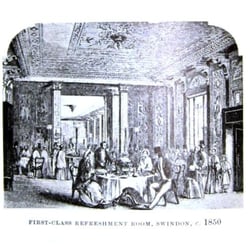
    Swindon Station - Contemporary woodcut print of the First-Class refreshment Room, Swindon , c. 1850

    Contemporary woodcut print of the First-Class refreshment Room, Swindon , c. 1850

    Swindon Station
    Swindon Station - Contemporary woodcut print of Swindon station, c. 1850

    See all

    Contemporary woodcut print of Swindon station, c. 1850

    Moreton-in-Marsh station - trainstations - Updated July 2026

    Loading...
    Loading...
    Loading...