Cancel

    Open app

    Search

    Ohkay Owingeh Pueblo Photos

    Recommended Reviews - Ohkay Owingeh Pueblo

    Your trust is our priority, so businesses can't pay to alter or remove their reviews. Learn more about reviews.
    Yelp app icon
    Browse more easily on the app
    Review Feed Illustration
    Photo of Leza M.
    390
    419
    250

    12 years ago

    Helpful 0
    Thanks 0
    Love this 0
    Oh no 0

    Verify this business for free

    Get access to customer & competitor insights.

    Verify this business

    Rio Grande Gorge Bridge - Can't walk across the bridge, but the overlook is here at the Rest Area  10-06-2025

    Rio Grande Gorge Bridge

    4.5(144 reviews)
    26.4 mi

    I hate that we couldn't access the sidewalk to be on the bridge. The area next to it does have…read moreparking but it is limited. They have a nice trail you can walk on and different areas to take cool photos. The best part is that it is free. They also have vendors selling goods in the parking lot.

    Located about 10 miles from Taos, NM stands this majestic bridge!…read more While on vacation, we decided to come see the gorge, the Rio Grande River, and the bridge that spans it. And what a sight it was to behold! We parked in the Rio Grande Gorge Rest Area. The bridge & gorge are viewable from here. There are sheltered picnic tables and restrooms here. In 1963 the bridge was started and was completed in 1965. It is part of the US Highway 64. There are three spans connected to create one bridge 1,280 feet long (two 300-foot-long approach spans with a 600-foot-long main center span). September of 2012, the bridge underwent a $2.4 restoration which included structural steelwork, a new concrete deck surface, new sidewalks, ramps, curbs, and gutters. We were unable to walk out onto the bridge, but we did walk out to the rim. The dirt path was easy to navigate. Once near the rim, it becomes rocky and there is no barrier to keep you safe from falling off the edge, so watch your step! Since I am not very steady of my feet, I didn't go out as far as I would have liked to. A few more steps and I would have had a better view, but I stopped. Sadly, the bridge was closed to pedestrians in Sept. 2025 due to suicides. I feel that by not getting to walk across the bridge, my experience was hindered. I would have loved to get a full head on view of the gorge! For me, having the view from here would have been safer and more ideal! You've probably seen this bridge since it has appeared in a few movies including Natural Born Killers, Twins, White Sands, She's Having a Baby, The Signal, Paul, Vacation, Wild Hogs, and Terminator Salvation. Locals call this bridge the "High Bridge" or the "Gorge Bridge". It is the seventh highest bridge in the U.S. It is located in the Rio Grande del Norte National Monument. If we make it back here in the future, I hope we will be able to walk to the center of the bridge!

    Photos
    Rio Grande Gorge Bridge - Bridge entrance from our unofficial parking lot

    Bridge entrance from our unofficial parking lot

    Rio Grande Gorge Bridge
    Rio Grande Gorge Bridge

    See all

    Taos Pueblo - O

    Taos Pueblo

    3.8(211 reviews)
    32.8 mi

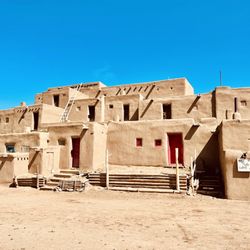
    My friend Bob had never been to New Mexico before and wanted to see an "iconic" pueblo. Taos…read morePueblo immediately came to mind and a place that Gayle and I had not been for over 18 years. It was a bit of a drive up (via the High Road), but well worth the time and effort. These multi-story homes are more than a thousand years old. None of the homes in the Taos Pueblo are vacant - five or six families live on the Pueblo full time, while the others live in town (with running water and electricity) but stay in their ancestral home many weeks throughout the year for important celebrations. We about the history of the Taos (or Tewa) people from our guide, Riley. That started at the Saint Geronimo Chapel and onward to the old church grounds, that hold the crumbling ruins of the original San Geronimo Chapel. Built in 1619 by Spanish priests using forced Native labor, it was destroyed during the 1680 Pueblo Revolt and again in 1847 by the U.S. Army (with women and children inside). In between were information on Pueblo ovens, family ties, and the Missing and Murdered Indigenous Women (MMIW) movement. There were also various shop sprinkled throughout, with a few pleasant surprises, like one run by an established Santa Fe painter, and some nicely done local jewelry and other art. There was a lot to see here and I appreciated the leisurely pace, while being respectful of restricted areas and honoring any cultural-related requests by our hosts.

    've always wanted to visit Taos Pueblo, even though it's quite out of the way. From Santa Fe, it's…read moreabout a 70-mile drive through winding mountain roads and small towns, which made the trip feel longer than it actually was. When I arrived, a staff member stopped me at a stop sign before I reached the exact location on the map. He explained where to park--either in the main lot or the one just ahead--and pointed out that the admission office is directly across the street, which was helpful. Adult admission is $25. I had seen complaints about the price beforehand, but honestly, I didn't feel that way at all. This isn't a state park or a monument--people are still living here--so the experience feels very real and meaningful. I picked up a brochure at the admission office. The highlights for me were the church (no photography allowed inside) and the cemetery, as well as the famous North House and South House. The air was crisp, and there was the smell of burning wood everywhere, which added to the atmosphere. I also stopped by a small shop selling handcrafted jewelry and decorations. I bought a hummingbird for $20 and was glad I had cash, since the seller told me I'd need to step outside to use Venmo (not sure why--my reception was fine). If you're interested in Pueblo history, this is absolutely a must-visit. It may not appeal to everyone, but for those who appreciate culture and history, it's a very special place. This lady was selling bread across from the office where they charge admission. It's $5 each absolutely delicious and no additive! Horno style bread," or Pueblo oven bread, is a traditional, dense white bread with a crunchy crust, historically baked in a beehive-shaped, outdoor adobe oven called a horno in the American Southwest. The term "horno" comes from the Spanish word for "oven

    Photos
    Taos Pueblo
    Taos Pueblo
    Taos Pueblo

    See all

    Bandelier National Monument - Bandelier National Monument

    Bandelier National Monument

    4.8(220 reviews)
    31.1 mi

    Without a doubt one of the best national parks or monuments I've ever been to! Highly, highly…read morerecommended if you are in the Santa Fe area. A couple notes: 1. Parking looks like it might get tough on busy weekends, mid-week we didn't have an issue early, and but when we left in the early afternoon, the main lot was pretty full. 2. The main Pueblo Loop trail was well maintained and quite accessible up to and just past the Big Kiva and Tyuonyi. The top-back part of the loop was a little more broken up, but still a pretty easy stroll. 3. The trail out to the Alcove House was absolutely beautiful! It's not paved, but it's a well maintained gravel. The ladders to the alcove itself are an interesting experience. If you don't love heights, there are some benches at the bottom of the ladder to sit on and relax. 4. Helpfully, there is a well-maintained pit toilet about halfway out, in case you need it. 5. The restaurant at the visitor center might not be the most efficient place, but the food was much better than you would expect!

    I have been fascinated by Native American cliff-dwelling habitats since studying them in grade…read moreschool, but I never had, nor took the opportunity to explore them, until daytripping to Bandelier. The visitors' center and the grounds were everything. The paths were clear and an easy hike. Looking off, beyond the paths was the gem. You could viscerally feel as though you were on the otherside of the looking glass, into time forgotten. There was almost a sacred quality to the excursion, which could've been because it was a weekday and there weren't many other tourists. Or, it could've been because the Pueblo people who lived there from 1150 to 1550 were still there, peacefully watching over the place. Haunted is different than sacred. I guess the best way to describe it is: It was a place of a more natural, more wild west and awareness. It's a well-known place to New Mexicans as well as people studied in the culture of the area. As a layperson, I was both surprised and captivated. If you are mesmerized by history and want to step into a different culture, a different time, this is a place you must explore.

    Photos
    Bandelier National Monument - Bandelier National Monument

    Bandelier National Monument

    Bandelier National Monument - Bandelier National Monument

    Bandelier National Monument

    Bandelier National Monument - Bandelier National Monument

    See all

    Bandelier National Monument

    Jemez National Monument - A local

    Jemez National Monument

    5.0(4 reviews)
    43.9 mi

    Jemez historic site (formerly Jemez State monument) include the ruins of 17th century Spanish…read moremission and the remains of an early Native American Pueblo- Giusewa (Towa's word for hot springs) cca 700 years old. The site is National Historical Landmark. It is somewhat secluded in Jemez river valley at the community of Jemez Pueblo or Walatowa. Parking is on the site, gravel and dirt covered lot in front of museum, that is also an entrance for the site. The whole loop trail is quiet short (1,400 steps), but with museum included, we spent an hour walking around. Large kiwa on the beginning of the trail is incredible. It's fully restored and can be entered by ladder. Inside can't be photographed, and honestly I don't think any photograph would do it justice. The energy of this place is amazing. I was happy that I got to spend few moments alone in there, as on the day we visited not many people were there, and most of them were intimidated and didn't even attempt to enter the kiwa. After kiwa there are pueblo walls, some more ruins and the main building at the site-the mission church. In the 17th century, the Spanish missionaries established a Catholic mission at the village (pretty common event for the time), but it wasn't long lived, due to no interest from locals. Giusewa moved to different location soon, and the ruins were decaying til the beginning of the 20 century when they were rediscovered and acquired by state. I liked the place was not overrun by tourists, it's quite condensed and it's beautifully taken care of.

    Actual Name: Jemez Historic Site…read more 700 years ago the precursors of today's Jemez Pueblo (known as the Walatowa), began constructing their homesteads in the narrow San Diego Canyon, which is now beautiful downtown Jemez Springs. They named their village, "Giusewa," translated as " Many hot springs." They were right about that. Three centuries later the Franciscans missionaries arrived with their Spanish culture intent on christianizing the heathens, whose spirituality they saw as demonic. Of course, they had it backwards, as it was the invading barbarians who were cruel in their conversion practices who disregarded the simple beauty of the indigenous culture, and ultimately destroyed the locals through outright hostilities and European diseases. In 1621, the brown robes began building a church to be the foundation of their mission. Defacto slave labor was used and the structure was said to be quite unusual for a remote house of worship, with octagonal bell tower and large colorful frescos on the thick walls. It was abandoned by 1640 during the successful rebellion of this pueblo and many others against the Spanish and the Franciscans, who were seen as little more than soldiers without armor by the populis. Today, the ruins of the church and the older adobe village remain to remind visitors that religious persecution is no way to win the hearts and minds of the people. Interestingly, the Catholic Church has established a religious retreat for priests in need of rehabilitation nearby. One wonders if the irony is recognized by the recovering abusers, that it was their predecessors who really needed the enlightenment to see the profound error of their ways, and that if the church had truly loved the people they encountered, all the death and destruction that came afterwards might have been avoided. But, then again, their ancestors didn't learn much from the Crusades.

    Photos
    Jemez National Monument - The entrance to the museum

    The entrance to the museum

    Jemez National Monument - The mission church is in the back

    The mission church is in the back

    Jemez National Monument - Large restored kiwa

    See all

    Large restored kiwa

    Santa Fe Plaza - Right down main street is the old church

    Santa Fe Plaza

    4.2(157 reviews)
    35.5 mi

    I love that Santa Fe's Historical District restrictions allow the Plaza to retain its old world…read morecharm and wide accessibility for the community. The rest of metro Santa Fe might be their version of suburbia, but the heart that anchors Santa Fe is right here. Yes, the shopping on the adjacent streets is a bit high end, but the classy charm of the plaza and the Tribal merchants across the street at the Inn of the Governors grounds the experience. Besides the interesting mix of people at the Plaza, I note 2 interesting experiences: 1. The Classic Car show on Friday night that circled the entire Plaza on the outside, accented by "Low Riders" occasionally circling. Our friend Laurie even found the model of car that her family drove around during her childhood. 2. The Santa Fe Plaza Obelisk, historically known as the Soldiers' Monument, was toppled by protestors in 2020 and its pieces are slated for a museum. What will become of the Monument proper is in community committee hands, which will probably go round and round without much meaningful progress short term.

    Founded in 1609 by the Spanish, this plaza is the main heart of Santa Fe with a lot of shops and…read morerestaurants accessible from here. This was where El Camino Real de Tierra Adentro, the royal road of the interior, ended, having begun in Mexico City. This is where the Santa Fe Trail ended its 900-mile-long journey from Independence, Missouri. There are markers in the plaza commemorating both. The best part of the plaza is the Native American street vendors that sell arts and crafts on the street. Many of them have their ID card and we loved meeting Paul and buying some of the hand painted see pots him and his wife made with hummingbirds on them. We asked him what the bird meant and he said "the beauty of life" and it made it a must buy. We saw other vendors selling jewlery, turquoise, paintings, and sandstone art but this was the tail end of our trip and we had no space anymore. This is an idea/tip but we asked around for fry bread or other Native American foods and nobody knew anywhere close by that served it. A nice Native American food truck or small stand would make a killing in this area!

    Photos
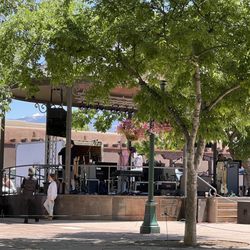
    Santa Fe Plaza - Santa Fe Downtown Plaza, Santa Fe, NM June 8, 2023 - band setting up on a Thursday at about noon

    Santa Fe Downtown Plaza, Santa Fe, NM June 8, 2023 - band setting up on a Thursday at about noon

    Santa Fe Plaza - Prepping for beautiful spring grass

    Prepping for beautiful spring grass

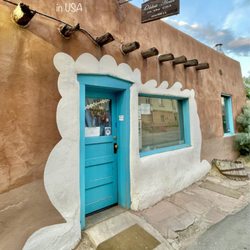
    Santa Fe Plaza - An outdoors alley shop with souvenirs and gifts

    See all

    An outdoors alley shop with souvenirs and gifts

    Ohkay Owingeh Pueblo - landmarks - Updated June 2026
    Loading...
    Loading...
    Loading...