Cancel

    Open app

    Search

    Savannah Waterfront Association

    5.0 (1 review)

    Savannah Waterfront Association Photos

    More like Savannah Waterfront Association

    Recommended Reviews - Savannah Waterfront Association

    Your trust is our priority, so businesses can't pay to alter or remove their reviews. Learn more about reviews.
    Yelp app icon
    Browse more easily on the app
    Review Feed Illustration
    Photo of Jai C.
    545
    1527
    2531

    18 years ago

    Helpful 1
    Thanks 0
    Love this 1
    Oh no 0

    Verify this business for free

    People searched for Community Service/Non-Profit 195 times last month within 15 miles of this business.

    Verify this business

    Midway Museum

    Midway Museum

    3.7
    (3 reviews)

    Highly recommended…read more If you live along the 113-mile Atlantic Coast of Georgia and, by extension, related areas into the low country of South Carolina to the north, you can't help but absorb a healthy dose of colonial-era culture and history. The evidence abounds everywhere in the region. You can see the history and culture of this area with a look at names on the road signs, cemeteries, old buildings, shopping plazas, parks, and land title documents. You'll note the name Oglethorpe, courtesy of James Oglethorpe, the founder of the British Colony of Georgia in 1735, who created the plat and layout of Savannah while issuing colorful edicts like banning lawyers, alcohol, and slavery from the Colony. You can feel the history and culture of this area via the magnificent live Oak trees and the barrier islands, out of whose bark and sandy grains oozes tales of local shipbuilding, wars, famine, and lives of love and loss over the centuries. On the coast, you can embrace wisps in the winds and the grit of the soil in places like Blackbeards Island, a refuge for and reminder of the presence of Sir Edmund Teach (Blackbeard) during an era when piracy on the high seas was at an all-time high. In part, battles between the European Colonial powers waged with Colonial America caught in their crosshairs during the pirates' reign. If you're a visitor to the area or just passing through, you can get a quick snapshot of area history in a 1.5-hour briefing and tour at the Midway Museum. It's a place chock full of memorabilia --impressive for a small-town. Here are a few snippets from our tour: James Oglethorpe detested slavery and banned the practice in the Colony of Georgia. But King George of England reminded Oglethorpe of his promise to make the Colony of Georgia profitable. In 1750, the King revoked Oglethorpe's ban on slavery. Between 1750-1756, 71 families, two single men, and 1,500 slaves were the subjects of a directed move from Dorchester, South Carolina, to present-day Liberty County, Georgia, to found a new village: Dorchester. The new residents of Dorchester wanted a church Midway between Savannah and the port of Darien (the latter is at exit 49 off I-95 today). Thus, the Midway Congregational Church was built and stands today next door to the present-day museum. The original church was burned down in 1779 during the American Revolution and rebuilt in 1791. The name "Midway" stems from the action to found the local church. The settlers at Dorchester became rich quickly. By 1758, wealthy colonist Mark Carr decided the area needed a seaport independent of Savannah or Darien. A land grant by King George to Carr led to creating the port at Sunbury, the deepest natural port on the East Coast of the United States, second only to the Chesapeake Bay. Today, it is a recreational seaport and home to the 5-star Sunbury Crab Company. In Liberty County at Hinesville, you'll discover the Convention and Visitors Bureau, now found in the old Bacon-Frazier home built in 1839. Descendants of the Frazier family still live in the county. Their ancestors go back to the revolutionary era when members of the colonial resistance hid courthouse records in local swamps to prevent their seizure by the British. There's too much to report about this place. It's a must-visit spot for history buffs. Go and enjoy. If you're lucky, as we were, you'll get an extended tour if you're a travel journalist if your host has the time to do so. Directions to the museum: Take exit 76 off I-95 due west for about 6 miles to Route 84 and 17. Turn right, go about 1/4 of a mile, and you see the museum on your right directly across the street from a NAPA Auto Parts Store and adjacent to the Midway Congregational Church, itself a relic of revolutionary days.

    Great place to learn about colonial Georgia history. So much early history in this area and this is…read morethe place to go to learn about it and see great artifacts. Staff is very knowledgeable and engaging. Great library/book store available to borrow or purchase. This is a definite must for anyone that likes history!

    The Old Exchange & Provost Dungeon

    The Old Exchange & Provost Dungeon

    4.3
    (130 reviews)

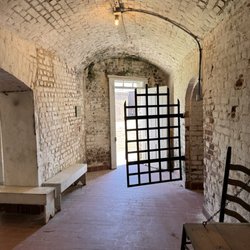
    Visited: February 16, 2026…read more The Old Exchange & Provost Dungeon was the perfect blend of history and hustle. From the moment you step onto the grounds, you feel the weight of Charleston's past. Inside, the immersion begins immediately -- postcards, patches, and meaningful souvenirs that make it easy to bring a little history home for friends and family. The highlight, though, was the tour. Our guide was a jolly local with razor-sharp, dry Southern wit -- the kind of storyteller who can pivot from Revolutionary War imprisonment to a perfectly timed sarcastic aside without missing a beat. Equal parts charm and "bless your heart," she made centuries-old history feel present and personal. Down in the Provost Dungeon, those brick walls carry gravity. British occupation. Prisoners of war. Pirates passing through. It's one of those rare spaces where you instinctively lower your voice. You don't just learn history -- you feel it. History hit different here. If you appreciate immersive storytelling, preserved architecture, and a tour that balances education with personality, this is absolutely worth your time.

    Fact: Provost Dungeon is older than our country!…read more The British originally owned it and used it as a commercial exchange and customs house. Also used as a post office, prison, and city hall, it is currently a museum. In addition, in 1788 South Carolina approved the US Constitution here. Yet another testament to the rich history of Charleston, Old Exchange, and Provost Dungeon a fascinating places to visit. Built in 1771, it has changed roles countless times: it was a British dungeon during the American Revolution, an elegant hall during George Washington's 1791 visit to Charleston, and a meeting place for the ratification of the Constitution, In 1780 the British occupied Charleston for two years and housed many prisoners in one large cell in this basement making it a provost, or dungeon. Because of the awful conditions here, disease was rampant due to crowding, and no bathroom facilities. Under these conditions, many people died while in prison here. This prison held all types of people, including American and British soldiers, private citizens, and slaves. The first and second floor of the building is home to a museum dedicated to the other uses of the Exchange Building. Fee: Admission to this historic building is only $12 for adults. For a small fee, a guided tour through the lower level and you can learn a lot from the guide.

    Middleton Place

    Middleton Place

    4.2
    (251 reviews)
    $$

    We did a walking tour w/luncheon at Middleton Place. In2026, they are celebrating 250 Years of…read moreAmerican Independence. We booked thru the Middleton Place website. Our Guides were knowledgeable & wonderful communicators for the tours we selected for our visit. The history of Middleton Place is fascinating & the relationship the Middleton owners had with the French botanist , André Michaux, is well documented & at least one of the four camellias of the "Reine des Fleurs" variety he brought to the plantation, in 1786, still survives in the gardens today. The grounds , during the off season ( February ) were well maintained. And there were still some flowers to be enjoyed on the camellias. It was quite chilly as the plantation is next to an inlet to the sea, so if visiting in winter wear appropriate clothing as tour is mostly outside. We did enjoy the onsite restaurant as well - serving a 3 course meal with selections that meet most diners palates. Our highlights included visiting the stables & getting a true historical & respectful description from one of our guides on the slave period experienced at Middleton Place. Every cent worth price of admission especially when bundled with lunch.

    There are a number of plantations near Charleston. Each one is different So I recommend…read more searching in AI mode to see which one best fits your interests. Based upon on search results from AI below we felt that Middleton Place best fit what we wanted to see at a plantation. From AI This sweeping 110-acre National Historic Landmark is perfect for those who want a blend of beautifully manicured landscapes and comprehensive history. * The Focus: Classical 18th-century European garden design alongside an educational look at the plantation's economic past. * Key Highlights: Breathtaking tiered lawn terraces descending to the Ashley River, a working stableyard with historic livestock, and Eliza's House--an interpretive site detailing African American history on the property. This is a very apt description of what we saw during our visit in June 2026. We arrived early enough to walk the grounds down by the river before taking the Beyond the Fields tour which you should build your visit around. The tour ended at Eliza's House where a docent explained family history of those who were enslaved here. We visited a few other areas as well. I'd describe the plantation as very interesting not spectacular. I believed it helped that we had taken Franklin's black history tour and visited the IAAH museum prior to the plantation visit to give us an overview that enhanced the enjoyment of our visit. The plantation has a restaurant that was recommended but we did not eat there.

    Augusta Museum of History

    Augusta Museum of History

    4.6
    (45 reviews)

    This is one of Augusta's most rewarding museums, a place that manages to tell a 12,000‑year story…read morewithout ever feeling overwhelming. The Augusta Museum of History is the city's oldest historical institution, founded in 1937 and now the only accredited museum in the Central Savannah River Area, which gives it a level of curatorial depth you can feel as you move from room to room. The museum's signature exhibition, Augusta's Story, begins with the region's earliest Indigenous cultures, including artifacts from the Stallings Island people, and then moves through the Colonial Era, the antebellum period, the Civil War, and the city's twentieth century reinventions. You see everything from slave‑made pottery to a 12‑pounder bronze Napoleon cannon tube and an 1869 steam fire engine tied to the devastating 1916 fire that reshaped parts of the city. It's a rare chance to see Augusta's full arc laid out in a way that feels comprehensive. The museum also excels at capturing the city's cultural identity. The James Brown gallery is a highlight, celebrating the life and global influence of the "Godfather of Soul" with photographs, stage pieces, and biographical context that show how deeply he shaped Augusta's modern identity. Several media options to watch him performing and to hear other leading figures discuss his influence. The golf and Masters Tournament section offers a thoughtful look at how the sport became intertwined with the city's reputation, and the medical history exhibit includes an impressive wall of antique medicine bottles that gives you a sense of how local healthcare evolved over generations. One of the most enjoyable parts of the visit is the Transportation Corridor, which brings Augusta's mobility story to life with a 1914 steam locomotive, a 1917 steam trolley, a reconstructed 1930s gas station, and a range of early vehicles. Walking through the restored streetcar and stepping into the rail car for photos adds a tactile, playful element that balances the more traditional exhibits. Upstairs, the museum's radio history exhibit traces the rise of WBBQ, one of Augusta's most influential stations, including a "then and now" section installed for its 60th anniversary. There are also exhibits on local law enforcement and firefighting, as well as a gallery of regional legends that highlights entertainers, athletes, writers, and other notable Augustans. The entire museum is comfortably explored in about two hours, which makes it an easy and rewarding stop whether you're spending a full day downtown or pairing it with the Morris Museum of Art or the Riverwalk. It's the kind of place that leaves you with a clearer sense of Augusta's character, from its earliest settlements to the voices and industries that shaped the city you see today. Don't miss it. [Review 203 of 2026 - 904 in Georgia - 25392 overall]

    We were in town for the weekend and decided to pay this place a visit. The admission price was…read moreonly a dollar so you really can't go wrong with that price. The first floor has a pretty extensive history of the city and was very interesting. The second floor has about five other sections including golf, James Brown, medical, and locals.

    Savannah Waterfront Association - nonprofit - Updated June 2026

    Loading...
    Loading...
    Loading...