Even before Gangnam Style became the unofficial anthem of the world, and before Kimchi became available at every supermarket, Seoul Barbecue was already serving up authentic Korean Food along Libis. My family and I have been eating here for almost 15 years, and today Seoul Barbecue
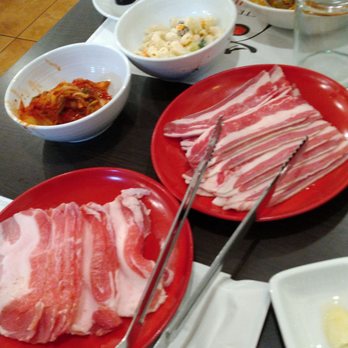
At the outset, however, it must be said that Korean Barbecue is decidedly NOT Seoul Barbecue's specialty. While I got my first taste of samgyeopsal and woo samgyup at this very restaurant,and while they are very tasty here, Seoul Barbecue's standout dishes are its braised dishes and stews. I think that's a good thing, as it lets this bastion of my childhood stand out from the growing crowd of samgyeopsal specialty restaurants.
I have to mention the banchan that's given out at Seoul Barbecue. To be really honest, if I had a set of Seoul Barbecue's banchan and rice, I'd be good. Maybe it's just because this is the restaurant where I learned to eat banchan, but the kimchi, beansprouts, and fishcakes seem to be fresher and cleaner tasting than usual. To give quality items for something which is essentially free speaks to a Korean restaurant's commitment to quality, so I appreciate it. The kimchi, in particular, is so good that my family orders a kilo to take home every 2 weeks or so.
As I mentioned, the Korean barbecue is just OK. While different in the early 2000s, with the influx of Korean barbecue restaurants since then, Seoul Barbecue's precooked samgyeopsal isn't anything special anymore.
However, as I also mentioned, their stews still are. The sauces and broths involved are well-balanced and clean.
More particularly, my family and I always enjoy the Ojingo Bokeum (cuttlefish in spicy sauce), Gopchang Jeongol (Tripe in Spicy Sauce), the Galbi Jjim (Beef rib in sweet broth), and Beef Bulgogi (Beef Strips in spicy sauce). The red spicy sauce is pleasantly spicy but not overwhelming so at all. The cuttlefish has a chewy texture, as you'd expect, but it's tender and not rubbery at all. The tripe dish might not be for everyone, but if you like tripe in kare-kare or callos, this is excellent. All four kinds of tripe (smooth, honeycomb, "tuwalya," and bumpy) are included in the stew, and while the gaminess is inherent in that kind of meat, it is mitigated by the same spicy sauce.
The sweet broth used in the Bulgogi and the Galbi Jjim might be the best in Manila. It's always very clear and clean, and never develops a layer of hardened fat, even when cold. I guess that's a result of very thorough skimming. The meat that is stewed in that broth is melt in your mouth tender. In the case of Galbi Jjim, even the bones are softened to the point of melting in your mouth. If you order it, be sure to take the daikon. That's the best part for me.
Aside from these stews, Seoul Barbecue's Bibimbap is excellent. Where most other restaurants only offer a vegetarian bibimbap as a side dish to barbecue, this is a full meal here It also comes in a sizzling hot stone bowl, allowing for some toasted rice bits, which is the real point of bibimbap. Adventurous eaters can also get Yuk Hae (steak tartare) with their bibimbap here in a cold dish. Because I like Steak Tartare, this is was an easy sell to me, but I understand why most would shy away.
Seoul Barbecue specializes in other Korean favorites too, like Kim Bap (Korean sushi roll) and Mandu (Korean dumplings). These are also well worth ordering, but do not stand out as much as the rest.
You can finish off your meal with the free fruit the restaurant provides, or help yourself to some Lotte Ice Cream. After that, you can waddle or roll home, as stuffed as a teddy bear.
Overall, Seoul Barbecue remains one of the best Korean restaurants in Manila,and while their barbecue isn't as good as other places', there is still a lot on offer here to make a visit worthwhile. read more