Cancel

    Open app

    Search

    Anfiteatro Flavio

    4.5 (4 reviews)
    Open 9:00 am - 3:00 pm

    Anfiteatro Flavio Photos

    Recommended Reviews - Anfiteatro Flavio

    Your trust is our priority, so businesses can't pay to alter or remove their reviews. Learn more about reviews.
    Yelp app icon
    Browse more easily on the app
    Review Feed Illustration

    7 years ago

    Helpful 0
    Thanks 0
    Love this 0
    Oh no 0

    Anfiteatro Flavio Reviews in Other Languages

    Verify this business for free

    Get access to customer & competitor insights.

    Verify this business

    Museo Archeologico Nazionale - Lighting and heating instruments collection

    Museo Archeologico Nazionale

    4.4(59 reviews)
    10.9 kmCentro Storico

    One of Naples' crowning museums, the artifacts here complement a visit to Pompeii in the same trip,…read moresince the collections span archaeological finds from Pompeii, Rome and beyond. From sculpture, sacred and funerary objects, mosaics, paintings, household items and furniture, to architectural models and decorative elements, there's plenty of intriguing objects to pique various interests. On a grey Sunday morning in April, I arrived at 10am, and was glad I didn't come later! There were two lines, one for those purchasing tickets at the entry and those with pre-booked tickets online in advance. The latter was a fairly short line, maybe about 10 people, while the former was about 20ish. When I left a couple hours later both lines had more than doubled in length. Inside, the exhibit halls begin with sculptures unearthed during archaeological finds, with the direction of visit encircling one of the smaller inner courtyards. They do an excellent job of providing Italian and English translations for didactic labels and descriptions, and I was able to learn much about a) the background and provenance of sculptures and other finds, b) key figures in archaeological excavations which discovered many of the pieces now housed here, and c) the history of this museum. The route of visit continues to a columned hall with some waiting area seating and contemporary local art pieces, (apparently where school groups rest before touring the museum with docents), which lead up a pair of curved stone staircases where you can look upwards at a central dome. On the second floor highlights include a collection of watercolor works from watercolorist Luigi Bazzani, who captured colorful paintings of Pompeii at the turn of the 20th century, a collection of elaborate furniture, and many rooms of artifacts from steles, ceramics, blown glass and tableware. Many colorful wall paintings found in villas and homes were transferred from archaeological sites to this museum. There's a curious collection of erotic art from antiquity called the Secret Cabinet* too. Unfortunately both these sections were closed: a) the mosaic floor where they previously allowed visitors to enter wearing cloth covers over shoes, and b) the sprawling mini replica of Pompeii that looked to be at least 12 x 15 feet. The latter I glimpsed thru a walkway that was cordoned off. The Sundial Hall, named after (you guessed it) a functional sundial installed in the SW corner of the room, was one of the most impressive rooms in the museum, originally serving as the Bourbon** Royal Library of Naples, then later as the National Library. The beautifully restored ceiling fresco depicts the Bourbon royalty as patrons of the arts. Among the most famous group of objects here are items from the Farnese Collection, begun by then Cardinal Alessandro Farnese (1468-1549), who later became Pope Paul III. Theses works were displayed in various settings notably the Farnese palace, villa and gardens in Rome, then subsequently passed down to descendants. Farnese Hercules, Farnese Artemis, the Farnese Bull and the Farnese Cup are all sublimely sculpted pieces. The total time recommended is easily 2.5-3 hours, additional if you want to read more of the placards. Free lockers, coat check and bathrooms are available. Admission is €20.00 for regular tickets, €2.00 for 18-25 year olds, free for teachers, disabled and those with certain city passes including Artecard and Naples Pass. Hours: 9.00 am - 7.30 pm with last entry at 6.30 pm Closed Tuesdays. *did not post these pics as I didn't want to get flagged for posting explicit content! lol **Bourbon as in the royal dynasty that ruled southern Italy from 1734 until 1860. Not the whisky made with a higher percentage of corn from the southern United States. =)

    If you visit Pompeii or Herculaneum, you must visit this museum to see the treasures found in those…read morelocations. Sign up for their free Wi-Fi so that you can download the map because there is very poor signage throughout the museum to help guide you. I was disappointed by the T-shirts they had available because they didn't show the name of the museum in a prominent way, only teeny little letters below an image.

    Photos
    Museo Archeologico Nazionale - Museum cafe

    Museum cafe

    Museo Archeologico Nazionale - Paintings from early 1st century AD

    Paintings from early 1st century AD

    Museo Archeologico Nazionale - Stairs to second story

    See all

    Stairs to second story

    Museo Cappella San Severo

    Museo Cappella San Severo

    4.5(39 reviews)
    11.1 kmCentro Storico

    Known as Cappella Sansevero Art Museum, or Chapel of Santa Maria della Pietà, this Neapolitan…read morebuilding contains a diverse collection of ornate sculpture visible for just 7Euro. Adhering to a strict photography policy, circumvented only through time and patience, expect to spend an hour in the two small chambers, mesmerized by the ornate netting on Il Disinganno and breathtaking Veiled Christ by Giuseppe Sanmartino. Downstairs guests will also find two anatomical studies of human vasculature that long pre-date the "Bodies" exhibits touring globally

    Visited in April 2026, and was really blown away by the detail in the marble sculptures. The way…read morethe sheerness of the fabric captured all the folds and wrinkles over the forms of the Christ and Modesty sculptures was stunning. My mind can't even begin to comprehend how Genoese sculptor Francesco Queirolo carved the life-like roped fishing net texture and structure draped over the two human figures out of solid stone for Disillusion. He certainly was a virtuoso in this art form. The other statues in the room were incredibly elaborate and detailed as well. As other reviews have mentioned, the chapel has a strict no photography policy, there are multiple security guards posted around this room and they watch with hawk eyes so don't even try. The "anatomical machines" portion of the exhibit was two open bodies one male, one female, preserved for scientific study, showing possibly the most complete real life version of the human cardiovascular system including veins and arteries. Fascinating, though could present an ick factor for those that aren't into seeing explicit internal organs. Open daily 9am-7pm except Tuesdays. Regular admission is €12.00 for adults, €6-8 for students, handicapped, youth 10 yrs and over. Free admission to 9 yrs and under. Audio guides are available for an additional €3.50 fee. Regular admission feels steep for essentially access to 1.5 rooms, given the amount of people, had to dock a star. A lot of info available on their website below, I don't think you need the audio guide if you can read thru the descriptions in advance, though cell service isn't great inside, so wouldn't recommend trying access it live. https://www.museosansevero.it/en

    Photos
    Museo Cappella San Severo - Our tour guide entered the chapel with her devil horns, and no one told her to take off. lol

    Our tour guide entered the chapel with her devil horns, and no one told her to take off. lol

    Museo Cappella San Severo - Entrance - no pictures allowed inside in April 2026

    Entrance - no pictures allowed inside in April 2026

    Museo Cappella San Severo - Description outside the church

    See all

    Description outside the church

    Maschio Angioino - Castel Nuovo - Palatine Chapel

    Maschio Angioino - Castel Nuovo

    4.5(29 reviews)
    10.7 kmPlebiscito/Centro

    You're greeted with beautifully carved pillars and arches with details that tell you stories. The…read moremassive doors are dramatic! Do some neck and shoulder stretches before visiting because looking up and around is required. It's a castle on the outside and a Civic Museum inside. For €6 entry, you get a lot for your visit. An audio guide is optional for €4 more. Note that you're able to get a brochure with a map in English. After entry, you step into a huge courtyard. It appeared an event was being set up the day of my visit. I headed to the left toward the stone steps to start my self-paced tour into the: BARON'S HALL - it looks like a courtroom. Awesome ceiling architecture! Tried to follow the map; forget about going in alphabetical order. On the ground level you'll find the: PALATINE CHAPEL - closed doors for preserving artwork; so full of emotion. No flash photography. Place your camera glass to glass against the doors. Up more stairs to the: 1st FLOOR - find a bronze door with a cannon ball stuck in it. This floor has a lovely collection of religious paintings from 15th-18th centuries. 2nd FLOOR - you'll see more of paintings with war stories and lifestyles from 18th-20th centuries. 3rd FLOOR - modern day collections. Note that these floor exhibits are not directly above each other. Refer to the map and legend on the brochure for your preferred route. Art lovers and appreciators can take their time. Definitely a recommended visit for tourists. Don't forget to catch a breeze and take in views of the Tyrrhenian sea.

    Constructed in 1279, and for centuries the Royal residence of Naples' kings into the 16th century,…read morethe gothic exterior of this massive fortress with five towers is a magnificent reminder of Napoli's medieval history and maritime prowess, with an entrance over the largest man-made moat I've seen. Arriving at 5pm on a weekday afternoon, I scrambled (ie. speed walked for half a mile) to make it before their assigned last entry time, which I thought was 5pm for a 6pm closing time, though apparently it's last entry at 5:30pm. Well...I got an extra workout. There's a small ticket window to the left inside the main doors, which takes cash or card, and can also validate your city/museum pass (I had a Naples Pass). Regular admission is €15, tickets for local residents €10, free for children under 18. However because of ongoing renovations to major sections, they were offering reduced admissions of €10 and €6 respectively. Inside what's available to view as of mid-April 2026 are several components. To me each stands alone and feels a bit disjointed to the others, though given its lengthy history and different functions over time perhaps the range of spaces truly embodies the story of the castle, one embued with varied relevance and purpose. - Palatine Chapel: an austere chapel with stone block floors, inset with ledger stones.* - Archaeological route and former Armory room: this is where the ruins can be viewed below a glass floor--of what's believed to be past of a lavish Roman villa from 1st century BCE beneath the castle. Tours need to be pre-booked in advance if you want to descend to the underground level to visit these. - Hall of the Barons: this is the kind of grand hall I'd imagine medieval royalty to preside over, with a massive octagonal star-shaped arched stone ceiling and central round skylight, though it was actually a later construction in the 15th century. The layout includes a U-shaped wooden seating arrangement where the current Napoli city council meets. - Chapel of the Souls of Purgatory: single room with entrance off the courtyard to the right of the entrance to the Palantine Chapel, the frescos are colorful though space is small. - First floor Civic Museum - Art Gallery: this is up a flight of steps (aka the second floor for those of us across the pond), a gallery of about 50 works ranging from 15-18th century religious Neapolitan art, transferred here from other historic buildings that are no longer in use. - terrace on second floor with partial view of the port: I was a little disappointed since I thought the roof of the castle would be accessible though I'm glad I didn't rush here on my first day in Naples and instead went to Monte Echia nearby where the views were much better, more panoramic. It took about 30 minutes to walk around the parts that were open, there are more extensive galleries on the upper stories that were under renovation. I felt it made sense to reduce the price since some portions were closed. For more info: https://www.comune.napoli.it/vivere-il-comune/luoghi/castel-nuovo-maschio-angioino/#orari_apertura https://www.naplesinsider.com/en/e/castel-nuovo-maschio-angioino *an inscribed stone slab usually laid into the floor of a church to commemorate or mark the place of the burial of a deceased person. (as per Wikipedia)

    Photos
    Maschio Angioino - Castel Nuovo - Construction underway

    Construction underway

    Maschio Angioino - Castel Nuovo - Upstairs on the 2nd floor is a small gallery

    Upstairs on the 2nd floor is a small gallery

    Maschio Angioino - Castel Nuovo - "Natura merta con pesci" by Giuseppe Reco

    See all

    "Natura merta con pesci" by Giuseppe Reco

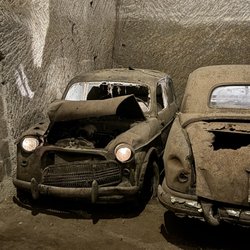
    Galleria Borbonica - Damaged cars from WWII

    Galleria Borbonica

    4.9(22 reviews)
    9.9 kmChiaia

    This was another highlight during our visit of Naples. It's not to be missed if you're a WWII buff,…read moreor have any personal connections to this era. We purchased the standard tour (there are 3) which starts at the entrance of Vico del Grottone. It's close to the Piazza del Plebiscito. There are timed entries. We just happened to get there just before the guided English tour at 11:00am. The timing was perfect. I would rethink this one if you have mobility or night vision issues. The very first thing you'll do is walk down a very high, narrow, and dimly lit stairway with pumice walls surrounding you. I'm pretty sure our tunnel guide said it was 90 steps down. The good news is that you won't have to climb up at the end. You'll exit out into a covered parking area along Via Monte de Dio. Our guide was so passionate & knowledgeable. I think his name was David. He also made sure that every question was answered. It's quite a long & rocky history of why the King had it built, and the obstacles they had building around the aqueducts and holding tanks. The vision was never fully realized after the fall of the Bourbon monarchy. It was abandoned until WWII when it was used as a shelter from bombs. It's an incredible story, and you can see how the residents of Naples lived under the brutal conditions of war. Some lived there longer because they had nowhere else to live after houses were destroyed. We were very impressed with how well the tunnels were restored, and hearing about how all these secrets (artifacts) were uncovered. It had been hiding under Naples all these years until being rediscovered some time in 2005. I don't think it even opened to the public until 2010. It was a very memorable & unique experience. Very much worth the small admission fee. Definitely seek it out if you are in Naples. It only takes an hour, and it's well worth the time.

    An inspiring tour to take. Long history of use in Naples. Started hundreds of years ago and used…read morethrough WWII and after. Excellent tour guides. Multiple tour options ranging from easy to more involved requiring hard hats. Unique antiques shop included as part of tour. Well worth the price of 10€ to see this amazing underground area.

    Photos
    Galleria Borbonica - Damaged cars from WWII

    Damaged cars from WWII

    Galleria Borbonica - The part of the tunnel that leads to the palace

    The part of the tunnel that leads to the palace

    Galleria Borbonica

    See all

    Certosa e Museo di San Martino - One view of the "wow" nativity scene, this one cycles from dark to light and back again.

    Certosa e Museo di San Martino

    4.9(19 reviews)
    9.8 kmVomero

    Naples isn't Florence, Venice, or Rome and nothing could have screamed that louder than Certosa e…read moreMuseo di San Martino, a diamond in the rough. Located at the very top of the Vomero district and sitting beside the imposing Castel Sant'Elmo, the Museo di San Martino does little to outwardly win your heart. Here, you need to work to reveal the wow factor. Immediately after paying the entry fee I walked into a tired-looking courtyard. As one of the first things you encounter, it's easy to wonder what you've gotten yourself into. Next you'll wonder how to find the treasures talked about on the audio guide you rented. Pro tip: don't bother renting the audio guide, something I rarely say. Next up is a beautiful church, classic Italian, ornate and lovely. Friends I was with walked from here through another building, then out to the gardens. I'm not sure what's happened since some of the photos posted here on yelp, but it was impossible to walk through the gardens thinking anything other than "how hard would it be to pull some weeds?" The garden is a lovely stroll with beautiful views but majorly unkempt. So look a little harder. It wasn't until I began wandering off the beaten path here that I discovered riches. Naples is known for their hand-carved nativity scenes, assembled by locals at the start of December. Here, you'll find the best of that genre, featuring entire city scenes, flying angels, babies, toddlers, water features, the poor and unbathed... the list goes on. One of the things Neopolitans are quick to tell about their nativity scenes is how realistic the figures are. That is: the people are not made to look like models. They feature the faces of the the needy, the unattractive, those generally not featured in the arts from this time, making the scenes all the more interesting. Anyhow, there's a heavenly assortment of nativity-scapes here including a huge one that goes dark and then brightens to daylight. This section is a must-see. There's tons of other ancient (circa the 1500's) sculptures here as well as some fabulous views of Mount Vesuvius. There was honestly more to see here than I even saw. In the end, despite Museo di San Martino not being a place that screams "see me", it is.

    This place is nothing short of awesome. It used to be a monastery and sits right next to Castel St…read moreElmo. In a way it has been turned into a museum, but there is still much of it that is reflective of the former monastery. I actually discovered this place completely by accident, namely because I was looking for the entrance to the Castel and ended up walking in here instead. Needless to say the old monastery part of this, especially the religious art that covered the walls, was nothing short of mind blowing. Mind you, it can be easy to get lost in here, however once you find your way into the courtyard, the serenity of the place literally washes over you.

    Photos
    Certosa e Museo di San Martino - Entrance

    Entrance

    Certosa e Museo di San Martino - One of many fabulous views from here.  Mt. Vesuvius is what you're seeing in this view.

    One of many fabulous views from here. Mt. Vesuvius is what you're seeing in this view.

    Certosa e Museo di San Martino - Classic, ancient, Italian church is part of the Museo di San Martino.

    See all

    Classic, ancient, Italian church is part of the Museo di San Martino.

    Museo di Capodimonte - Alberto Burro grande centro nero

    Museo di Capodimonte

    4.5(15 reviews)
    11.4 kmCapodimonte

    Look to spend at least four hours walking through and reading up on some of the most eye catching…read moredisplays. If your smartphone has the space and your cell network has the reception, I suggest downloading their museum app guide. On the business side, it's a great idea that they offer this instead of providing headsets and hand carry narratives. So, good luck if you're a foreigner with an outside network ;) The exhibits during my visits were awesome. I enjoyed the sculptures and contemporary art most. There are thousands of paintings and they were beautiful as well. I found the stitch work the most impressive. They look like rugs... These are ginormous and span an entire wall with high ceilings. Each of them tell a story. But the details are what captured me most. Strong reccomendation anyway, to take time for any museum and learn something you never knew. Plus in this museum, you gotta check out the outside view from the second level!

    This is worth the travel to get to it. Allow a full day and why not take a picnic for the gardens?…read moreNaples is quite unique in that it hasn't actually been part of Italy that long (historically speaking) and has been an independent principality a number of times and has been under the 'control' of both Christians and Muslims at different times. The Capodimonte family are one of the great families of Naples and the house and gardens are tributes to their vision. The décor inside the house is exquisite.

    Photos
    Museo di Capodimonte - Museo di Capodimonte, Napoli, Italia

    Museo di Capodimonte, Napoli, Italia

    Museo di Capodimonte - Carved stone

    Carved stone

    Museo di Capodimonte - Stanza di porcellana.

    See all

    Stanza di porcellana.

    Anfiteatro Flavio - museums - Updated June 2026

    Loading...
    Loading...
    Loading...