Cancel

    Open app

    Search

    Complesso

    5.0 (1 review)

    Complesso Photos

    Recommended Reviews - Complesso

    Your trust is our priority, so businesses can't pay to alter or remove their reviews. Learn more about reviews.
    Yelp app icon
    Browse more easily on the app
    Review Feed Illustration

    14 years ago

    This is a lovely church but you really must go around the back the the gardens and museum. Very beautiful. Worth every penny.

    Helpful 0
    Thanks 0
    Love this 0
    Oh no 0

    Verify this business for free

    Get access to customer & competitor insights.

    Verify this business

    Duomo di Napoli - The lights make it feel like the statues are glowing

    Duomo di Napoli

    4.6(19 reviews)
    0.8 kmCentro Storico

    For the casual tourist, while not necessarily the largest cathedral, the Duomo di Santa Maria…read moreAssunta, aka Duomo di Napoli, aka Cattedrale di San Gennaro--still presents a visual feast for the eyes. For the spiritual visitor, this cathedral is the city's central catholic parish, seat of the Naples archdiocese, dedicated to the city's principal patron saint. San Gennaro (Saint Januarius)*, was a bishop martyred in 305 AD under Roman emperor Diocletian, later buried here. While little is known about his life, his body was transferred a few times, lastly in 1497 to Naples. This was at the behest of Cardinal Oliviero Carafa, where his remains were kept in the Succorpo, a richly decorated crypt constructed for this specific purpose. The most notable religious relics housed here include: 1) ampoules of the saint's blood that supposedly liquify three times a year in a miracle to show the favor of the saint upon the city, and popes that visit. For this reason it's become a pilgrimage site for those hoping to witness the miracle of liquefaction. It's debated what type of liquid is contained within the hermetically sealed vials, though scientific evidence is scant considering the contents cannot be removed in fear of damage to its contents. 2) the treasure of San Gennaro (for which a separate ticket must be purchased €13) consists of the many works bestowed upon or donated to the cathedral over seven centuries from royalty and lay persons, as signs of devotion. Paintings, busts, ex-votos, objects made with precious metals and jewels are included in this collection. While there are a few sections of the cathedral that are currently not open regularly to the public, including a) the Santa Restituta, where the Baptistery of San Giovanni in Fonte is located (part of the church built earlier in the 14th century--you could peak in from the side though couldn't enter), b) the Chapel of the San Gennaro Treasury, c) the Minuto Chapel, --the parts the were open were very impressive. In the cathedral, highlights include the colorful soaring dome, golden coffered ceilings, and the decorative statue "Assumption" at the main altarpiece by Pietro Bacci (1739). Mid-afternoon lighting thru the windows cast a bright warm glow making the statue look like it was shining. The Succorpo was also one of the most ornate crypts I've ever seen. Open daily 9:30am-17:00pm, general admission is free and there are tours available with advance booking required (€10 adult, €8 student, €6 6-15yr olds, €0 for 5 and under and those with disabilities.) Tickets for rooftop access are €6. Good-sized gift shop. For more info - their website is very informative about the duomo's history and visiting details: https://duomonapoli.it/en/ *This is the same saint for which an annual festival Feast of San Gennaro is held.

    Spiritually Full and Completely in Awe…read more Duomo di Napoli took my breath away the moment I stepped inside. I can't even fully put it into words... the calmness that washed over me was unreal. My heart felt full... my spirit felt fed... and I could've stayed there for hours just soaking it in. The architecture is beyond anything a photo can capture: the detail, the artistry, the reverence in every corner. You feel the history... the faith... the devotion... all around you. If you're visiting Naples, do not miss this cathedral. It's not just a tourist stop... It's an experience for your soul. Absolutely beautiful.

    Photos
    Duomo di Napoli - Central nave

    Central nave

    Duomo di Napoli - View towards the doors

    View towards the doors

    Duomo di Napoli

    See all

    Certosa e Museo di San Martino - One view of the "wow" nativity scene, this one cycles from dark to light and back again.

    Certosa e Museo di San Martino

    4.9(19 reviews)
    1.1 kmVomero

    Naples isn't Florence, Venice, or Rome and nothing could have screamed that louder than Certosa e…read moreMuseo di San Martino, a diamond in the rough. Located at the very top of the Vomero district and sitting beside the imposing Castel Sant'Elmo, the Museo di San Martino does little to outwardly win your heart. Here, you need to work to reveal the wow factor. Immediately after paying the entry fee I walked into a tired-looking courtyard. As one of the first things you encounter, it's easy to wonder what you've gotten yourself into. Next you'll wonder how to find the treasures talked about on the audio guide you rented. Pro tip: don't bother renting the audio guide, something I rarely say. Next up is a beautiful church, classic Italian, ornate and lovely. Friends I was with walked from here through another building, then out to the gardens. I'm not sure what's happened since some of the photos posted here on yelp, but it was impossible to walk through the gardens thinking anything other than "how hard would it be to pull some weeds?" The garden is a lovely stroll with beautiful views but majorly unkempt. So look a little harder. It wasn't until I began wandering off the beaten path here that I discovered riches. Naples is known for their hand-carved nativity scenes, assembled by locals at the start of December. Here, you'll find the best of that genre, featuring entire city scenes, flying angels, babies, toddlers, water features, the poor and unbathed... the list goes on. One of the things Neopolitans are quick to tell about their nativity scenes is how realistic the figures are. That is: the people are not made to look like models. They feature the faces of the the needy, the unattractive, those generally not featured in the arts from this time, making the scenes all the more interesting. Anyhow, there's a heavenly assortment of nativity-scapes here including a huge one that goes dark and then brightens to daylight. This section is a must-see. There's tons of other ancient (circa the 1500's) sculptures here as well as some fabulous views of Mount Vesuvius. There was honestly more to see here than I even saw. In the end, despite Museo di San Martino not being a place that screams "see me", it is.

    This place is nothing short of awesome. It used to be a monastery and sits right next to Castel St…read moreElmo. In a way it has been turned into a museum, but there is still much of it that is reflective of the former monastery. I actually discovered this place completely by accident, namely because I was looking for the entrance to the Castel and ended up walking in here instead. Needless to say the old monastery part of this, especially the religious art that covered the walls, was nothing short of mind blowing. Mind you, it can be easy to get lost in here, however once you find your way into the courtyard, the serenity of the place literally washes over you.

    Photos
    Certosa e Museo di San Martino - Entrance

    Entrance

    Certosa e Museo di San Martino - One of many fabulous views from here.  Mt. Vesuvius is what you're seeing in this view.

    One of many fabulous views from here. Mt. Vesuvius is what you're seeing in this view.

    Certosa e Museo di San Martino - Classic, ancient, Italian church is part of the Museo di San Martino.

    See all

    Classic, ancient, Italian church is part of the Museo di San Martino.

    Catacombe di San Gaudioso

    Catacombe di San Gaudioso

    4.8(25 reviews)
    1.4 kmCentro Storico

    Quite different from San Gennaro, these catacombs have a claustrophobic space. We entered to the…read moreright side of the original catacomb entrance. It's inside the church. The church was built around and over the catacombs to protect it. Another history lesson you'll have to hear about on this tour. You'll find the church's interior really beautiful and grand with gates that guard the original entrance. Put away or secure all your loose belongings like cellphones, cameras, sunglasses or hats cuz you're gonna need to hold on to the sides making your narrow way downstairs to the underground. You can take pictures once you're safely flat on two feet. Oh and hopefully you ladies are wearing flats or tennies cuz it is not the kind of platform to walk pretty. The stone paths further in are just right for one person, cozy for two. Making your way through, there are more turns. There's an area we stopped to learn about how the rich back in those times, were the only ones who can afford the service where their loved ones whom have passed away were "treated" in the section that drains body fluids into a container placed beneath the corpse. When the flesh deteriorated the skeleton's skull would often fall. And so the skull would be placed on a stone shelf just above their bones; lined up across. (A scene you may find familiar in many Latin cultures especially during Dia de Muertos.) It wasn't a sanitary practice, but we're talking history, and change came with time. Giovanni Balducci was a Tuscan artist who was hired to be the only one that painted skeletons at San Gaudisio catacombs. These are the only catacombs known to have placed the skulls of the dead in the concrete (see photos)... again, for the rich who were able to afford the service. Along the shorter gallery (in comparison to San Gennaro's larger expanse), the painted skeleton of the men are on left; women are on the right painted with skirts. P.S. your entrance ticket to San Gennaro gets you into these catacombs for free - two for one.

    Tour would have been great if they had staggered the English speaking and Italian speaking tours…read more They started at the same time so all you could hear was the loud Italian speaker screaming behind us. Would not recommend. Two stars is being generous.

    Photos
    Catacombe di San Gaudioso
    Catacombe di San Gaudioso
    Catacombe di San Gaudioso

    See all

    Chiesa del Gesù Nuovo - Closer look at the main altarpiece in the front

    Chiesa del Gesù Nuovo

    5.0(7 reviews)
    0.1 kmCentro Storico

    Naples has no shortage of historic basilicas and church buildings and this is one of the most…read moreimpressive in the city. Highly recommend to drop by for a look as admission is free (donations accepted), and they are open later until 7pm so it's convenient to swing by before heading to dinner. On a cloudy day in April apparently many like-minded visitors had the same idea as it was fairly busy, though not extremely crowded. Located on the western edge of the Centro Historico district, the "New" in its name distinguishes it from another existing church of the name Gesu Vecchio. Initially the palace residence built in 1470 for Roberto Sanseverino, Prince of Salerno, political divisions led to his son and heir Ferrante Sanseverino being exiled and property confiscated, and this property sold to the Jesuit order. In 1584 construction began, led by appointed architect Giuseppe Valeriano, to convert this aristocratic palazzo to Jesuit church. The palace's unique facade was the only remnant left, with its bugnato (rusticated) grey volcanic-stone punta di diamante (diamond point) protrusions. What's even more intriguing is that this facade, designed by original palazzo architect Novello da San Lucano, who was also a composer, incorporated musical notes in Aramaic letters incised into the stone, which has been interpreted by musical historians as sheet music. The music has been named "Enigma" and you can find it played on YouTube. Other scholars interpret these symbols to be related to alchemy and esoteric practices popular in the day. This building passed between different hands thru the centuries though in 1900 definitively returned to the Jesuits. Nowadays it's known for the vast number of artworks that line its ceilings and chapels. They were certainly awe-inspiring to see! I spent about 30-45 minutes walking around, this is a functioning parish so administrative offices, prayer sections, a shop for purchasing ex-votos and souvenirs, and other functional facilities are also present. Hours: 8am-12:45pm, 4-7pm daily.

    What a big surprise! There's a hidden gem behind that palace facade. You enter through the Baroque…read morelooking entryway at the Piazza of the same name. We were totally amazed at what we saw inside this church. I would have never known based on its exterior. It's immensely grand and ornate as you walk inside. The ceiling and chapels are covered in Italian Baroque art from famous artists such as Francesco Solimena and Luca Giordano. There are alters made of precious stones and marble statues. All of which are saintly and historical. I didn't realize it at the time, but people do go there to be healed. There is a chapel dedicated to a Naples doctor & saint named Giuseppe Moscati. His tomb lies under the chapel altar. He is known for taking care of the sick and the poor. There was a line of people waiting to enter a part of the church that houses his personal quarters and belongings. We didn't get to see it, so I can't comment on it. It's just something to consider seeing while you're there. This whole area is full of historical churches. I mean, you could visit churches all day long if that's your thing. This is a great option if you only have time to visit one, and it's free to the public. They accept donations as most churches do.

    Photos
    Chiesa del Gesù Nuovo - The Chapel of St. Francesco

    The Chapel of St. Francesco

    Chiesa del Gesù Nuovo - Looking towards the entrance

    Looking towards the entrance

    Chiesa del Gesù Nuovo

    See all

    Basilica San Francesco di Paola - Evening

    Basilica San Francesco di Paola

    4.6(7 reviews)
    1.3 kmPlebiscito/Centro

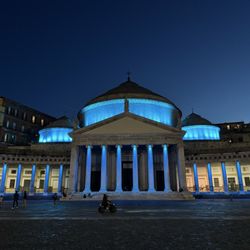
    Hemming in the western edge of Piazza del Plebiscito, this basilica is reminiscent of the Pantheon…read morein Rome with its focal dome, and colonnaded portico arms branching north and south. Commissioned by Joachim Murat (Napoleon's BIL) in 1816 as a tribute to Naps himself, it was Bourbon King Ferdinand I who took credit for completing the construction under his rule when the the French government was ousted and rule reverted to the Neapolitan and Sicilian houses, hence the equestrian statues erected in the square directly in front of this basilica. A little tricky to find the opening hours as the building info on G-maps is confusingly vague, it lists several businesses including a handful if BnBs within the same location, and from the number of reviews it doesn't seem like a much trafficked site (or maybe intentionally so for local safeguards). Either way, from the pictures online the dome is sizeable, there are a couple side chapels though not much extra to gaze upon. In the evening the exterior is lit with color lights and adds a chill ambiance to the piazza. Many local kids riding bikes, some families and friends taking a walk. With free entry, if I was in the area again during the daytime would definitely peek in to check it out!

    Located in Piazza del Plebiscito, the main square of Napoli, San Francesco di Paola contains a…read morenumber of statues and chapels while its shape and grandeur harkens Rome's Pantheon. Good for a quick visit.

    Photos
    Basilica San Francesco di Paola - No crowds around nightfall

    No crowds around nightfall

    Basilica San Francesco di Paola
    Basilica San Francesco di Paola

    See all

    Purgatorio ad Arco - Skull

    Purgatorio ad Arco

    4.0(7 reviews)
    0.5 kmCentro Storico

    Happy Halloween! Who's hanging up the garlic and readying their silver stakes? Who's sucking? Who's…read moretrick or treating? I doubt Count Giulio will be doing any of that. But his tomb lies in the crypt of the lower church. To check it out, you have to pass the other stone graves and walk toward the back through a narrow hallway into an extremely dim and lightless tomb. Yyyyeah I felt the hair on my arms stand! He awaits... Photography is not allowed in the lower church. Tours were not available when I visited so I picked up a self explanatory paper guide. Below are grave sites or shrines for the souls in purgatory. They're composed of numerous 17th century anonymous remains, as families couldn't afford proper burials. The upper church is where you can tour the museum and artwork. Pictures are allowed. Watch your step! ...and your back... mmmmmheheeee

    We didn't have enough time to see all the churches we wanted to see, so we opted for this one…read morebecause we didn't really have a choice. The only reason I'd give it three stars is because we weren't really sure what we were looking at. The tour was in Italian only and we were given pamphlets of what the underground section of the church meant, but if that was the case, why were we on the tour anyway? For us, we were there for only 15 minutes and then we left. It didn't matter anyway since we couldn't understand :( And no photos allowed for us, but our tour guide let the Italians take photos. What gives? Otherwise, it was really interesting to learn about the church (from what we could gather about the pamphlet). I enjoy this side of Naples witchy/gothic side - I just wish I could have learned more!

    Photos
    Purgatorio ad Arco - Skull

    Skull

    Purgatorio ad Arco - In the classical church you have to look for special signs of the purgatory but you will find them.

    In the classical church you have to look for special signs of the purgatory but you will find them.

    Purgatorio ad Arco

    See all

    Complesso - religiousorgs - Updated June 2026

    Loading...
    Loading...
    Loading...