Cancel

Open app

Search

Footer's Dye Works Photos

Recommended Reviews - Footer's Dye Works

Your trust is our priority, so businesses can't pay to alter or remove their reviews. Learn more about reviews.
Yelp app icon
Browse more easily on the app
Review Feed Illustration

4 years ago

Helpful 4
Thanks 0
Love this 5
Oh no 0

Verify this business for free

Get access to customer & competitor insights.

Verify this business

George Washington's Headquarters

George Washington's Headquarters

4.0(4 reviews)
0.2 mi

History is worth looking at. This is an interesting spot if you're a Washington fan. Get to know…read morehis early days.

Borrowed from the below site:…read more www.mdmountainside.com/listing/george-washingtons-headquarters/2042/#:~:text=The%20Headquarters%20of%20George%20Washington,the%20United%20States%20of%20America. "The Headquarters of George Washington is a historic site, located at 38 Greene Street, in the historic downtown district of Cumberland, Maryland. The centerpiece and primary attraction at the site is a historic log cabin twice occupied by George Washington, the first President of the United States of America. The cabin resides in an area known today as Riverside Park but was originally built about 2 blocks away. The original site is located nearby at 16 Washington Street. The cabin was originally built by General Edward Braddock's men, between 1755 and 1758, for then Colonel George Washington's use during his service in the French and Indian War. He later returned and used it briefly during 1794, then as the Commander in Chief, in order to review the troops gathered to put down the Whiskey Rebellion. This site is notable, as it signifies Washington's first military command. The original site lies on a hill that overlooks Wills Creek and the Potomac River. It was once the location of Fort Cumberland (Maryland) and today, The Emmanuel Episcopal Church (Cumberland, Maryland). The headquarters was part of Fort Cumberland during the French and Indian War, and it is the only building to survive from the original Fort. Though closed to the public, the cabin has windows visitors can peer into and see historical displays and artifacts of what the cabin may have looked like including a bed, desk, and fireplace as well as a life-size wax replica of Washington." If you come here, parking in the area is somewhat tight. During our visit, Greene and Baltimore Streets were under a lot of construction so we parked two blocks away for a buck in a pay lot near Basecamp Coffee. If you're so inclined, you could also park on the other side of the creek at the visitor center and walk over the bridge to get here. We came, read the placards, took a few pictures, walked a short distance to read a few more of the placards that go under 68 but then saw a few loud locals (i.e. homeless-hobo-vagrant) and thought better of going any further. With that said, this is by no means a stop that you're going out of your way for. At best, this is a few minutes passing curiosity just to say that you saw it. If you want something more substantive about Washington's time in the general area as a British officer, the NPS site Fort Necessity is the place. Tons of stuff there that George did including surrendering to the French. www.nps.gov/fone/index.htm

Photos
George Washington's Headquarters

See all

Great Allegheny Passage

Great Allegheny Passage

4.8(4 reviews)
0.1 mi

A friend and I rode the Great Allegheny Trail from Myersdale, PA down to Cumberland, MD. It was a…read more33 mile ride overall, but we really enjoyed it. Now, neither of us are Lance Armstrong wanna-bes. We're old farts riding plain bikes. From Myersdale, the first 9 miles is uphill, but since it's an old railroad, it's a very gentle uphill slope. The highlight of this part of the trip was riding across the Keystone Viaduct. On our uphill leg, our average speed was 8.0 mph (from my GPS). At the end of the 9 miles uphill, we arrived at the Eastern Continental Divide. From there, it's ALL downhill all the way to Cumberland. We overheard someone else on the trail say that on the downhill side, "you don't need pedals, all you need are brakes." My GPS said our average speed during the downhill leg was 13 mph. There are a few spots along the way you could get on the trail and just do the downhill portion. We saw some families with kids doing the downhill portion, too. As an alternative, you can ride the Western Maryland Scenic Railroad from Cumberland up to Frostburg, then ride your bikes from Frostburg 16 miles back down the hill to Cumberland. Lesson learned: We had planned to stop and have lunch in Frostburg, MD. When we arrived in Frostburg, we found there was a nice rest area for bicyclists along the side of the trail with maps of the town, park benches, bicycle racks, and port-a-potties. Unfortunately, the path goes by at the BOTTOM of the side of the hill that Frostburg is on. In order to go into town for lunch, we would have had to either bike or hike half a mile UP a steep hill. We decided not to do that. We just ate snacks that we had packed in our backpacks and continued onward to Cumberland. The scenery was beautiful. There were three long tunnels to go through. Each tunnel was either short enough it didn't need to be lit up because you could see light from either side, or had installed lighting (the Big Savage Tunnel was really long but well-lit inside). The trail is well marked with mile markers along the way so you can tell how far you are from Cumberland, MD. The trail ends right in downtown Cumberland next to the Western Maryland Scenic Railroad train station and right where the C&O Canal Towpath begins. We had a great time and I would love to come back here and do the downhill portion with my kids sometime. I think we might try the Western Maryland Scenic Railroad 1-way trip up to Frostburg then ride our bikes down the hill. Side note: Why do I give it 4 stars instead of 5? Only because I try to reserve my 5 star ratings for restaurants that are truly spectacular, and I don't want to inflate my average grade with a rating for a bike trail. :-)

We did it! My husband Rick & I biked the 130+ miles of the Great Allegheny Passage Trail between…read moreCumberland, MD & McKeesport, PA! I'm sore now! We'd been planning this trip for years as we are avid bike trail riders, and it's been our goal to bike the entire extant length of the trail. For those of you who are unfamiliar with the Great Allegheny Passage, it's the ultimate in rails-to-trails conversions. It occupies the roadbeds of several abandoned rail lines including the Western Maryland, the B&O, and the P&LE. It connects with the C&O Towpath in Cumberland, and it's planned to connect with the present South Side/Three Rivers Heritage Trail in Pittsburgh. Thus a bike ride all the way from Pittsburgh (Station Square) to Washington, DC will be possible. So my brother Paul drove us down from Pittsburgh to the Canal Heritage Center, a former railway station in Cumberland. This also doubles as the train station for the Western Maryland Scenic Railway. And yes, because my husband's a railfan, I've ridden their trains. We arrived in Cumberland in the afternoon and from the Canal Heritage Center, we set out for the initial 17 miles to Frostburg. Because we had to carry overnight bags and our food supplies (I'm a type-1 diabetic) we borrowed some kiddie trailers from a friend. Rick carried the overnight bags and I carried the coolers. The initial ride from Cumberland to Frostburg is also the steepest. The Great Allegheny Passage rises from an elevation of about 500 feet in Cumberland to about 1600 feet in Frostburg. But the climb isn't that bad as the right-of-way remains an active rail line at this point. It's not like you're climbing Sycamore Street in Pittsburgh or Lombard Street in San Francisco. Here the line follows the Western Maryland Scenic Railway. The State of Maryland had considered forcing the rail line to discontinue so they could build the trail. But then they realized how much money visitors bring into Cumberland and Frostburg because of the train line. The scenic highpoint here is Helmstetter's Curve, where the trail and rail line arc around the Helmstetter farm in a "U" pattern. It's a smaller version of Horseshoe Curve in Altoona. Just beyond that the train line and the trail share Brush Tunnel. The tunnel is lighted, but trail riders are warned not to enter when a train is approaching. The WMSR runs both diesel and steam locomotives. Guess which one we saw? I'll give you a hint--Railfan Rick was slightly disappointed. We arrived in Frostburg and spent the night at the Trail Inn. We set out again the next day and just north of Frostburg, we hit the Borden Tunnel. This tunnel is NOT lighted. You MUST dismount your bike and walk it through. This tunnel is over 900 feet long, so headlights or a working flashlight are recommended. Around milepost 20, we came up to the Mason-Dixon Line, the boundary between MD and PA and the boundary between North and South (read your American history). A 1900 foot bridge connects the two sides. We turned to the north and went thru Big Savage Tunnel. This tunnel is 3,294 feet long, the longest on the GAP. It is lighted, but please take note. The Big Savage Tunnel is CLOSED between late November and early April and there is NO DETOUR route around it. So plan carefully if you intend to bike or hike in the area between those dates. Not long after leaving the Big Savage Tunnel, we came to the highest point on the Great Allegheny Passage at 2392 feet. We'd climbed 1892 feet since leaving Cumberland! A few miles later we hit Deal and from that point, it's all downgrade to McKeesport. Deal has restrooms, if you need to make a pit stop. Continuing northbound we made our way to Sand Patch, PA. Here we crossed the Eastern Continental Divide, marked by a short tunnel, which demarcates two watersheds of the Atlantic Ocean: the Gulf of Mexico watershed and the Atlantic Seaboard watershed. Much of the Great Allegheny Passage parallels the Amtrak Capitol Limited route and I've seen signs marking the divide while riding the train. We'd been following Flaugherty Creek and north of Sand Patch, we crossed the 909 foot long Keystone Viaduct. We made our way into Meyersdale, PA and as this is the largest town en route, we stopped at Food Lion for some supplies including steaks for our dinner tonight. We also made a rest stop here as we've been pedaling for about 20 miles with another 45 to go. Besides, I needed a snack for my blood sugars. Meyersdale was first settled by the Monongahela Indians and has hosted the PA Maple Syrup Festival for the past 60 years. --Continued in Part Two below--

Photos
Great Allegheny Passage - The GAP begins.... This is right in front of the old train station, below the big C &O Canal sign.

The GAP begins.... This is right in front of the old train station, below the big C &O Canal sign.

Great Allegheny Passage

See all

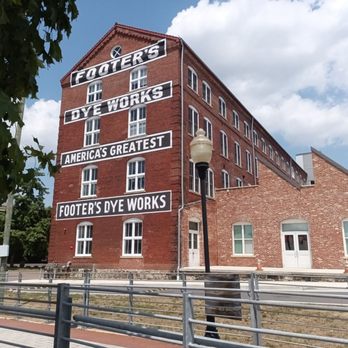
Footer's Dye Works - landmarks - Updated June 2026

Loading...
Loading...
Loading...